Two young men stood on the windswept prairie of Northern Colorado.
One of them, Brandon Herrera, was a 26-year-old gun maker and influencer whose YouTube channel has several million followers. The other, Kyle Rittenhouse, was best known for shooting three people, two of them fatally, at a street protest in Wisconsin two years earlier. They were meeting up for a day of firing automatic weapons from a helicopter.
“All right, let’s go have some fun!” Mr. Rittenhouse said with a grin before climbing into the aircraft.
The stunt was being filmed for an October 2022 YouTube video for the National Association for Gun Rights, a hard-line Second Amendment advocacy group whose president, Dudley Brown, had been courting online gun influencers like Mr. Herrera, often referred to as “guntubers,” for several years.
“I was trying to drag them into the political fight,” Mr. Brown said recently, and Mr. Herrera was a particularly bright prospect. (Mr. Herrera did not respond to requests for comment for this article.) When he told Mr. Brown months later that he was considering a campaign for Congress in Texas against a Republican incumbent who had run afoul of gun-rights advocates, “I said, ‘If you run, we’ll dump money into it,’” Mr. Brown recalled.
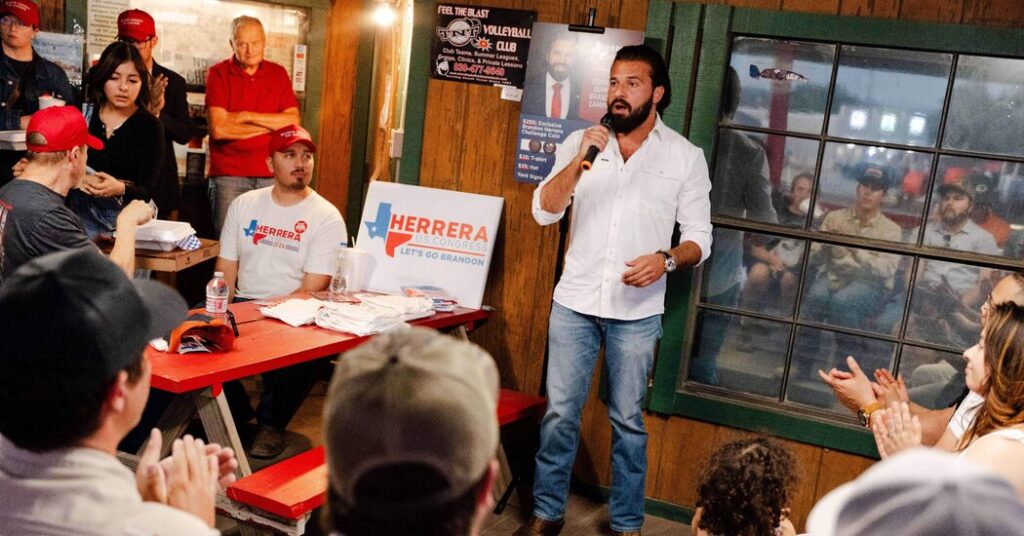
Two years later, Mr. Herrera is the Trump-endorsed presumptive Republican nominee in the state’s 23rd District, after the incumbent, Tony Gonzales, withdrew from the race.
Gun-rights activists are a long-established force in Republican politics. But no candidate with a credible chance of reaching Congress has had a profile quite like Mr. Herrera’s.
He is a celebrity in a new gun culture that has grown in prominence over the past decade, centered around younger generations and fueled by social media, video games and a booming consumer market for military-style firearms. Its best-known figures — activists, content creators, firearm-industry entrepreneurs or, like Mr. Herrera, a combination of all three — fuse the more-is-more ethos of popular YouTube entertainers with Second Amendment views that go well beyond the National Rifle Association in their absolutism.
This culture, frequently short-handed as “gun culture 2.0,” is untested as a political force. But it is increasingly filling a vacuum in gun-rights advocacy as the N.R.A. — beset by financial missteps, scandal and declining membership — has waned in influence, and as the values and priorities of older generations of gun owners fade.
Observers point to Mr. Herrera’s candidacy as a potentially important inflection point in this shift.
“You’ve seen these people grow a significant audience,” said Stephen Gutowski, a veteran firearms journalist and founder of the publication The Reload, which covers gun politics and policy. “Now they’re trying to take some political influence as well. You can look at Herrera’s race as emblematic of that.”
Mr. Herrera’s career loosely tracks the rise of gun culture 2.0 as a whole. About a decade ago, he started uploading videos of a custom-built rifle modeled after the AK-47 that could shoot large .50-caliber bullets. He called it the AK-50 and called himself “the AK Guy.”
His early videos focused on shooting firearms and gun-related experiments. Later he branched out into social and political topics and current events.
In this respect he is similar to many guntubers, whose work and influence are essential to understanding the new American gun culture. The popular hosts are often men with devout followings and sponsorships, whose channels are clearinghouses for information — trainings, history lessons, product reviews — and, secondarily, for politics.
“If you look at Brandon’s channel, his isn’t overtly political,” said Erich Pratt, the senior vice president of Gun Owners of America, another advocacy group. “I think that’s the way it is with a lot of them. They will only deal with it occasionally.”
Some younger gun owners have learned how to shoot from watching guntube channels. Many have arrived at an interest in guns through video game streaming channels and view firearms as a logical next step from the first-person shooter video games they grew up with.
“Social media and video games made firearms mainstream for the next generation,” said Lucas Botkin, the founder of Adaptiv Defense, a firearm accessories start-up.
The new gun culture, like the old, leans decidedly right in its politics, but with important differences. It is less tied to rural conservatism and more at home in the casual nihilism of internet culture, and is particularly informed by the societal schisms and breakdowns of 2020.
“My generation, millennials and Gen Z, are a lot more cynical, to the point of not having a lot of hope for the future,” said Mr. Botkin, who is 32.
Guntubers and their audiences are also much more aggressive in embracing firearms as completely necessary to protecting their rights.
A case in point is the generational rift when it comes to defending the AR-15, the popular military-style rifle. The N.R.A. has long insisted that the AR-15 is not a weapon of war, but rather a sport shooting and hunting rifle. Younger influencers and gun owners, by contrast, have happily embraced the AR-15 for what it is: a weapon of military origin and use, which they argue is an essential tool in upholding the Second Amendment and its intended purpose, opposing tyranny.
“If the Second Amendment protected only one gun today, the AR-15, the modern-day equivalent of the muskets used by our forefathers, would be it,” James Reeves, a lodestar in the guntube community, said in a 2024 Independence Day video.
Such views have made young guntubers like Mr. Herrera and their audiences appealing allies for a longstanding cohort of gun-rights groups commonly called Second Amendment absolutists.
For decades, organizations like Mr. Brown’s and Mr. Pratt’s were widely considered fringe actors in a national gun debate in which the pro-gun position was dominated by the N.R.A., a more conventional political lobby that was willing to make concessions as necessary to pursue its broader aims. But in recent years, their relationships with online content creators and communities have raised their profiles and influence.
“A lot of these channels, even though they may not always dabble in the politics, they are talking about it,” Mr. Pratt said. “They’re not necessarily gun activists, but they can be on a moment’s notice.”
The National Association for Gun Rights’s political arm contributed to Mr. Herrera’s 2024 campaign after he decided to challenge Mr. Gonzales over his vote in favor of the 2022 Bipartisan Safer Communities Act. The law was a limited gun-safety measure prompted by that year’s mass shooting at an elementary school in Uvalde, Texas, a city in Mr. Gonzales’s district.
Mr. Gonzales beat Mr. Herrera in 2024 by fewer than 400 votes in a runoff. This year, the two were once again advancing to a runoff before Mr. Gonzales announced that he would drop out of the race after admitting to an affair with a member of his staff who died by suicide in September.
Both Second Amendment absolutists and their opponents agree that the guntubers and their audiences represent an important new factor in gun-policy debates.
“One could say, I think with a straight face, that guntube is more influential in that debate than the N.R.A. is today,” said Nick Suplina, the senior vice president for law and policy at Everytown for Gun Safety, a gun-control advocacy group. “They’re reaching large audiences. They’re reaching new audiences.”
But guntubers and their fans typically espouse views on gun rights that are further in both substance and rhetoric from mainstream public opinion than those of prior generations of advocates and enthusiasts. How they will be received by general election voters is a particularly open question in the 23rd District, where the Uvalde massacre, in which a gunman armed with a military-style rifle killed 19 children and two teachers, prompted Mr. Gonzales to break with most of his party and support the 2022 bill.
“I think it just plays into people’s minds: Do we really want a representative who makes money from this type of weapon?” said Esmeralda Rodriguez, the chairwoman of Northwest Democrats, a group in Bexar County, the district’s most populous county.
Guntubers also frequently engage with extremist views and discussions of political violence, with varying degrees of irony and sincerity, and Mr. Herrera’s own past statements have been a recurring issue in his two campaigns.
In the 2024 race, Mr. Gonzales, a moderate Republican, called Mr. Herrera a “known neo-Nazi,” an apparent reference to a 2022 YouTube video in which he fired a World War II-vintage German weapon and described it as “the original ghetto blaster.”
Since Mr. Gonzales’s exit from the race, Democrats and gun-control advocates have surfaced footage of Mr. Herrera discussing his copy of Adolf Hitler’s “Mein Kampf” on a podcast in 2024 and staging re-enactments of historical assassinations. Speaking to The Times this month, Mr. Herrera described his online video work as “comedy” and called the circulation of a brief clip from the podcast, a provocative but humorous and critical discussion of the Nazi text, “disingenuous.”
Activists on both sides acknowledge that a fan base and a voting bloc are not the same thing. Mr. Herrera’s first campaign against Mr. Gonzales, in which he focused heavily on Mr. Gonzales’s vote for the 2022 bill, was the first real test of the new gun culture’s power in a Republican primary, and it came up narrowly short.
“All Brandon Herrera has shown us is that having four million followers translates into 20,000 votes,” Mr. Suplina said.
For people who knew Mr. Herrera before he became a flashpoint in gun politics, his emergence as a leading candidate for public office still seems remarkable.
Chase Welch, a firearms industry insider and the host of the Gundies, the award show for guntubers, remembered meeting Mr. Herrera in 2017 at a machine gun shoot in Kentucky, where Mr. Herrera drew male genitalia in the layer of dust coating Mr. Welch’s rental car as a joke.
But that was nearly a decade ago. “He didn’t have the benefit of experience or age, and he’s become more cognizant of the realities surrounding these political issues and how they play out on the ground,” Mr. Welch said. “He’s really put in the work.”
Charles Homans is a reporter for The Times and The Times Magazine, covering national politics.
The post In Texas, an Unyielding Gun Culture Jumps Off YouTube and Into Politics appeared first on New York Times.