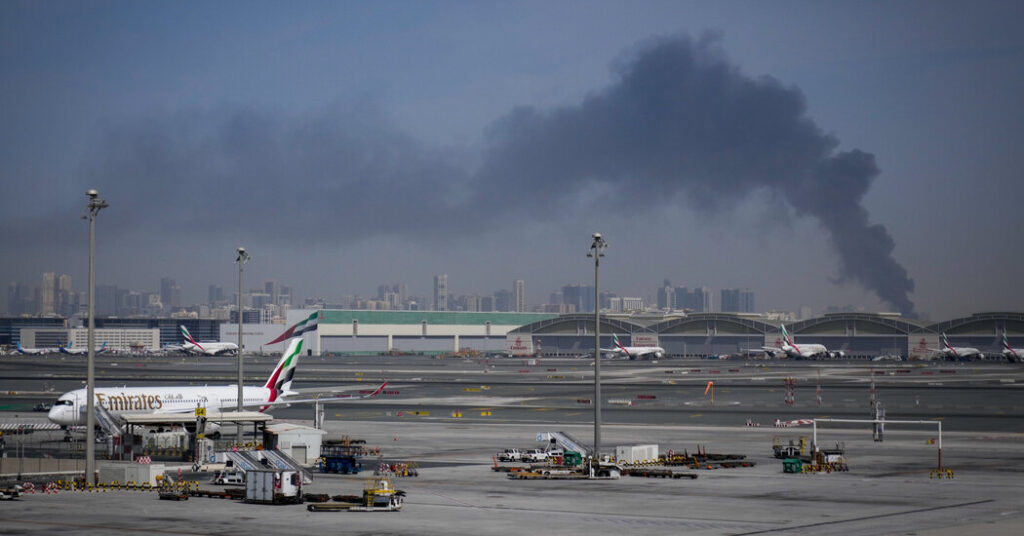
Four decades ago, in the middle of a different war in the Persian Gulf, the rulers of Dubai started Emirates, an airline that would defy the odds and become one of the world’s largest and most profitable carriers.
Now, it and other airlines in the region are facing their biggest test since the Covid-19 pandemic. The war in Iran has forced these companies to cancel tens of thousands of flights, tearing up the travel plans of millions of people, many of them intending to continue on to other destinations. The big questions now are how well Emirates and other Persian Gulf airlines are managing the fallout and how long will it take them to recover.
“We’ve got some major hubs out there for airlines, and they have built themselves into an indispensable force for connecting passengers,” said Mike Malik, the chief industry officer at Cirium, an aviation data firm. “But when something like this happens, those hubs get shut down and you basically break the system.”
Geography has been central to the success of the three big Persian Gulf airlines — Emirates, Qatar Airways and Etihad Airways. Much of the world’s population lives within reasonable flying distance of the airlines’ home bases in Dubai, Doha and Abu Dhabi, making them natural transit hubs for people traveling long distances like New York to New Delhi or London to Sydney, Australia.
But the three carriers also had access to their governments’ deep pockets and hired savvy executives from all over the world. That perhaps explains why other airlines in the region, which have the same geographic advantages, have not done as well.
The airlines have an especially tight grip on travel to and from Europe, according to Cirium. They carry about one in three people traveling from Europe to Asia and one in two people from Europe to Australia and other destinations in the Southern Pacific Ocean region. All told, 227 million people flew to, from or through the region last year, according to the International Air Transport Association.
But the war has paralyzed that traffic. More than 52,000 flights to and from the Middle East — more than half of all flights planned in the region — have been canceled since the war began on Feb. 28, according to Cirium. An estimated six million passengers have been affected.
The costs are adding up, too. Crews and planes for Middle Eastern carriers were displaced. And tourism to the region has effectively ground to a halt.
“You’ve still got the costs of your aircraft, the cost of your staff, maintenance, head office, admin,” said John Strickland, an aviation industry consultant.
The financial toll could be substantial. The loss of tourist spending alone could range from $34 billion to $56 billion this year, depending on how long the war lasts and how much it scares off travelers, according to an analysis by the research firm Tourism Economics. Given the current state of the war, experts at the firm expect the toll to come in at the high end of that range.
And the effects could extend far beyond the region to countries that have become reliant on flights that connect through the Persian Gulf, like India and Australia.
“Safe to say that there’s hundreds of destinations out there that are significantly impacted by various degrees,” said Brendan Sobie, an industry analyst who runs his own research and consulting firm based in Singapore.
Late last month, Deel, a human resources and payroll company based in San Francisco, flew almost 1,500 employees from around the world to Dubai for a corporate gathering. The United States attacked Iran the day after the event ended, leaving about 500 Deel employees stranded.
Joe Kauffman, the company’s president and chief financial officer, was already home in California, where he took in the news and started to worry. “I wasn’t sure exactly how everything was going to play out,” he said. “Where are all our employees? Are they safe?”
Deel quickly transported about 100 people by bus to neighboring Oman, where they caught flights out of the region. Within a week, almost all Deel employees had been evacuated, he said.
“It was kind of a choose-your-own-adventure,” Mr. Kauffman said. “How do I first and foremost get out to somewhere that will be less affected by this and then find a way home eventually?”
Many travelers affected by the airspace closures in the Middle East said the airlines had done their best in a difficult situation, but others said they had received conflicting information or little help. American travelers have also expressed frustration with the State Department for not helping them return home.
All three of the big Gulf airlines have a lot to lose if customers feel the companies stranded them. The carriers, all government-owned, have posted robust profits in recent years and have established reputations for providing good service, industry analysts said.
Emirates and Qatar Airways declined interview requests, referring to statements in which they provided guidance to travelers. Etihad did not respond to an interview request.
Of the three, Emirates was the first to become a global force. It was established in 1985 in Dubai in the middle of a nearly decade-long war between Iraq and Iran. This was well before Dubai was a financial hub studded with skyscrapers.
Now, Emirates and the other Gulf airlines have the highest profit margins in the industry. Carriers in the region earned an estimated $29 per passenger last year, followed by airlines in Europe, which earned just under $11, according to the International Air Transport Association. North American carriers earned just under $10 a passenger.
“For premium brands, the real reputational test is not whether disruption happens but whether confidence, calm and control are maintained while it happens,” said Tony Stanton, the chief executive of Strategic Air, an aviation consulting firm.
Some aviation experts said they expected the region’s airlines and airports to bounce back once the dangers subside. They noted that air travel often recovers quickly from crises, including crashes, terrorist attacks and the pandemic.
“Passengers tend to have short memories, especially when there are bargains to be had,” said Eddy Pieniazek, head of advisory at Ishka, an aviation data and consulting firm.
Big carriers like Emirates, Etihad and Qatar Airways also have significant cash reserves, which should help them recover relatively quickly, analysts said. Smaller carriers and budget airlines may struggle more.
The war could benefit airlines elsewhere, at least for the next few months. Carriers like British Airways, Lufthansa, Qantas and Turkish Airlines often fill between 80 and 90 percent of the seats on their long-distance flights, but those planes are probably departing nearly full as travelers seek alternatives, analysts said.
This week, Lufthansa Group said it planned to add flights, particularly to Asia and Africa. It said that it would add limited flights from German airports to Singapore, Cape Town and Riyadh, Saudi Arabia.
But airlines don’t generally have lots of spare planes, pilots and flight attendants to quickly start new routes. And it is hard to predict how long the war will last, let alone how it will change travel patterns.
Mr. Kauffman of Deel, for one, is not ruling out another corporate event in Dubai in future years. The company’s work force is dispersed around the globe and works entirely remotely, he said. It is relatively easy to convene its staff in a central location that has many hotels, restaurants and other amenities.
“I really think that Dubai will continue to be a good place for us to be,” he said.
Niraj Chokshi is a Times reporter who writes about aviation, rail and other transportation industries.
The post War Has Grounded High-Flying Gulf Airlines Like Emirates appeared first on New York Times.