There were few signs of life this past week on Sprinzak Street in Israel’s northernmost city, Kiryat Shmona, which sits about a mile from the border with Lebanon.
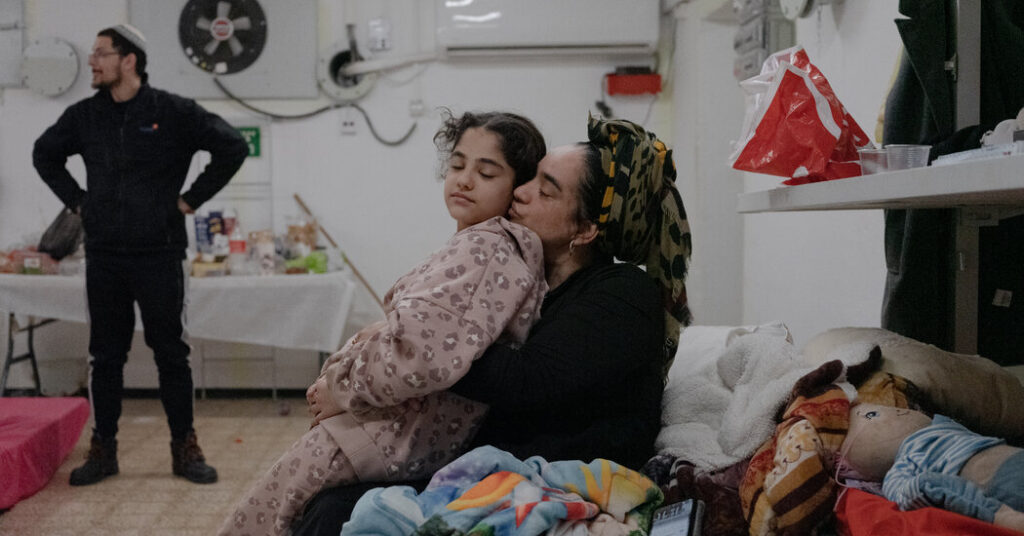
Amid escalating hostilities between Israel and Hezbollah, a Lebanese militia backed by Iran, some residents were holed up in their homes. Others relocated to a dismal underground bomb shelter, a relic from decades past, with spartan metal bunks lining the walls.
About 18 men, women and children from the public housing project above were living, eating and sleeping in the bunker’s two bare, uninviting rooms. The only modern conveniences seemed to be air-conditioning units and a new fridge in one corner, provided by city hall.
Given the city’s proximity to the border, early warnings of incoming fire are at most measured in seconds. Often there is no warning at all.
“I am scared to take a shower; I haven’t showered in three days,” said Yasmin Twito, 40, a mother of four who moved her family into the bomb shelter on Sprinzak Street. She said she had occasionally rushed back to her apartment to cook some food and quickly bathe the children, two at a time.
The cross-border fighting began days after Israel and the United States attacked Iran. Hezbollah fired rockets into Israel on March 2 in support of Tehran, opening up a new front in the expanding conflict.
That prompted waves of devastating Israeli bombardment on Lebanon and persistent rocket attacks from Hezbollah on Israel.
About 800 people have been killed in Lebanon, according to its Health Ministry. Missile fire killed at least 12 people in Israel during the current conflict, according to the Israeli ambulance service.
The nights have been particularly terrifying in Kiryat Shmona, families in the bunker on Sprinzak Street said. Hezbollah fired its heaviest barrage against Israel on Wednesday night, launching more than 200 rockets, missiles and drones at the north of the country.
The military said that its air defenses had intercepted most of those projectiles and that no one was killed.
The same night, Israel carried out waves of airstrikes in and around the Lebanese capital, Beirut, killing at least seven people, according to Lebanese officials. The strikes largely targeted a densely populated district in the south of the city, a Hezbollah stronghold, but have extended into areas beyond that.
Early Friday, a missile from Iran slammed into Zarzir, an Arab Israeli village about 50 miles south of Kiryat Shmona, injuring 60 people and damaging about 300 homes.
Kiryat Shmona sits in a part of Israel called the Galilee panhandle, a finger of Israeli territory that juts into Lebanon, and has long been a symbol of national resilience. It has suffered decades of attacks and incoming rocket fire, first from Palestinian militant groups in Lebanon and then from Hezbollah.
A large majority of Jewish Israelis support the Israeli-American war against Iran, according to recent polling by the Israel Democracy Institute, an independent research group. Many, including residents of Kiryat Shmona, say they are willing to put up with rocket and missile fire if it leads to Israel’s enemies being defeated.
But life in these northern border communities has become more complicated than in other parts of the country, with projectiles flying over them and the constant booms of fighting in Lebanon.
The last time the fighting near the border heated up, after the attack led by Hamas on southern Israel in October 2023, the Israeli government decided to evacuate Kiryat Shmona’s population of about 25,000, along with another 40,000 residents of the country’s far north. The attack ignited the war in Gaza, and, soon after, Hezbollah fired rockets at Israeli positions in support.
After more than a year of fighting, Israel and Hezbollah agreed to a shaky cease-fire in late 2024. The next March, the Israeli government said it was safe for the evacuees to return to the north. By that summer, government funding for the evacuees had stopped.
During this latest flare-up, however, the Israeli government has told its citizens in the north to stay put.
“Nobody is leaving their land and their home,” the country’s defense minister, Israel Katz, said in a statement on Feb. 28, the day the war with Iran began.
The situation has left people in Kiryat Shmona confused. Many said the decision to evacuate in 2023 was necessary amid fears that Hezbollah commandos would infiltrate the border and kill and kidnap people, as Hamas gunmen had done in southern Israel.
Some were ambivalent about the government’s direction for this conflict, reluctant to flee but also afraid to remain in their homes. A few said that given the tenuousness of the cease-fire, it was a mistake to tell them to return to Kiryat Shmona last year.
“It was wrong to bring us back without protection,” said Ms. Twito, the mother of four. “We aren’t pampered; we survive. We try to be strong, but my soul is wounded from every side.”
Ms. Twito said she was still traumatized from a monthlong war between Israel and Hezbollah in 2006, when a rocket exploded near her.
In October 2023, the family was evacuated to a school in central Israel, where it stayed for nine months before renting a nearby apartment using government grants. While the family was away, a rocket hit an apartment building a few feet away from hers, Ms. Twito said.
The family returned home in June, at the end of the school year.
Tension persisted even during the cease-fire with Lebanon, Ms. Twito said. Israel carried out near daily attacks across the border, saying Hezbollah had violated the truce. “There was talk of another war,” she said. “I was anxious. The booms never stopped.”
Still, having left Kiryat Shmona with a single suitcase in the last evacuation, Ms. Twito said she did not want to face upheaval again.
Another resident of the Sprinzak Street bunker, Yaniv Weizman, 41, complained that when a missile falls in Tel Aviv, the whole country pays attention. But when one falls in Kiryat Shmona, “Nobody cares.”
Aviv Ben Shimol, 28, leaves the shelter to work at a local clinic and returns at the end of each day, preferring not to stay in his apartment alone. He had spent 16 months as an evacuee in a hotel in the city of Tiberias and returned home a year ago.
“They said it was safe,” he said of the government. “Now, a year on, here we are.”
Only about 16,000 residents returned to Kiryat Shmona after the evacuation, according to Doron Shnaper, a spokesman for city hall. He said that since the latest hostilities broke out, dozens of families had chosen to leave.
Those who stayed hoped the military would fully eliminate the threat from Hezbollah this time, even if the outcome of the broader war is far from clear.
“The last year was not really normal here,” said Avraham Guy Kalfon, 55, who had evacuated during the last war but remained in his ramshackle apartment in Kiryat Shmona this time. Even before the latest bout of fighting, he said, the city had not returned to life and was shuttered by 5 p.m.
“People didn’t feel safe,” Mr. Kalfon said. “Nobody was out. There was no culture. We were living under a question mark.”
Still, he says, he would not evacuate again: “That’s not the solution. Strength brings peace.”
Isabel Kershner, a senior correspondent for The Times in Jerusalem, has been reporting on Israeli and Palestinian affairs since 1990.
The post As Rockets Fly Overhead, Residents of Israel’s Border City Stay Underground appeared first on New York Times.