If you’ve been thinking about your tax bill, here’s something else to stew about.
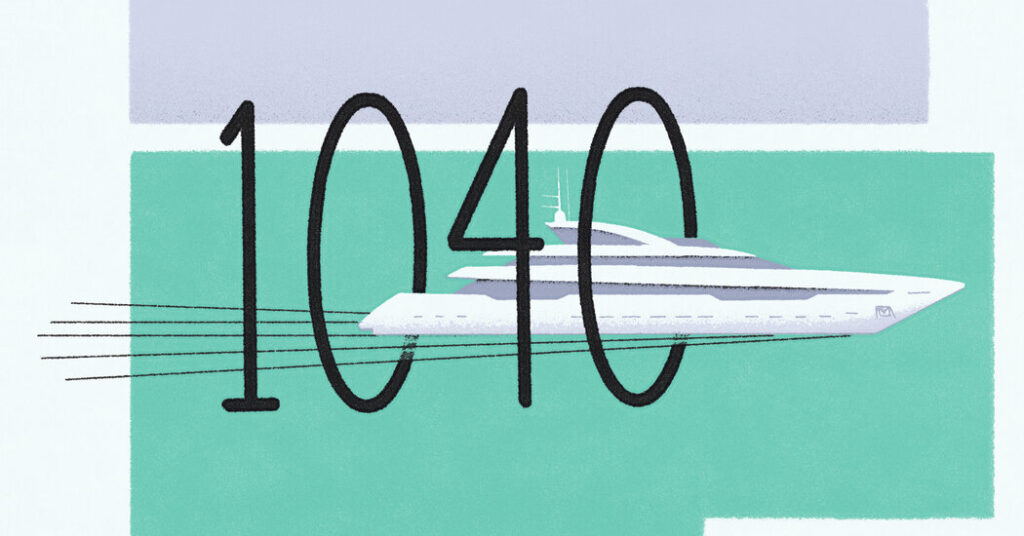
Scores of people with enormous wealth are paying relatively little, if anything, in taxes. Billionaires — and those with fortunes that are merely in the hundreds of millions — can avoid taxes legally, using loopholes that are unavailable to the rest of us.
The income tax is for working people. So is the payroll tax — which wage earners and their employers pay into Social Security and Medicare, week after week. The payroll tax and the income tax corral nearly everybody who holds down a job.
Then there are the superrich. They live by another set of rules. The wealthiest people in the United States pay taxes on a minuscule proportion of their income, and some avoid the income tax and payroll tax entirely, says Ray Madoff, an expert on taxes at Boston College Law School. Much of their staggering wealth — assets including cash, stock, bonds, gold, art collections, homes, yachts and every other valuable thing they have already accumulated — is barely taxed, she says.
Professor Madoff has written a persuasive book, “Second Estate: How the Tax Code Made an American Aristocracy.” She says billionaires in the United States can be virtually exempt from taxes, like the French aristocracy before the revolution of 1789.
Some billionaires manage to bypass the income tax entirely, she says. And they are all barely touched by the payroll tax because the income captured by that tax is capped at $184,500.
“There are two classes of people in the United States today,” she said in a long phone conversation. “Those who pay taxes, which is most of us, and the ‘wealth class’” — a self-perpetuating elite that passes on riches that are barely taxed, from generation to generation.
The tax code, she said, has helped create a new “hereditary class,” which is taking advantage of arcane rules that are hard for most people to fully understand.
Taxes Are for Workers
Salaries are heavily taxed, Professor Madoff writes. So perhaps the most critical move in the standard “Tax-Avoidance Playbook” for billionaires, she adds, is “to avoid those traditional earnings.”
On the face of it, that seems a little strange. After all, traditional earnings are all I’ve ever had. I’ve usually assumed that I don’t have enough. And if I retire one day, most of the money I’ve put away in tax-sheltered 401(k) and individual retirement accounts will be taxed in the traditional way when I start to spend it.
But if I were a billionaire, I’d know better. The superrich don’t need to bother with paychecks or 401(k) withdrawals. There are much better ways for them to minimize taxes and, perhaps, avoid paying them entirely.
Consider that The New York Times has published annual accounts of the compensation of the highest-paid chief executives in the United States, using Equilar data, for the past 18 years. These tallies often have not included some of the richest people in corporate America — billionaires like Jeff Bezos, Warren Buffett, Steve Jobs, Mark Zuckerberg, Peter Thiel and, for a time, Elon Musk.
Why have they been missing? These billionaires paid themselves little or nothing in salary, instead amassing wealth mainly in stock shares and options. (Even so, Securities and Exchange Commission regulations have led to the disclosure of occasional gargantuan stock grants.)
For day-to-day expenses, to say nothing of yachts and planes and private islands, billionaires have excellent options, from a tax standpoint, to raise cash.
The most straightforward is to sell assets. Even if you sell hundreds of millions of dollars’ worth of stock or other assets, like art collections, you will be taxed at a low federal rate for long-term capital gains — an advantage often advocated by economists as an incentive for investment. But this preferential treatment makes an already tilted playing field even steeper.
“Capital gains are taxed at much lower rates than earnings from work,” Professor Madoff writes. “Because of this difference in tax treatment, someone who earns $50,000 from working a job pays higher taxes than someone who makes $50,000 from selling an investment.”
The truly rich may never need to sell their assets. Instead, banks and private credit firms will happily lend money at favorable rates, using wealth as collateral. And as long as their wealth grows at a higher rate than the interest rate charged on their loan, they become richer, tax-free.
Along with everything else they reveal, the millions of pages of documents released by the federal government in the Jeffrey Epstein files shed light on this tax strategy of the superrich. They show how Mr. Epstein helped Leon Black, the former chief executive of the Apollo Group private equity firm, live luxuriously while minimizing his taxes. Mr. Black was able to spend hundreds of millions of dollars, which he received in low-interest bank loans, using his art collection as collateral. As an account by John Hyatt points out in Forbes, the collection’s value grew from an estimated $1 billion in 2014 to $1.4 billion in 2017.
A Loophole for Private Equity
If Uncle Sam agreed, many people could save on taxes simply by claiming that their “earnings from work are investment income, and thereby eligible for capital gains tax rates,” Professor Madoff writes.
The Internal Revenue Service wouldn’t let me make that claim. Yet under current rules, managers of private equity, venture capital and hedge funds receive a fat share of their funds’ profits for their work, which they get to call “carried interest.” As a consequence, they pay lower tax rates.
In a recent S.E.C. filing, the Blackstone private equity company disclosed that Stephen A. Schwarzman, its chief executive, earned more than $1.2 billion last year. That included $111.8 million in incentive fees and carried interest, according to Equilar. His compensation included a $350,000 “base salary” — of which about half would presumably be subject to the payroll tax for Social Security and Medicare.
I am likely to earn more than the $184,500 cap this year, though not nearly as much as Mr. Schwarzman’s base salary. But under current rules, I would pay the same amount of payroll tax as Mr. Schwarzman.
Generations of Untaxed Wealth
There’s a strategy for billionaire families seeking true, intergenerational wealth to avoid taxes forever. It’s called “buy, borrow, die.”
Say you’re already rich, have accumulated assets and have borrowed against them. That covers “buy” and “borrow.” Now for the nasty part. Even billionaires die.
The estate tax once aimed at preventing the creation of an American aristocracy by taxing wealth when it was passed on to heirs. But Professor Madoff says that important tax is virtually toothless today. Branded “the death tax” in a fabulously successful public relations campaign financed by wealthy families, it can be gotten around completely if you’re rich enough to hire the best lawyers, she says.
Billionaires can pass these holdings on to their heirs without ever having paid tax on their gains. And for the heirs, the appreciated value of the holdings becomes the base against which future gains and losses are measured.
Over the course of a U.S. billionaire’s life, and even after death, taxes on “investments are not just less burdensome but effectively optional,” Professor Madoff writes. The wealth of families like the Waltons, the Kochs, the Mellons and the Rockefellers persists for generations. The tax system hasn’t prevented this, she says. It has helped make it happen.
What Is to Be Done?
Proposals for wealth taxes have been in the news in California, New York, Paris and Copenhagen. But these ideas aren’t simple.
Wealth taxes are imposed on what you already own, while income taxes are levied on the money you bring in. Property taxes are a form of wealth tax. More sweeping wealth taxes might require payments on a proportion of everything you own, not just real estate. And wealth taxes face a fundamental problem in the United States: The Supreme Court might well declare them unconstitutional.
In the meantime, Professor Madoff has another suggestion: taxing inheritances and gifts, with the recipient paying the bill. She would preserve hefty exemptions that now shield most people from gift and estate taxes, and exempt moderate-size family farms and businesses.
But when a billionaire dies or gives her estate to her daughter or son, the heir would owe the government a large tax bill. Perhaps as much as one-third of “all bequeathable wealth comprises unrealized gains,” she writes, citing a recent Brookings Institution study.
This proposed change in the tax code has a long, though unsuccessful, bipartisan history. Presidents Richard M. Nixon and Barack Obama both endorsed it. It would make a difference, though certainly not an immediate one.
Major changes in the U.S. tax code have come about in reaction to wars, depressions and, in other countries, revolutions. It may be too much to expect the United States to find ways of taxing the superrich gently and peacefully, without first experiencing a profound disaster. But I certainly hope that it can.
Jeff Sommer writes Strategies, a weekly column on markets, finance and the economy.
The post It’s Good to Be a Billionaire, Even at Tax Time appeared first on New York Times.