As American and Israeli armed forces hunt Iranian missile launchers, radar sites and warships, Iran is taking aim at a different set of targets: the civilian institutions that define the modern age of globalization.
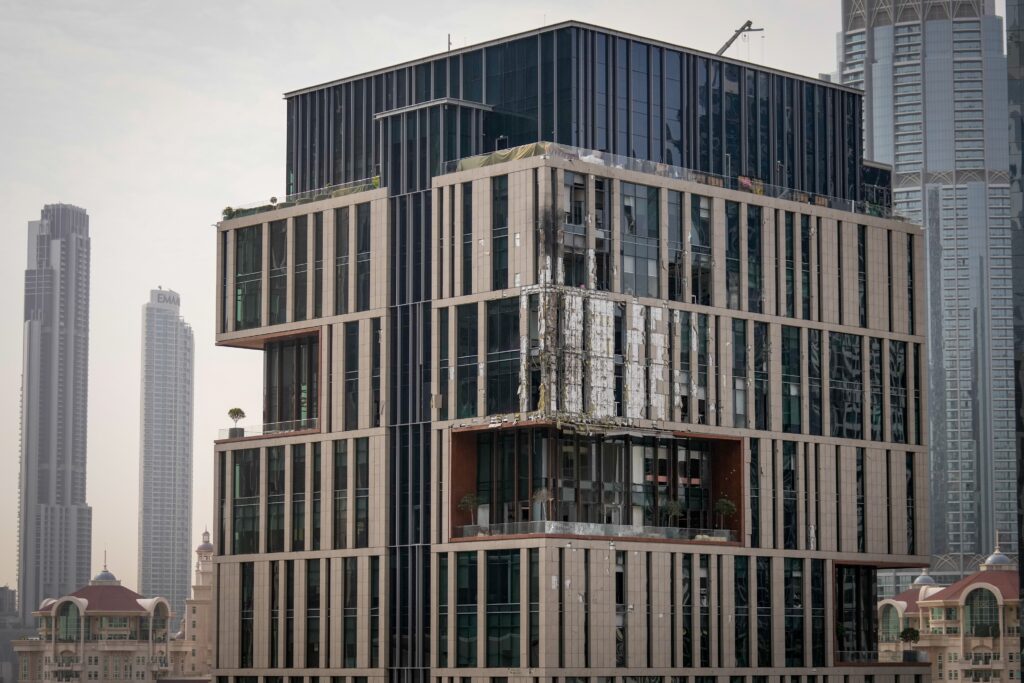
Tehran’s strategy in what some are calling the third Persian Gulf War — following clashes in 1991 and 2003 — threatens to imperil its more prosperous neighbors’ standing as a hub of global trade and finance. On Friday, the Dubai International Financial Center, home to banks such as Goldman Sachs and a Ritz-Carlton hotel, was hit by a drone attack, causing minor damage to one building.
At issue is more than the essential energy cargoes that are now blocked from transiting the Strait of Hormuz. Among Iran’s first targets for retaliation after the initial U.S. and Israeli attack on Feb. 28 were Amazon data centers in the United Arab Emirates and Bahrain, symbols of those nations’ technological ambitions.
On Wednesday, after a missile slammed into a downtown Tehran building belonging to state-owned Bank Sepah, the nation’s oldest, Iran promised to strike “economic centers and banks belonging to the United States and the Zionist regime in the region.”
The Iranian strategy illustrates the vulnerability of critical links in the global economy and explains why the U.S., China, Europe and Japan in recent years began emphasizing supply chain resilience rather than pure cost efficiency.
“There’s going to be a change to the default assumption that there is no risk for operating in a place like Dubai. There is risk. There is vulnerability,” said Richard Nephew, a former U.S. diplomat now at Columbia University’s Center on Global Energy Policy. “The risk premium for doing business in the Gulf was always assumed to be essentially zero.”
No longer. In recent weeks, the aura of safety that lured financial professionals to the Persian Gulf from around the world has been shattered.
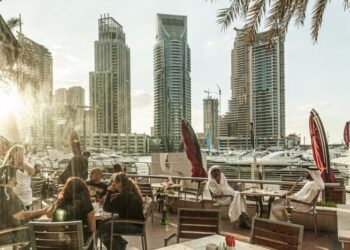
Those with the most at stake are Iran’s neighbors, including the United Arab Emirates and Qatar, which have marketed themselves to global audiences as ultrasafe for individuals and their money.
“We go out, we leave our doors open, our cars have the keys in the ignition. You don’t even have to worry about your property,” said Mohamed Bahaa, APCO’s Dubai-based managing director for the private sector in the Middle East and North Africa. “Nothing beats it.”
These fast-modernizing sheikhdoms have remade their economies in recent years, diversifying away from oil and gas into tourism, finance, trade and artificial intelligence.
While China is perhaps better known as a beneficiary of globalization, the emirates also have thrived thanks to cross-border linkages.
Over the past quarter century, Dubai, the UAE’s largest city, emerged as a center of global trade, finance and tourism, attracting wealthy expatriates. Once a dusty pearl-diving settlement, the city saw its population rise to more than 4 million from less than 1 million in 2000.
A reputation for neutrality drew customers of all stripes. Wall Street bankers and Indian executives relied on the same low-tax, lightly regulated market that sometimes drew less savory investors. Among them: the Iranian Revolutionary Guard, which relied on a network of front companies there to handle its illicit trade in oil, according to the U.S. Treasury Department.
Dubai’s evenhanded stance, however, earned it no combat reprieve. Iran has launched 1,600 drones, 15 cruise missiles and 294 ballistic missiles against the UAE since the war began, the emirates’ Ministry of Defense said Saturday.
In recent fighting, Iranian drones damaged Dubai International Airport, one of the world’s busiest. Cargo movements were briefly paused at Jebel Ali, one of the world’s largest container ports, after debris from a rocket intercept landed nearby.
Financial markets were caught unawares. As the war began, stocks were riding high on a wave of AI-related optimism and investors made little distinction between good credit risks and bad.
“The risks were higher than people understood,” said Fabio Natalucci, chief executive of the Andersen Institute for Finance and Economics in Washington. “They’re now scrambling to figure out how long this will last.”
Any corporate or investor second thoughts about the region would continue a broader rethinking of globalization that began following the 2008 financial crisis and accelerated amid the covid pandemic and Russia’s invasion of Ukraine.
For decades following the Cold War’s end, companies stretched their supply lines across thousands of miles of ocean and placed outsize bets even in notoriously unstable regions like the Middle East. Government officials and business executives alike assumed that expanded trade would promote a more stable global environment.
Today, companies that operate globally must hedge against unexpected developments in a growing list of venues, said Demetrios Marantis, a former U.S. trade negotiator, citing Venezuela, Cuba, the Middle East and Ukraine.
“You have to assume the worst,” he said. “Businesses really have to be paying attention to potential flash points because they’re flashing,” he said.
As Dubai came under fire this month, several banks such as Citibank and Standard Chartered ordered employees to work remotely. Some investors already are considering moving investments from the Middle East to Hong Kong, the CEO of CSOP Asset Management, Ding Chen, told Bloomberg Television on Thursday.
Once the war ends, the Gulf states may try to reduce their reliance on the United States, which officials in the region believe launched the war without adequate consultation, Nephew said. That could create business opportunities for European defense firms.
Many expatriates anticipate an eventual return to the status quo ante.
Though a person was killed by falling attack debris not far from his Dubai home, Reza Baqir, global head of sovereign advisory services at Alvarez & Marsal, remains confident about the emirates’ post-conflict prospects.
Once the fighting ends, Baqir, the former head of Pakistan’s central bank, said that he expects the government to create a “very aggressive set of incentives to demonstrate that Dubai is back in business.”
So far, the firm’s clients are reviewing their financial exposure and adopting a cautious stance toward new business but are not bolting for the exits. Baqir said he, too, intends to stay put along with his wife and teenage daughter.
“I feel safe,” he said. “It is certainly a situation which is not easy to deal with at all. [But] I have a business to run.”
The reemergence of geopolitical risk — and the breakdown of the traditional U.S.-led global order — is drawing greater attention from business leaders, especially in the financial sector. In May, JPMorgan Chase established a new geopolitics center to advise clients on an “increasingly complex global business landscape.”
Headed by Derek Chollet, a former State and Defense Department official, it will draw on advice from others, including former British prime minister Tony Blair and former House speaker Paul D. Ryan.
In a March 9 podcast posted on JPMorgan’s website, Chollet said he was “pretty bullish” about prospects for the current conflict eradicating Iran’s malign role in the region.
“If you think of all of the change that the Middle East has seen in the last decade, in terms of investment, and becoming a transportation, financial, tourism, AI hub of the world, all the changes in Saudi [Arabia], UAE and Qatar, the dramatic change we’ve seen in that part of the world, the one country that has been doing the most to undermine that has been Iran,” he said.
Iran enters an economic war with little to lose. The U.S. for years has tried to isolate Iran from the global economy, maintaining at least eight separate sets of financial sanctions. Businesses and individuals in Iran, a nation of 93 million, are prevented from using the U.S. dollar, the global reserve currency.
The result is a stunted economy that has largely missed the globalized progress of the past few decades. Vietnam’s annual non-oil trade, for example, is roughly seven times that of Iran, though the two nations have roughly the same population.
In February, Treasury Secretary Scott Bessent took credit for creating “a dollar shortage” in Iran, which he said contributed to the collapse in December of a major bank, a plunge in the Iranian currency and the start of widespread anti-government protests.
Iran has its own weapons. Last week saw oil tankers burning off the Iraqi shoreline and a Qatari natural gas plant shut down to avoid Iranian fire. On Friday, Defense Secretary Pete Hegseth said Iran’s attacks on civilian targets were a sign that Tehran is becoming “increasingly desperate.”
There is probably more to come. The state-owned Bank of Sepah that was targeted by the U.S. or Israel earlier in the week has ties to the Iranian military and the Islamic Revolutionary Guard Corps. When the bank’s digital processing facility was destroyed, it was processing March paychecks for Iranian military personnel, according to Iran International, an anti-regime media organization based in London.
“The Americans should expect our painful retaliation,” the semiofficial Fars News Agency said on Telegram, advising people in the region to stay at least one kilometer away from any bank.
Iran has launched thousands of missiles and drones against an ever-widening array of targets, achieving relatively modest results. But if even a handful of explosive drones hit soft targets such as storage tanks for oil, chemicals or fertilizer or the vessels that carry them, they could disrupt key global arteries, said Monica Gorman, managing director at Crowell Global Advisors and a former supply chain specialist in the Biden White House.
“I think they have correctly identified ways they can inflict real pain,” she said.
The post Iran wages economic war in hopes of outlasting U.S. and Israel appeared first on Washington Post.