THE SECRET HISTORY OF FRENCH COOKING: The Outlaw Chefs Who Made Food Modern, by Luke Barr
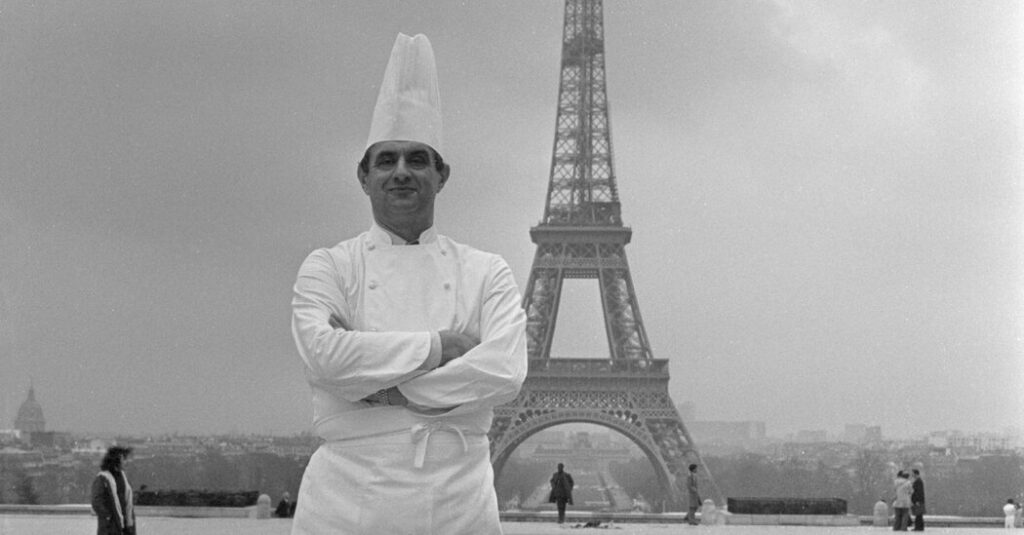
Surprisingly, there has not been a big biography of Paul Bocuse, the first modern celebrity chef, who was so committed to the integrity of a signature Lyonnais poached chicken dish that he once smuggled pig bladders from France into the United States in his underwear.
Maybe that’s because Bocuse — who died in 2018 at 91, just as #MeToo was in high boil — was himself a male chauvinist pig, to use that quaint term of feminism’s second wave that used to be printed on our mugs of middling Maxwell House.
“I would rather have a pretty woman in my bed than behind a stove in a restaurant,” was a typical declaration to the press from a man who blithely maintained two mistresses and countless other liaisons alongside his 70-plus-year marriage. And: “Women who become chefs are limited in their accomplishments. They have one or two dishes they accomplish very well, but they are not great innovators.”
Somehow Julia Child restrained herself from whacking this fellow over the head with a cast-iron frying pan.
Bocuse and other like-minded toque bros — the so-called Bande à Bocuse — figure centrally, and often comically, in Luke Barr’s new book, “The Secret History of French Cooking.” Barr concentrates on the 1970s, the last moment when the strict precepts of Gallic cuisine reigned supreme in the Western world, even as the Wimpy burger landed like a flying saucer from Indiana; when the ladies who lunch flocked to La Côte Basque and La Grenouille rather than around Sweetgreen slop bowls. A set of revolutionary methods called “nouvelle cuisine” was challenging the tyranny of “Terrible Rich Brown and White Sauces” in the form of 10 commandments printed in an upstart food magazine, Le Nouveau Guide Gault-Millau. Bye-bye, bain-marie. Salut, sous vide.
Barr is the grandnephew of the great food writer M.F.K. Fisher, whose wartime classic of thrift, “How to Cook a Wolf,” got popular again during the pandemic. Barr’s own work tends to plumb the flabby folds of luxury and excess. “Provence, 1970” mined Fisher’s diaries and correspondence with colleagues like Child and James Beard to recreate their fruitful gathering in the South of France. “Ritz and Escoffier” visited the decadent scene, all ortolans and Oscar Wilde, at the Savoy Hotel in fin de siècle London.
“The Secret History of French Cooking” is an enticing title, conjuring both Donna Tartt and apple tart. But the excesses of this period were actually the opposite of secret, so chronicled were they by a suddenly avid American food press. Its number included the libidinous Gael Greene, who wrote of energetic trysts in a loft bed with the chef Jean Troisgros as the staff prepared breakfast below; and Nora Ephron, whose essay collection “Crazy Salad” echoed the name of a popular concoction of truffle, foie gras and vegetables by Michel Guérard, the creator of “cuisine minceur” — slimming cuisine. There was also the fantastically named Waverley Root, one of umpteen reporters to trail the canny Bocuse to the farmers’ market. Even Al Goldstein, the publisher of Screw, made it to one extravagant junket.
In France, though, there were gastronomes more ghastly, like a three-surnamed aristocrat whose affection for the Romanovs and habit of falling asleep after dinner earned him the name “Divan the Terrible.” He was one of several social satellites to Robert Courtine, the sideburned restaurant critic for Le Monde, the most important French newspaper, a prolific purist and traditionalist who wrinkled his nose and pounded his typewriter if the quail was farmed or the Scotch was blended or the tomatoes at Maxim’s were unpeeled.
Courtine was anti-snack bars, anti-de Gaulle, anti-hygiene, anti-Chinese food (“for sadists,” he sneered; “they cut everything up into tiny pieces!”) and deeply antisemitic. When one journalist, sifting through Nazi collaborationist archives at the Bibliothèque Nationale, discovered Courtine’s call, among other screeds, for the Germans to come collect Jewish children and “finish the job,” he threw up.
And yet the critic became the strange bread-fellow of female chefs when both the traditional trade association and a new one formed by Bocuse, though publicized by the glamorous press agent Yanou Collart, excluded them. No fan of nouvelle cuisine’s publicity stunts, rule-bending and presentation gimmickry — “plate painters,” he called them — Courtine saw women’s cooking as “a bedrock of the French culinary heritage,” reviewed their restaurants favorably and helped them form their own organization.
Barr knows his stuff, and doesn’t overstuff as Bocuse arguably did his famous Mediterranean sea bass wrapped in fish-shaped, egg-washed pastry filled with lobster mousse, ground pistachios, truffles and cream. (Pass the Wegovy!) Barr’s sentences are crisp, sometimes slightly undercooked — here come the food metaphors, creeping in — clear as consommé, punchy. “What was a cardoon, exactly, some kind of degenerate artichoke?” You’ll finish his secret history five pounds heavier but a little happier.
THE SECRET HISTORY OF FRENCH COOKING: The Outlaw Chefs Who Made Food Modern | By Luke Barr | Dutton | 337 pp. | $32
Alexandra Jacobs is a Times book critic and occasional features writer. She joined The Times in 2010.
The post Truffles, Foie Gras and Sexism: Nouvelle Cuisine Served It All appeared first on New York Times.