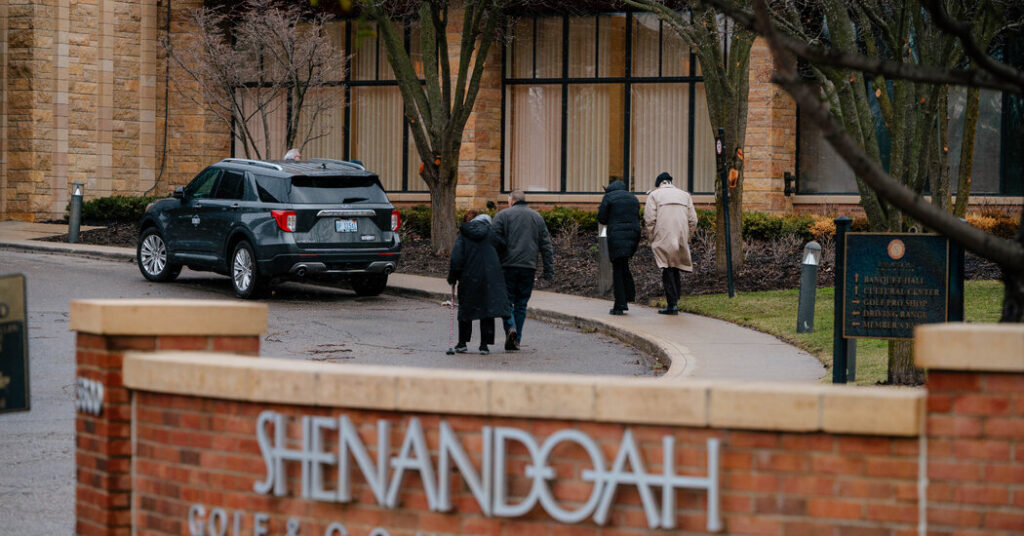
When more than 100 preschool children and their teachers fled Temple Israel in West Bloomfield, Mich., on Thursday amid fire and smoke from an antisemitic attack, they took refuge across the street at the Shenandoah Country Club, a hub for the local Chaldean community of Iraqi American Christians.
The club’s staff served the children food and candy while they waited to reunite with their parents. The following evening, the club hosted the synagogue community for a somber, joyful and defiant Shabbat service.
“Shenandoah opened itself to Temple Israel to be the command center, to be our shelter, to be our home,” Rabbi Paul Yedwab said.
“We treat our neighbors as we treat ourselves,” said Hassan Yazbek, Shenandoah Country Club’s general manager. “These are our brothers and sisters.”
Those moments of grace between Jewish and Arab neighbors have resonated deeply across the Detroit area since the attack, which was part of a global rise in antisemitic violence.
For more than a century, Jews, Arabs and Muslims have lived alongside one another in and around Detroit, mostly peaceably. The tenor of that coexistence shifted after Oct. 7, 2023, when Hamas, a Palestinian militant group, led an attack on Israel, killing over 1,000 people and taking more than 200 hostages. It set off a war in which Israeli strikes have killed more than 67,000 Palestinians. Over the past several weeks, American-Israeli strikes on Iran, and Iran’s retaliation, brought war throughout the Middle East. More than 2,000 people have died so far, further dividing some Americans who have roots in the region.
In the Detroit area, city councils, school boards and student governments engaged in months of contentious debate over the Israel-Hamas war. There were disagreements over school curriculum, foreign aid funding, history, slogans and protest imagery, and arguments over when political speech had veered into antisemitism or Islamophobia.
The offices of Jewish institutions, and the homes of several Jewish community leaders, were vandalized. There have been threats against mosques in Dearborn, a hub for Muslim immigrants. Both mosques and synagogues have invested heavily in security.
More recently, some local Arab American and Muslim political leaders have vocally opposed the American-Israeli bombing campaign in Iran, while some prominent Jewish groups greeted the conflict with cautious optimism, hoping for new leadership in Tehran less likely to support anti-Israel militant groups.
Arab and Muslim organizations in the Detroit area have condemned the synagogue attack. The suspect, Ayman Mohamad Ghazali, rammed a truck filled with fireworks into the Temple Israel building and opened fire, according to the authorities. He then took his own life. Mr. Ghazali, 41, reportedly lost two brothers, a niece and a nephew in a recent Israeli airstrike in southern Lebanon.
“There is no justification for what this man did,” said Dawud Walid, executive director of the Michigan chapter of the Council on American-Islamic Relations. He noted that in the Detroit region, “We’ve had hundreds of families who lost family members” in Israeli bombings of Gaza and Lebanon.
J Street, a liberal, pro-Israel group in Washington that has been critical of Israel’s current government, responded to the synagogue attack by stating, “We must be crystal clear: Blaming or targeting American Jews for the actions of the Israeli government is antisemitism — full stop.”
Leor Barak, 45, a former synagogue president in downtown Detroit, said that while his congregation had always participated in interfaith events, he has felt a falloff since the Oct. 7 attacks.
“I wish I felt more unity, but I personally haven’t felt it,” said Mr. Barak, who is a lawyer and a musician. “I’m proud to be Jewish, but I don’t let people know that I’m Jewish or my ethnic background for fear of being judged. I hide my identity more than I ever have in the past.”
He said he felt closest to Muslim and Arab friends on the soccer field. He plays recreationally several times each week. “What really heals is people hanging out and doing something fun,” he said.
In the early 20th century, the Arab and Jewish populations of Detroit tended to live in different neighborhoods and have little contact, said Lila Corwin Berman, a historian at New York University. Arabs were more likely to work in the auto industry, while Jews were more involved in retail.
The two groups got to know one another more intimately after 1965, when Jews and Arabs moved to some of the same suburban neighborhoods. They began to work in similar white-collar professions and often sent their children to the same public schools.
On local political issues around land use and civil rights, the groups’ interests were often aligned. But for decades, Middle East policy has been a source of tension. The desire to cultivate a strong Jewish identity and love of Israel was one reason some Jewish parents moved their children into Jewish private schools, Professor Berman said, even if they were not particularly religiously observant.
In 2024, the West Bloomfield office of the Jewish Federation of Detroit was defaced with anti-Israel graffiti, on the first anniversary of the Oct. 7 attack. Several days before, antisemitic fliers had been tossed on over 100 lawns in the area.
The federation’s chief executive, Steven Ingber, described this week’s attack on Temple Israel as “a major escalation” in a pattern of rising regional and national antisemitism.
The synagogue is one of the largest Reform congregations in the country, with 12,000 members, and is “proudly Zionist,” Mr. Ingber said. Its website prominently features the Israeli flag. The congregation has organized trips to Israel, and recently hosted an event discussing how Israelis with disabilities are able to serve in their country’s military. An emissary from the Israeli government spoke at the Shabbat service after Thursday’s attack.
Given the risk of violence, Jewish institutions might reconsider whether they publish online the exact locations of such events, Mr. Ingber said. But, he added, “We are not going to cower. We’re going to be here and be proud.”
And despite fervent disagreements on foreign policy, “We live together,” he said of Jews, Arabs and Muslims in Greater Detroit. “We have lived peacefully for years and will for years to come.”
Some Detroit residents said that in recent years, they have been more likely than before to discuss difficult issues across lines of difference — often over a shared meal.
“Since Oct. 7, something has shifted,” said Salam Rida, 37, an architect and designer. She has Iraqi, Palestinian and Iranian heritage, and grew up in the suburb of Oak Park with many Jewish friends. “Conversations that once felt super impossible to have are starting.”
A bright spot has been Muslims and Jews volunteering alongside each other on Mitzvah Day, when non-Christians staff Detroit soup kitchens, toy drives and other events on Christmas, said Robert Bruttell, a Catholic community leader who works with the InterFaith Leadership Council of Metropolitan Detroit.
Left-leaning faith groups have worked together in opposition to the Trump administration, said Lisa Tencer, the interim executive director of Detroit Jews for Justice. She noted that the day before the synagogue attack, Jewish, Muslim and Christian activists had participated in a protest against Immigrant and Customs Enforcement.
Within the region’s Jewish community, there is a broad range of views on Israel, ranging from strongly supportive to anti-Zionist. But Ms. Tencel said political divides receded after the synagogue attack.
“We all know each other and are connected. We are family,” she said. “The metro Detroit Jewish community is frightened right now, and that is for good reason.”
Zulfiqar Ali Shah, religious director of the Islamic Association of Greater Detroit, said local clergy had an important role to play in reminding their communities of a millennium of shared history and culture between Jews and Muslims.
“We need to have the same dialogue,” he said, “on an international level.”
Ryan Patrick Hooper contributed reporting from Detroit, and Oralandar Brand-Williams from West Bloomfield, Mich.
Dana Goldstein covers education and families for The Times.
The post Synagogue Attack Tests Bonds of Michigan Community appeared first on New York Times.