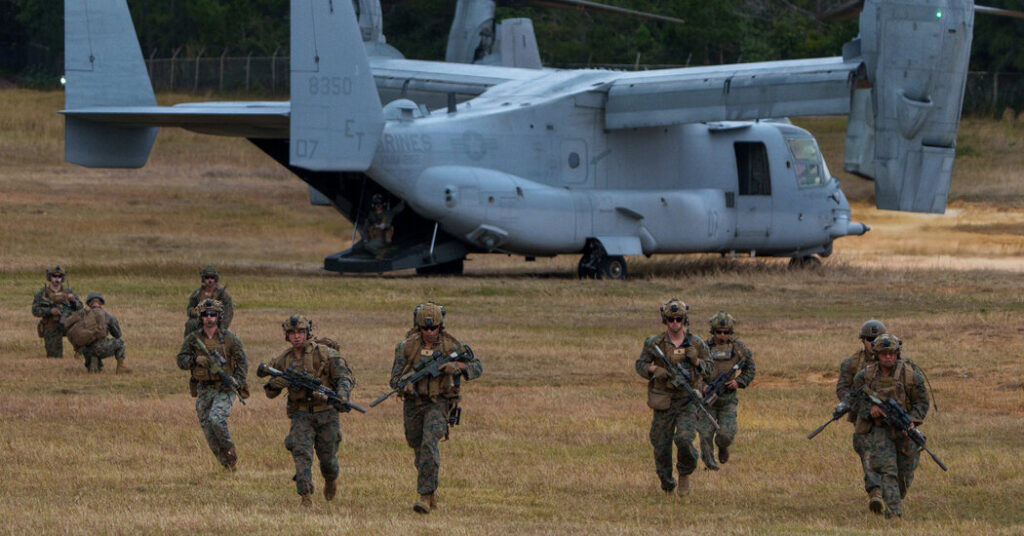
The deployment of about 2,500 Marines to the Middle East represents a new phase in the two-week-old war in Iran, as Iranian forces increase their attacks on the Strait of Hormuz.
The unit, officially known as the 31st Marine Expeditionary Unit, according to two U.S. defense officials, will be in an unusual position given the problem vexing the Pentagon: the Iranian military’s ability to mine the strait, a narrow waterway through which a fifth of the world’s oil passes.
U.S. airstrikes have forced the Iranians to forego their larger naval vessels and deploy fast boats carrying mines that can evade aircraft. These boats would likely launch from an archipelago of islands closer to the strait.
With the arrival of the 31st Marine Expeditionary Unit from the Indo-Pacific region in the coming days, the Pentagon will be able to quickly launch raids onto the islands with infantry Marines who will have logistics and air support, said a retired senior defense official with knowledge of the unit’s capabilities.
That raises the risk of escalation. President Trump has been quick to authorize smaller-scale military operations — such as the raid to capture President Nicolás Maduro of Venezuela in January — that have possible short-term payoffs but could be disastrous if things go wrong.
Mr. Trump announced on social media on Friday that the U.S. military had conducted a large bombing raid on Kharg Island, a key port and Iran’s oil export hub. Mr. Trump said that the raid had “totally obliterated” military forces on the island, but that he had directed the Pentagon not to damage its oil infrastructure, “for reasons of decency.”
The global price of oil has surged by 40 percent since the United States and Israel began the war with Iran late last month.
Though their numbers are relatively small compared to the 50,000 U.S. troops already in the region, Marine Expeditionary Units are valued by military commanders because they can rapidly put detachments of troops and vehicles on the ground. In the Strait of Hormuz, the Marines could also conduct counter-drone operations with jamming vehicles placed on their ships, escort tankers and other merchant ships, the retired senior defense official added.
Marine Expeditionary Units typically deploy with several ships, including a short-deck amphibious assault ship that can carry MV-22 Ospreys, transport helicopters and attack jets like the F-35 Joint Strike Fighter. Other vessels carry infantry Marines, their supporting artillery and amphibious assault vehicles for ship-to-shore landings.
With an East Coast expeditionary unit supporting the war in Venezuela and the 31st Marine Expeditionary Unit deploying to the Middle East (the 31st is usually based out of Okinawa, Japan), there will be no quick response force to aid operations in the Pacific theater, including Korea and Taiwan, the former senior U.S. defense official said. That leaves another gap in U.S. defenses atop the repositioning of critical air defenses from South Korea to the Middle East.
In the past, Marine Expeditionary Units, known colloquially as “America’s 9-1-1 force,” have been deployed to combat zones, evacuated embassies and conducted counter-piracy operations. Marines from the 15th Marine Expeditionary Unit were some of the first conventional U.S. forces on the ground during the U.S. invasion of Afghanistan in 2001.
Thomas Gibbons-Neff is a national correspondent for The Times, covering gun culture and policy.
The post How a Marine Unit in the Middle East Could Open New Phase of Iran War appeared first on New York Times.