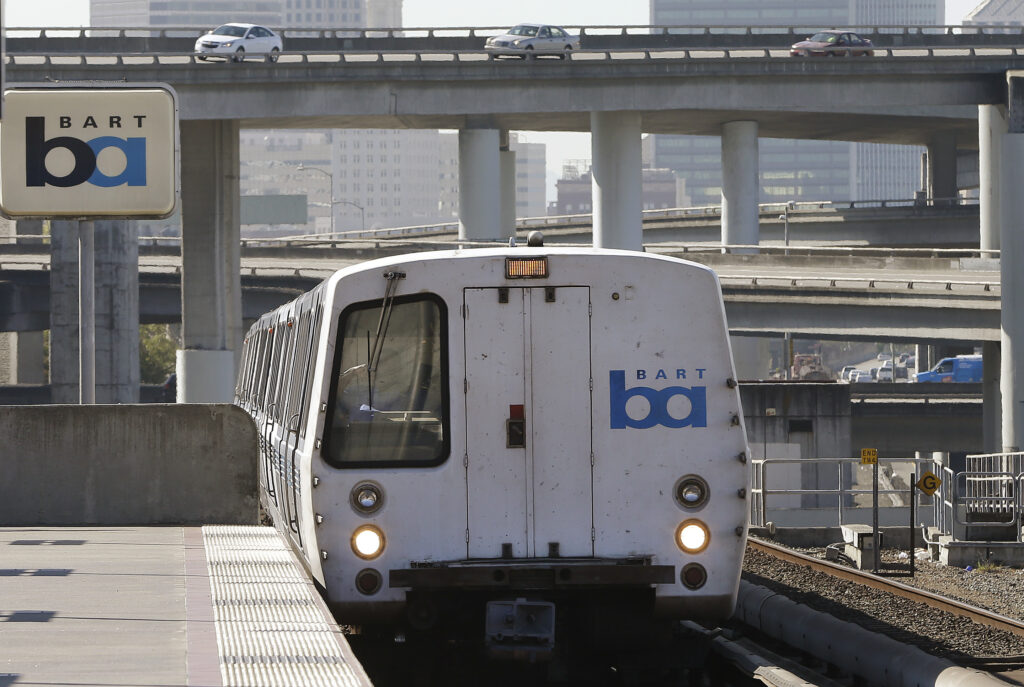
It looks like the Bay Area Rapid Transit system is headed for a financial death spiral. High costs and low ridership have pushed the transit authority to threaten major service cuts – unless wary voters approve a regressive tax hike in November. This farce was predictable but not inevitable.
BART has served greater San Francisco for more than half a century, and there was a time when it was mostly self-sustaining. As recently as 2019, a fare covered about three-quarters of the operating expense of a trip. The system has hiked fares, but the cost of any given trip has soared because ridership has collapsed. That’s why BART’s leaders want to raise the sales tax across all five counties that it serves by at least half a percentage point.
Few signs suggest that riders are coming back. Public transit use is down across the country, but most other systems are closer to pre-pandemic levels. The Bay Area, however, is filled with technology firms that offer generous work-from-home policies.
About three-quarters of BART’s operating expenses come from labor, and those costs have soared as ridership fell. BART had total operating expenses of $883 million in 2024. It spent over $150 million more on labor that year than it did in 2019, despite passengers completing 73 million fewer trips.
This destructive inefficiency is not entirely BART’s fault. Longstanding federal law makes it difficult for any public transit agency that receives federal money to cut its workforce. Nationwide since the 1960s, the total number of transit trips is approximately the same, but operating costs have quintupled, largely driven by labor costs.
BART now has an annual structural deficit of about $400 million. That’s a lot, but it pales in comparison to overall spending by governments in counties served by BART.
The City and County of San Francisco had a balanced budget in 2012. Government spending has grown by 54 percent since then. That is adjusted for inflation. It is not adjusted for population growth, because the population is basically the same.
Despite having a similar population, the city-county government had 27 percent more workers in 2025 than it had in 2012. Their average compensation is $205,000. They aren’t helping the transit situation, as one-quarter of them work from home two or more days of the week.
Meanwhile, San Francisco is asking residents to approve a full percentage point increase to their sales tax rates so that they can also bail out the Muni, which operates buses, street cars and subway trains.
Just comparing budgets from immediately before the pandemic in 2019 to 2024, the five counties BART serves were collectively spending over $9 billion per year more, adjusted for inflation. They achieved this despite the region having a stagnant population. Politicians should be asking themselves whether all that new spending was more important than BART before trying to saddle their residents with higher taxes.
Voters in Oakland already approved a sales tax increase last year, taking the combined rate in the city to 10.75 percent. That’s one of the highest rates in the country, and it’s 1.5 percentage points above the maximum rate allowed by California law. Local governments routinely ask for exemptions from that cap, however, and the state has been too happy to oblige.
Technologically, there’s a solution to transit costs. A 2023 studyfunded by the federal government concluded that “automation is a proven transit technology that not only reduces operations costs but can also improve service quality.” Automated trains aren’t some kind of AI innovation. They’re already normal in other parts of the world. Automation reduces operation costs by 46 percent, the study found, based on the financials of successful systems in Vancouver and Copenhagen.
Politicians would need to stand up to transit unions, repeal the federal law hindering labor cuts and set aside money for the one-time costs of transitioning to automated service. Maybe when the alternative is closing down transit systems altogether, they’ll see the light.
For the amount of taxes Bay Area residents already pay, they should have a well-run public transit system. Yet BART has been treated more like a jobs program for transit workers than a way for people to get around. That culture of contempt for the public is why bureaucrats treat never-ending tax hikes like the mob does protection payments.
The post The death of Bay Area public transportation appeared first on Washington Post.