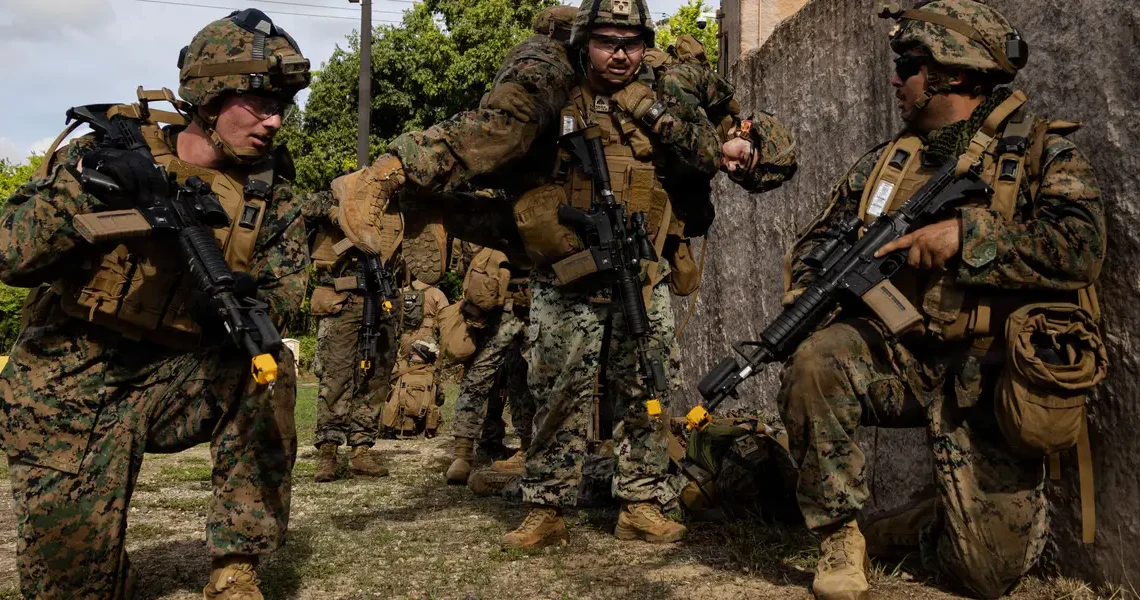

The Marine Corps is looking for a new outer garment to protect its troops from battlefield threats that can see through traditional camouflage and concealment.
The modern battlefield is becoming increasingly saturated with sensors, including thermal-imaging technology that can detect human and vehicle heat signatures in the infrared range of the electromagnetic spectrum. Many of the drones in the Ukraine war are equipped with thermal-imaging cameras that have been used to deadly effect.
Ukrainian troops have sought solutions, and now, so are US Marines.
The Marines published a new ‘sources sought’ notification on Wednesday announcing the service’s search for vendors who could create a camouflage to reduce the chance of infrared detection, calling the desired garment a “Multispectral Camouflage Overgarment.”
The post said it will deliver “individual signature management” by “mitigating detection across the visual, near infrared, and short-wave infrared spectrums as well as suppress thermal signatures in the mid-wave infrared and long wave infrared to reduce the likelihood of detection by thermal sensors.”
The garment is intended to mask how a Marine appears not only to the naked eye and night vision devices, but also to advanced infrared and thermal sensors used by drones and surveillance systems.
To accomplish that aim, the Corps is seeking “a single-piece, generously-sized draped design constructed to provide full-body coverage, including individual gear and equipment,” the document said. It must be capable of being donned within 15 seconds, over a Marine’s uniform and equipment, whether deployed or during training.
The cloak could significantly reduce the distance from which Marines are detected, making it harder for adversaries to spot them using both ground-based and aerial sensors. It must also function in extreme temperatures and varied environmental conditions.
The service says it intends to have more than 61,000 of the cloaks available to troops by fiscal year 2030.
The US military has long recognized the need for such a capability, but the extreme proliferation of sensors aboard cheap drones in the war in Ukraine has heightened the urgency.
“We know that adversary [target] acquisition systems are very, very capable in that, if you can see a target, with precision munitions … you can hit a target,” Gen. Mark Milley, then the Army’s chief of staff, told lawmakers in 2019. “So camouflage systems that break up electronic signatures and break up heat signatures are critical.”
Last year, Secretary of the Army Dan Driscoll spoke bluntly about the modern battlefield in Ukraine during a War on the Rocks podcast, saying that “you cannot move without being seen.” He said that would require changes in how ground forces operate.
Ukraine’s 56th Separate Motorized Infantry Mariupol Brigade shared video footage last March of its efforts to combat thermal imaging, presenting what it described as anti-thermal suits.
“This is not fantasy. It is the reality of modern warfare,” the 56th said in a caption posted alongside the video footage.
“Thermal imaging suits are changing the rules of the battlefield, making soldiers invisible to enemy thermal-imaging cameras and drones. Such technologies are critical for assault teams, reconnaissance, snipers, and even evacuation missions. And this is just the beginning.”
Read the original article on Business Insider
The post US Marines are on the hunt for a cloak they can wear to hide themselves from thermal-imaging sensors appeared first on Business Insider.