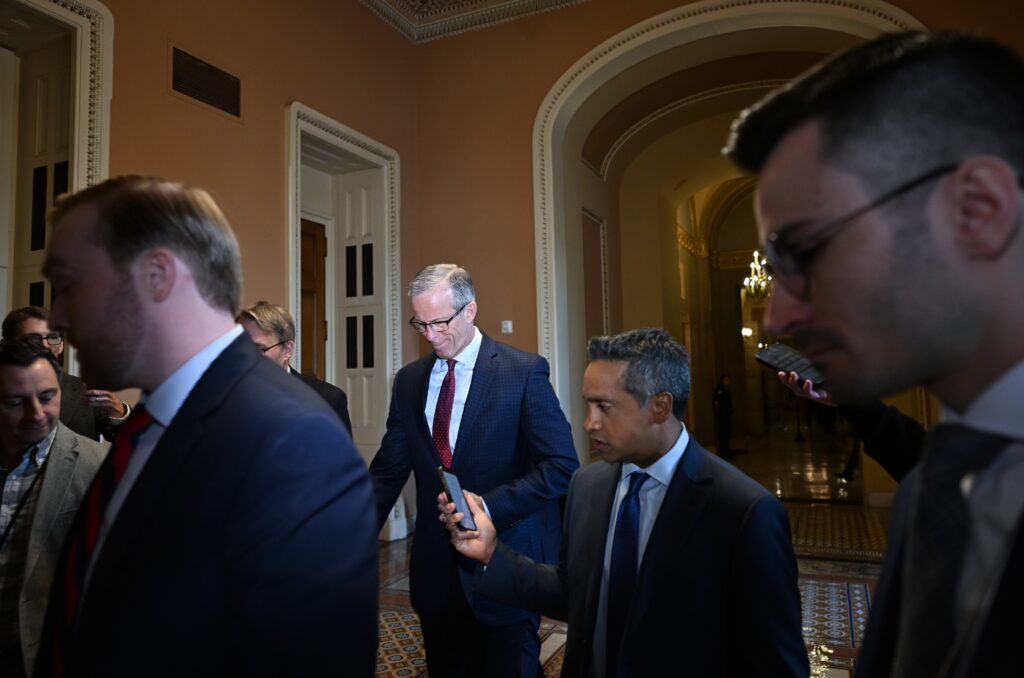
Senate Republicans have found themselves in a spot nearly identical to the one Democrats were in four years ago.
Their domestic policy agenda has been slow to take root, leaving voters disgruntled about an uneven economy. The president is focused on foreign affairs, with voters telling pollsters he is not focused on their concerns. And the midterm elections are bearing down on the GOP with a chance to lose control of their congressional majorities.
So, what’s the way out of this particular political jam? For many Senate Democrats then and Republicans now, the answer was to do away with the filibuster, or at least weaken it.
Just as Democrats did in early 2022, a large bloc of Senate Republicans has focused on trying to pass a law to nationalize election procedures and voting requirements that they believe would help them in the midterms. But passing that bill under normal procedures is impossible, because unified Democratic opposition leaves Republicans far short of the 60 votes needed to end a filibuster and have a final vote.
GOP supporters believe they can change those procedures in a way that eventually ends the Democratic filibuster, while warning that the November elections will be a bloodbath unless their base voters see Republicans fighting on this issue.
“We’ve got to do everything we can to make sure our base shows up, and they’re not going to show up unless we fight their battles, unless we make that clear we’re with them,” Sen. Mike Lee (R-Utah), the main proponent of this strategy, told far-right podcaster Glenn Beck.
The substance of their proposals is starkly different — Democrats wanted to expand things like vote-by-mail and have automatic voter registration, while Republicans want to curtail those practices and require voter ID — but their rhetoric at least rhymes.
“If there is anything undermining the spirits of the Senate today, it’s frankly the way things work right now. It’s time for the Senate to adapt, to meet the challenge of the modern age,” Sen. Charles E. Schumer (D-New York), then the majority leader, said before a key vote Jan. 19, 2022,trying to change filibuster rules.
A few days earlier Schumer said Democrats had to move quickly to make sure they could pass their election bill, named after the late congressman and civil rights activist John Lewis (D-Georgia), in time for the November 2022 midterms. “Our experts have told us moving by mid-January is the latest we can go,” he said.
The effort failed when two centrist Democrats joined all 50 Republicans in blocking the Schumer-led effort to change filibuster rules that would have forced the minority to spend hours, weeks, possibly months holding the floor to stall legislation related to voting rights.
Now the political shoe is on the other foot, and Lee is pushing to change procedures to create a “talking filibuster” requirement for the minority. Under the rules and precedents of almost five decades, legislation can be successfully blocked if fewer than 60 senators agree to end debate, requiring the minority party to do little other than appear for one key vote.
President Donald Trump has turned up the heat and threatened not to sign any other piece of legislation unless Senate Majority Leader John Thune (R-South Dakota) thwarts the filibuster to pass the SAVE America Act, explicitly tying its passage to GOP wins in November.
“It will guarantee the midterms,” Trump told House Republicans on Monday at their policy retreat in Florida.
Sen. Brian Schatz (D-Hawaii), a rising member of his party’s leadership, said that he learned a lesson from a now-retired Tennessee Republican about hypocrisy and the filibuster early in his tenure, with each side being guilty of changing sides on the issue.
“Bob Corker told me to say as little as possible about the filibuster, because you’re going to find yourself on both sides of it, depending on how the election goes,” Schatz said Thursday. “And so I think we all play by the rules that are provided, and we all try to maximize our advantage.”
A few senators are consistent, at least in terms of where they stood in 2022 on the issue. “I am not for the talking filibuster. I’m not for doing away with the filibuster,” Sen. Susan Collins (R-Maine) said Tuesday.
Collins has enough like-minded Republicans to make it next to impossible for Thune to please Trump.
Some Republicans have rejected the idea that the midterms will be determined by imposing the GOP’s national voting standards, suggesting that the party would be better off if it tried to focus on advancing a more popular agenda.
“If Republicans lose in North Carolina, it’s because we’re taking our eye off the ball and we’re spending too much time infighting, rather than going out there and doing what the citizens sent us here to do,” Sen. Thom Tillis (R-North Carolina) said.
Tillis is opposed to the substance of the SAVE act — he supports some versions of voting by mail and says election rules should be set by individual states — and also says he will oppose any effort to weaken the filibuster.
“I’m not a ‘hold my beer, watch this’ kind of guy. Every time I’ve done that, I’ve gone to the emergency room,” Tillis joked.
To be clear, Collins and Tillis have voted to weaken filibuster rules applying to the confirmation process of presidential nominees, so they aren’t filibuster purists.
Thune plans to bring the election bill to the Senate floor in a few days and, at a minimum, hold an extensive debate that could stretch into round-the-clock sessions. He knows that he does not have enough Republican votes to change the rules and that another Lee strategy would open the floor to potential chaos with Democrats offering amendments on just about anything.
“The plan is to bring it up, yes. We are still deliberating with our colleagues exactly what the process would look like,” Thune told reporters Wednesday.
Outside conservative groups have taken up the cause, again, in similar fashion to liberal groups four years ago, and they have pressured longtime supporters of the filibuster to reverse course in obvious gestures toward political appeasement.
Sen. John Cornyn (R-Texas), who has been desperate to secure Trump’s endorsement before a May runoff election for the GOP primary, penned an op-ed in the president’s favorite newspaper, the New York Post,switching his position from four years ago.
In 2022, Sen. Chris Coons (D-Delaware), a longtime supporter of the Senate’s institutional quirks, was one of the most prominent flip-flops, casting his lot with those who wanted to weaken the filibuster to advance the Democratic voting bill.
Back then Democrats pushed election proposals that would have made Election Day a national holiday, required states to have up to two weeks of early voting and allowed for same-day voting registration — as well as make states seek Justice Department approval to change voting laws.
The GOP legislation would require voters to prove citizenship when registering to vote, impose strict ID requirements and run all 50 state voter lists through federal databases, among other things.
Democrats never passed their election legislation, but those midterms turned out much better for them than it appeared in the winter and early spring of 2022. Galvanized by the Supreme Court’s overturning of abortion rights, liberal turnout was better than expected and Democrats gained a seat in the Senate, retaining their majority, while they lost the House majority but only narrowly.
Sen. Jeff Merkley (D-Oregon), who has spent 15 years or more trying to weaken the filibuster, is the rare Democrat who wishes they had been successful four years ago and made it easier to pass legislation.
Merkley is not likely to ever vote with Republicans to weaken the filibuster, but he said that he would be happier if the Senate lived under more of a simple-majority rule.
“We didn’t have the votes to do it. But I wish we had,” he said. “Yeah, absolutely. As I said, I’ve supported exactly the same reforms when I’m in the minority, when I am in the majority. You bet.”
The post Push for GOP voting law has many switching sides on filibuster issue appeared first on Washington Post.