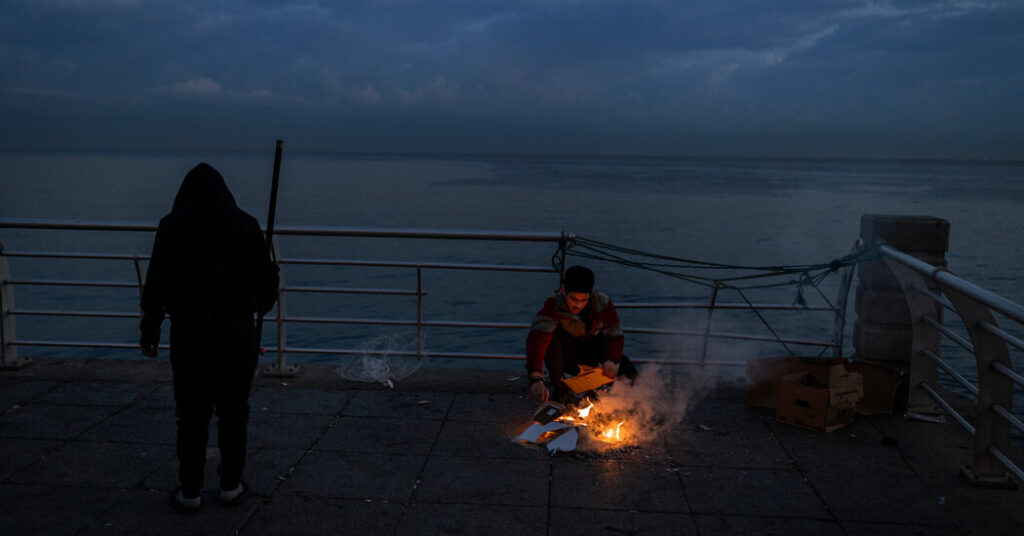
Sitting on a weathered bench overlooking the Mediterranean on a recent evening in Beirut, Lebanon’s capital, Fidaa Malhas vented her frustration at being uprooted.
Ms. Malhas, 38, usually lives in Sidiqeen, a town in southern Lebanon, where she works in a supermarket. Like many across the country, she was displaced by Israeli airstrikes. With no shelter in Beirut, she has been sleeping outdoors by the beach.
“We love our land,” Ms. Malhas said. “But we are never allowed to live on it in peace.”
Hundreds of thousands of displaced Lebanese are wondering when they might return home and are dreading reports of a possible Israeli ground invasion into southern Lebanon. Each update sharpens their unease.
Last week, the Israeli military issued evacuation warnings for all residents south of the Litani River, an area making up about eight percent of Lebanon’s territory and home to hundreds of thousands.
These orders, paired with sustained Israeli strikes, came after Hezbollah, the Iran-backed armed group in Lebanon, launched rockets into northern Israel in retaliation for the U.S.-Israeli attack on Iran. Israel also called for the evacuation of Beirut’s southern suburbs, known as the Dahiya, where Hezbollah holds sway, and parts of the eastern Bekaa Valley.
The result has been massive displacement: more than 830,000 people — about 14 percent of Lebanon’s population — are uprooted, according to Lebanon’s Ministry of Social Affairs.
Human Rights Watch said last week that the Israeli military’s call for the immediate evacuation of everyone south of the Litani River could violate the laws of war. The group said that the sweeping nature of the call raised doubts about the protection of civilians.
Many in southern Lebanon have now been forced from their homes for the second time in less than two years, mainly during a 2024 war between Israel and Hezbollah. Some had only recently returned, attempting to rebuild and reclaim normalcy, even as Israel continued striking what it said were Hezbollah targets in the area for more than a year.
Between October 2023 and January 2025, over 10,000 buildings in southern Lebanon were heavily damaged or destroyed, and reducing entire border villages to rubble, according to Amnesty International.
“We are suffering,” said Mirna Salman, who was displaced in 2024, and again more recently, fleeing to Beirut from Majdal Selem, a southern Lebanese village where she owns a farm.
Ms. Salman said she fled the south to stay with relatives in the Dahiya, but Israeli evacuation calls drove her north to downtown Beirut. Her three children, including a seven-month-old, sleep in their car to keep warm, while the adults huddle in a flimsy tent that barely holds back the cold.
“We miss home, but we have to stay patient,” she said.
The 2024 war between Israel and Hezbollah ended with a fragile cease-fire, but the truce terms have done little to ease uncertainty for those uprooted from the south. The agreement called for a full Israeli withdrawal by late January, but Israeli forces continued to hold five points inside Lebanon. Israeli officials said their troops would remain to protect Israeli towns along the northern border.
On the Beirut waterfront, Ms. Malhas, who was fasting for the holy month of Ramadan, said it was hard to believe she would spend the upcoming Eid celebration in the streets.
“The south is better than all of Beirut,” she said, throwing up her hands, recalling the fertile hills, fragrant orchards, and citrus, tobacco and olive trees of her native region. Her family owns farmland there.
“We love our land,” she added, “and we want to go back.”
Abdi Latif Dahir is a Middle East correspondent for The Times, covering Lebanon and Syria. He is based in Beirut.
The post ‘We Miss Home’: Displaced Lebanese Face Cold Streets and an Uncertain Future appeared first on New York Times.