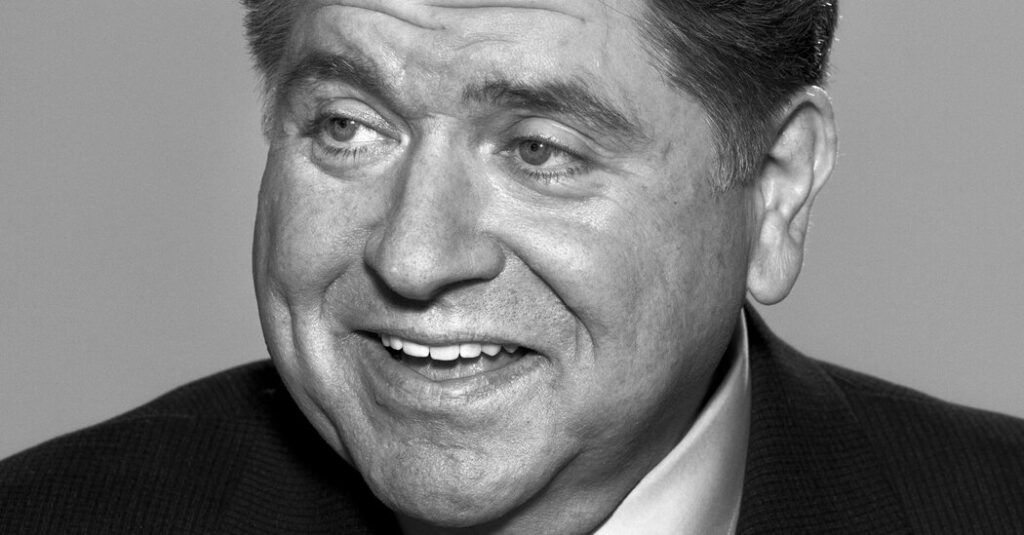
During his two terms as the governor of Illinois, JB Pritzker has become a national figure in the Democratic Party and one of Donald Trump’s main antagonists, at one point telling the president to “[expletive] all the way off.” That combativeness has created a narrative around Pritzker, whose sister, Penny, was secretary of commerce under President Barack Obama, as a potential contender for the Democratic presidential nomination in 2028, even if he’s not saying that yet as he runs for a rare third gubernatorial term.
Pritzker’s rise is interesting for a few reasons. As a member of one of America’s wealthiest families (his uncle founded Hyatt Hotels), Pritzker is a billionaire at a time when anti-billionaire sentiment is ascendant on the left. And as a longtime Jewish supporter of Israel, though very critical of Prime Minister Benjamin Netanyahu, Pritzker is not exactly in sync with the current direction of his party.
I wanted to understand how he’s navigating those potential tensions, how his family’s background, including two formative tragedies, have shaped him and where he sees his party, and the country, going from here.
Subscribe: Apple Podcasts | Spotify | YouTube | Amazon | iHeart
I want to start with more of a philosophical question. When we look at this era, what do you think the lesson is for Democrats from how President Trump has wielded power to get what he wants? What President Trump has done is operate like the president of a banana republic. That is, now that he’s got power, he’s going to vanquish his enemies and rule in favor of the people who will enrich him. I think that the lesson is for the country, that this is a dangerous road that we’ve gone down, putting someone like that in public office. We need to stand up against corruption. We need to make sure that whoever gets elected is good and decent and kind. Kindness is something that’s been missing in our politics. So you could say that’s a lesson for Democrats. I think it’s a lesson for all elected officials.
You’re talking about overreach and ruling like an authoritarian. Another version, though, is that Trump’s been able to push through an aggressive agenda — the “shock and awe” theory of governance. I’ve heard so many voters complain about incrementalism. I complain about it, too.
Are there lessons to be taken from the frustration of voters and the way that Trump’s managed to do it? If there’s a lesson, it’s that there should be a Project 2029 for Democrats. Now, remember: Project 2025 also included taking away people’s rights and freedoms. It included tearing down the safety net that holds up our working families and that stands up for the most vulnerable in our society. So there are things about the agenda that I think are reprehensible and anti-democratic. But yes, the speed of the agenda — and it’s not shock and awe so much as when you run and win on an agenda, you can accomplish that agenda and need to do it as soon as possible.
What does a Project 2029 agenda look like for you? I don’t think you can speak of it in shorthand, but we’ve got to restore the rule of law, and that means holding people accountable who’ve broken the law. I’m talking about the people in this administration who’ve broken the law and federal agents who’ve broken the law.
That means criminally prosecuted? Criminally prosecuted, civilly prosecuted. Whatever it is that we can do. A second thing is just thinking about people’s everyday lives, lifting people up and making things more affordable in the world. How about finally we Democrats get to universal health care? Obamacare was terrific and it advanced the cause, but we still have a whole lot of people who don’t have coverage. And now, of course, it’s being taken away from a lot of people. Another part of the agenda is, we’ve got to raise the minimum wage in this country. Minimum wage is $7.25. It’s about $14,000 a year if you have one full-time job. You can’t survive on $14,000 as a single person. Even if you hold two minimum-wage jobs, $28,000 a year — you can’t raise a family on that.
Why do you think there hasn’t been a Project 2029 yet? You talked about incrementalism earlier. I do think that people feel like we need the public to come along on every issue, and so let’s play them out over several years so that we can get consensus. But some of these issues have been around for an awful long time. I guarantee you that if you polled the American public about raising the minimum wage, 80 percent, including a majority of Republicans, would say it’s time. I don’t think we need to be incrementalist about some things that are universally understood.
The Texas Senate primary is being looked at very closely on both the left and the right. James Talarico defeated Jasmine Crockett, and that race was seen as something of a bellwether for the kind of approach that works best for Democrats. What were your takeaways? If you look across the last five or so elections — if you include Abigail Spanberger’s election in Virginia, Mikie Sherrill’s election in New Jersey, Zohran Mamdani’s election in New York City, the primary in Texas, as well as the nomination of Roy Cooper in North Carolina — they’ve run on an affordability agenda. They’ve run on making sure that working people understand we Democrats are the ones who are fighting for them, not the other guys. Now, I know that what you’re asking me is: Is there a split in the Democratic Party? But the truth is that both of these candidates in Texas exhibited the ability to excite young people who historically haven’t voted in large numbers. You didn’t hear either one of those candidates speaking in incrementalist terminology. They were out there talking about transformative change. That is the lesson.
But there’s another thing that people are inferring. Jasmine Crockett positioned herself as a fighter against Trump. And James Talarico has taken a completely different tack. You have adopted a very combative position in regard to President Trump. When you look at the lesson that some are drawing from Talarico, some would say maybe there’s another way to do this where you can stand for what you believe in but you don’t have to adopt the same public combativeness that President Trump adopts. When you’ve got somebody who’s taking people’s rights away, when he is not following the law, when he is corrupt and enriching himself — I mean, moms are being shot in the face — I don’t know how on earth you can say, Well, let’s work with him. You can’t work with him. He’s got an entire history of not living up to his promises. He can’t be trusted. I’m talking about when he was in business, you shake hands with him on something or sign a contract, he’d break it and sue you, even though he was in the wrong. In politics, every time he’d make friends with someone and then, all of a sudden, he’s turned on you. It’s happened repeatedly. He’s not a loyal person. He expects loyalty to him, but he’s not loyal back.
Mayor Mamdani of New York, whom you mentioned and who has been one of the bright lights for Democrats, has tried to woo Trump. He’s tried to work with him where he can because, as we’ve seen, the federal government wields enormous power and it’s hard to do things without it. What do you think about that way of doing things? Remember, I’ve been in office now for seven years. I was in office when Donald Trump was president the first time. When the pandemic hit, I called the president and asked for help — told him we needed ventilators, we needed masks and that he should invoke the Defense Production Act, but that we absolutely immediately needed to save people’s lives and needed the federal government. He promised to do that and didn’t deliver. This is in the most dire of circumstances. Look what he’s done to FEMA, the Federal Emergency Management Agency, which normally steps in when there are disasters. He’s ripped it apart. You can’t get help from the federal government anymore.
You seem to be implying that Mayor Mamdani is a neophyte. I’m not taking anything away from him. I understand why you try. I’m just saying I have my own experiences. Maybe our different circumstances are leading us to different conclusions.
I’d like to talk about how you became you. You suffered a lot of tragedy very young. Your father, Donald, died at the age of 39 of a heart attack, when you were 7 years old. That stuck in my mind because my father also died at the age of 39, when I was 5. What impact did that have on you? Do you remember that age and what happened? That’s obviously young, and you have limited memories, but of course I remember. My mother and father were actually out of town in Hawaii, and so my mother called her friends and said: “I need you to go to our house and make sure that our kids aren’t watching TV. I don’t want them to find out anywhere except from me.” And so her friends came and arranged to take us out for the day. We went to a place called Fisherman’s Wharf in San Francisco and it seemed like just a fun day, but it allowed my mother to get back.
I remember her coming back and taking us into their bedroom and sitting us down and telling us what happened. I think back on it now as an adult with children, and I think how hard that must have been for her. I know how hard it was for me to hear it, but how hard must that have been to tell your children that they’ve lost their father? People do it every day, unfortunately. She just lost the love of her life. And all of a sudden, she’s alone with three young children. So I remember all of that.
As an adult, I went back and found many of their friends who were in their 70s or 80s to talk to them about it. They remember distinctly, because my father was the youngest friend of theirs who had ever died, their first friend who died. And they remember how profound it was for them because he was also the life of the party. He was the person the whole room leaned toward, because he was a big, gregarious personality. And so it’s something I think a lot of people were profoundly impacted by. After that, my mother, who was an alcoholic — all the challenges you can imagine for someone who’s now become a widow with three young children, and then add on to that a disease that is so hard to overcome. …
You had to take care of her with your siblings. She went to Alcoholics Anonymous. She checked herself into a place that could help her. She tried really hard. It wasn’t like she was drunk all the time. She was sober a lot. She was one of the smartest people I’ve ever met, and I don’t think that’s just the view of a 7-year-old. I remember one day when I was 8 or 9, she sat us down and said, “I want you to know that sometimes it probably feels to you like I don’t love you because I’m not being the mother to you I want to be, but I want you to understand that this is a disease. I have a disease and I’m trying very hard to overcome it, and I’m going to overcome it.” She actually gave us a book to read about alcoholism, about the struggle that people have to overcome this disease. But unfortunately she was never able to overcome it. It overcame her and took her life.
You became an orphan at 17. That’s an extraordinary series of losses. How would you say that shaped you? I don’t want to aggrandize it or minimize it and just say that a whole lot of people go through tragedy and experience it differently and come out of it differently.
Losing both parents is a particularly difficult one for a child. Yes, and a lot of the outcome has to do with how old you were when those things happened — were there people around you who cared about you and took care of you and made sure that you weren’t going to fall off the edge of the earth?
Who were those people for you? My brother and sister and I were very close, and I was lucky I had two older siblings, so that was helpful for me. My parents’ friends cared deeply about us, and we had a broader family who really put their arms all the way around us and made sure that we were going to be OK. I just feel lucky because a whole lot of people, as you know, don’t have resources, don’t have a family that would step in and care for them and don’t have a large group of friends who can do what their friends did. There are a lot of lessons. Going through that, you learn compassion for other people because you’ve been through it yourself.
Your great-grandfather, the patriarch of the Pritzker clan, came to the United States in the late 1800s, fleeing the Jewish pogroms in Ukraine. He became incredibly successful and your family became one of the wealthiest in America, running one of best-known hotel companies in the country. Can I interrupt you just for a moment to say it was a motel business? My father and his brother built something that nobody thought would be successful. I only mention that because I think we overlook how hard it is to build something like that from scratch.
You are uncomfortable talking about your family’s wealth. Is that a statement?
It’s a statement and a question. I’m proud, I really am. I also feel incredibly lucky. I’m not uncomfortable. I’m just uncomfortable with the assumptions that people make about you. That obviously was part of what shaped me. I also think that the values that my parents taught me about social justice and compassion are things that, whether you’re wealthy or you’re poor or you’re middle class, those values that you grow up with are who you are. If you have resources, you can do more to carry out those values for other people, perhaps. But that’s how I think about it.
When I ran for governor in 2017, Donald Trump was president of the United States. The [wealthy Republican] governor of Illinois was failing the state miserably. And here comes a wealthy guy running as a Democrat. And it’s easy for people to be like, Why would Democrats want some wealthy guy when we’ve got a failed wealthy president and a failed wealthy governor? So I get it. I understand people had that in their heads, and for good reason. You had two bad examples. I had to go everywhere in the state and talk to everybody so people could understand that it’s where your heart is, it’s what your values are that matters — not how much you have or how little you have.
The reason I want to stay with this, and Donald Trump is obviously one example, is there is a real discomfort at the moment with wealth in politics. You’ve used a lot of your own money to finance your campaigns, to the tune of hundreds of millions of dollars. A lot of people might say that’s just not fair. I understand, but I will also tell you that what people know about me is that there’s no special interest that could buy me or tell me what to do.
What do you make of the moniker “the billionaire class” that has become very popular, especially on the left? Do you think all billionaires should be lumped together? You asked the question upfront, that I seem to be sensitive about wealth. And it’s in part because of a question like the one you just asked. I know that there are people who just want to lump everybody who is wealthy together and say that they are evil or they’re fighting against them. All I can say is, that’s not true of me, and it’s not true of a number of people I know.
You have positioned yourself as a leader in the national Democratic Party. As we speak, we’re in the second week of a war with Iran. How do you think it’s going? President Trump got us into this war without clear objectives, and the result of that is no one knows where we’re supposed to be going. So although President Trump has talked about trying to avoid “forever wars,” it seems like if you get into a conflict and don’t know how it’s supposed to end, that can easily turn into a forever war. When you’re then spending billions of dollars to get into a conflict where we were not drawn into it for any reason other than Donald Trump’s choice, you have to wonder, Is Donald Trump actually carrying out the mandate that he thinks he was elected to carry out? I thought he said he wasn’t going to get us into more conflicts, and yet we have Venezuela, Iran, he’s talking about invading Cuba. There’s a lot going on here that is evidence of Donald Trump lying about who he was going to be when he got elected. But as far as the war, with 140 American troops that have been reported wounded and half a dozen or more who have been killed, I wonder how long this conflict will go. I think the American public does not want to see it go any further. And again, what are we trying to achieve?
We’re seeing polling that shows that a majority of Americans are against the conflict. It’s having this polarizing effect on the left and the right, specifically around Israel’s involvement. The Democratic Party writ large has been moving away from unequivocal support of Israel. Recent polling showed overwhelming sympathy toward Palestinians in the wake of the war in Gaza among Democrats. And I’m wondering what you think the United States government’s relationship with Israel should be going forward. I’ve been terribly disappointed with the leadership who was elected in Israel. I respect the fact that it has been a democracy and they elect their leaders. But they’ve made the same kind of mistake that the United States electorate has made in electing someone like Benjamin Netanyahu. The result of Netanyahu’s leadership has been to create additional wars, drawing the United States into those wars and, very importantly, not carrying out what I think are the fundamental values of people who live in Israel, and that is the value of human life and the value of protecting people who are vulnerable and innocent. With regard to the leadership of Iran, these were torturous, murderous people. So no love lost on my part when it comes to the leadership being decapitated in Iran. I question whether that was a job that we should be involved in and whether we should be replacing leadership across the world who we disagree with or think are terrible.
But I must admit I’m challenged by this current situation, because Israel was created as a safe haven for Jews. We were in danger of extinction across the world. And Israel became that hope for Jews everywhere. And it has carried out, I think over almost all of the years of its existence, a desire simply to live in peace and within its own borders, to construct a society where people can live and work and exist and hope that they wouldn’t be attacked. Unfortunately, Israel has been under attack over a lot of years. Meanwhile, here we are where Israel had an opportunity after the atrocities that were committed by Hamas on Oct. 7 of 2023. There was an opportunity for Israel to then do what I think it has, over its history, done, which is to operate in a humanitarian fashion, to make sure that food aid was delivered to the innocent, to make sure that when bombs were being dropped or the war was being conducted in Gaza, that it would minimize innocent deaths. That didn’t happen. That’s on Netanyahu.
I believe strongly that we need to not only secure and grant the right to exist for the state of Israel as a safe haven, but also that we should have a state where Palestinians can be safe and live in peace, and that should be in Gaza, if you ask me. So I am torn because we now have a U.S. government supporting policies that I don’t think the majority of Americans believe in and I don’t think a majority even of Israelis believe in. But that’s what’s being carried out now.
I hear you using the words “torn” and “challenged.” I know that this must be, as it is for many Jews, an incredibly difficult conversation to have. You used to be on the board of AIPAC, the pro-Israel lobby group, and you’ve since distanced yourself from them. And last August, you also endorsed a Senate effort to block U.S. arms sales to Israel. You said it sends “the right kind of a message.” It made me wonder if you’re undergoing a personal evolution. Well, I abandoned AIPAC more than a dozen years ago. It was an organization that had at one time been bipartisan in nature and really all about preserving a strong relationship between the United States and Israel. But about a dozen years ago, the organization began to lean much more to the right and much more pro-Trump, who had then become a candidate for president, and that disturbed me greatly. AIPAC back then was not a PAC, I might add. It was a public affairs council; it didn’t have a political action committee that was giving money to candidates. But the organization became political. They created a super PAC. They began to get involved in elections directly and choosing to support candidates who were MAGA and right-wing and Trumpy. I just didn’t want anything to do with that.
Do you feel like the leadership of Israel changed, AIPAC changed and you felt distanced from it, or have your own views changed? It’s hard for me to answer that question. I think that it’s certainly true that AIPAC changed, and that’s why I walked away. Again, do I believe that Israel has a right to exist? I do, and my grandfather’s name is on a square in Jerusalem because my family has always believed that there should be a safe haven for Jews. But I also believe that others have a right to that kind of safe haven. And so, have my views changed? No, I think I’ve always believed that.
Where do you think that leaves someone like you? If you were in a position to decide U.S.-Israel policy, which I absolutely understand that you are not, what exactly should America’s relationship be to the state of Israel right now? We should be a peacemaker. That’s what we should do. Simply going along with Benjamin Netanyahu’s plan — that he’s had for many years, by the way — to attack Iran, we should have asked the question, Are there alternatives? The fact that Donald Trump went along, that’s the example of the thing that we shouldn’t be doing.
This issue is one that has divided a lot of Jewish families. I’m wondering, on a personal note, if that’s been something that’s come up in yours, especially as you’ve been deciding what positions to take publicly? Anybody who’s got a family of more than one or two people, there are a lot of different views. There are a few Republicans in my family. I don’t think there’s anybody who’s pro-Trump, but a few Republicans. And we have differences of opinions on lots of issues that come up, even among Democrats.
I’m Cuban. We argue about everything. There’s a joke among Jews that if there are two Jews, there are three opinions about any issue. [Laughs]
In his memoir, Gov. Josh Shapiro of Pennsylvania said Kamala Harris’s vice-presidential vetting team asked him about his faith, and even if he was an Israeli agent. You were also vetted, and I’m wondering if they asked you the same things in the same way. They did not ask me those same things in the same way. Going through that experience of being vetted for vice president is like getting the worst kind of colonoscopy. Some of it, I guess, seemed offensive to Josh Shapiro. I don’t know what led them to ask that question. I wasn’t asked and yet I’m Jewish, and I’m as much an adherent to my religion as Josh Shapiro is. So not exactly sure who asked that question or why. What I can say is that I wasn’t asked those things. I was asked hard questions, for sure, but nothing quite like that.
We’re kind of dancing around this central thing, which I feel compelled to ask you, which is that you are often mentioned as a potential 2028 candidate for president. What are you weighing as you’re making that decision? I’m not weighing that decision. I know you find that surprising, but I’m running for re-election as governor. That’s what I’m focused on. Listen, I’m proud and pleased that people think that my leadership is something that would put me on the stage as a potential presidential candidate. The reasons that people are doing that have more to do with the conviction that I have offered on the subject of stepping between Donald Trump and the people of my state and protecting people and speaking out and being unafraid. I wish more Democratic politicians were doing that right now, and more politicians in general. I wish Republicans would get religion about standing by the law and the Constitution. So I guess that’s why people have considered me as a potential candidate.
Governor, looking at the world right now and America’s place in it, it reminds me of what many Democrats see as President Biden’s fundamental miscalculation. When he became president, he pitched that Trump was an aberration, that we can go back to the before times. And I think we’ve now seen that there’s no going back to what came before. As Canada’s Mark Carney said in Davos, “The old order is not coming back.” Looking at the future beyond Trump, what do you think is coming? What keeps you up at night, and also what gives you hope? Donald Trump has made this world less safe. What keeps me up at night is that when we say that the world order is changing, it means less order and more adventurism — not just by the United States but by other countries too. If the free world isn’t willing to act as a collective against the Russian aggression on Ukraine, then we allow countries simply to decide: We don’t like our neighbor, or we’d like to have some of their territory, we’re just going to invade. If we have a more powerful army, it’s ours for the taking. That is the world I’m afraid is now upon us.
I agree that Donald Trump may have permanently blown up a world in which the United States was the leader and where now maybe we won’t be anymore. I’ve talked to a lot of Americans who live in Europe and I’ve asked them: “Do you think we can re-establish the trust that we had with our allies in Europe? Can we put it back together so that we’re all working in unison with one another, with the United States at the helm?” I asked how long it would take to do that. Two of them said 20 years, and the third one said never. So that is the fear that I have.
Now, what am I hoping for? I’m hoping that when we’re finally able to re-establish ourselves as a trustworthy ally, that we can go to the most important of our international relationships and restore a sense of order and direction, and that the United States can be the most important of the allies among a plethora of equals. And then our job, if we’re able to do that, is to restore hope among the American people. I think that people have lost the sense that we belong to the greatest nation in the world, that we’re all lucky to be here and that we have obligations. How about if we return to a world where people feel like they owe something and are willing to give to our country, and to promote our country throughout the world as a leader of peace?
This interview has been edited and condensed from two conversations. Listen to and follow “The Interview” on Apple Podcasts, Spotify, YouTube, iHeartRadio or Amazon Music. Follow us on Instagram and TikTok.
Director of photography (video): Cal Christie
Lulu Garcia-Navarro is a writer and co-host of The Interview, a series focused on interviewing the world’s most fascinating people.
The post How Tragedy, Wealth and Trump Shaped JB Pritzker appeared first on New York Times.