War with Iran has frozen commerce in the Persian Gulf and boosted oil prices by more than 50 percent worldwide, translating almost immediately into higher gasoline costs. It’s the largest global oil disruption ever and is likely to accelerate inflation throughout this year.
And yet, in the United States, the impact is much more muted than it would have been a few decades ago.
That’s in part because America uses less energy per unit of economic output than it used to. In economist-speak, the U.S. economy is less “energy intensive,” for a few reasons.
One, the U.S. economy now depends largely on services like health care, retail and entertainment, which require much less energy than manufacturing industries. There are only about 21 million jobs in goods-producing sectors, while private services employ 114 million people.
And two, the machines that Americans do use are now much more efficient, a trend that started in earnest after the oil price shocks of the 1970s. According to the Department of Transportation, the average new light-duty vehicle gets 28 miles per gallon of gas, up from 13 in 1975. Gasoline consumption rose until 2007, then leveled off as electric vehicles gained traction. As a result, consumer spending on gas as a share of discretionary income has fallen.
Economists at Wells Fargo estimate that a sustained 50 percent rise in oil prices — similar to the current situation — would have had about twice the effect in the 1980s as it would today, when it’s expected to trim about one percentage point from annual consumer spending growth.
The United States has also become the world’s largest oil and gas producer. Rather than depend on supply from the Middle East, the rest of the world now consumes petroleum products that are fracked from North Dakota and West Texas. All that new supply helped bring down prices globally in the 2010s, especially after Congress lifted a ban on natural gas exports in 2015. Theoretically, it means that profits from oil production stay in the United States, and can be redeployed for other investment. According to research from the Dallas and Kansas Federal Reserve branches, the shale boom added 1 percent to gross domestic product.
However, it is not clear that U.S. drillers are inclined to play the role of “swing producer” again this time. Price competition during the fracking boom was ruinous for investors. Many companies went bankrupt, unable to pay back all the money they had borrowed for expensive extraction infrastructure. They learned a lesson: Don’t invest a lot of money in pumping more just because prices rise. Especially if you’re not sure whether those prices will sink back down.
“I don’t see much happening from the production side in order to mitigate the effects for the U.S. economy,” said Christiane Baumeister, an economics professor at the University of Notre Dame who studies oil markets. “Companies just prioritize delivering returns to shareholders,” she said. “I think they would rather take advantage of the current situation to increase profits rather than investing that back into expanding output.”
Another deterrent to ramping up production: Steel and aluminum tariffs have raised the cost of the pipes and valves needed for it. The number of oil rigs that are actively pumping in the United States is down 7 percent from this time last year.
Even with the U.S. oil industry operating at full steam, it doesn’t generate many benefits for U.S. workers, as oil companies have learned how to operate with fewer people. The United States is pumping more oil and gas than ever, but the extraction, drilling and oil field services industries have been shedding jobs. The sector employs about 363,000 people, which is about 0.2 percent of all employment.
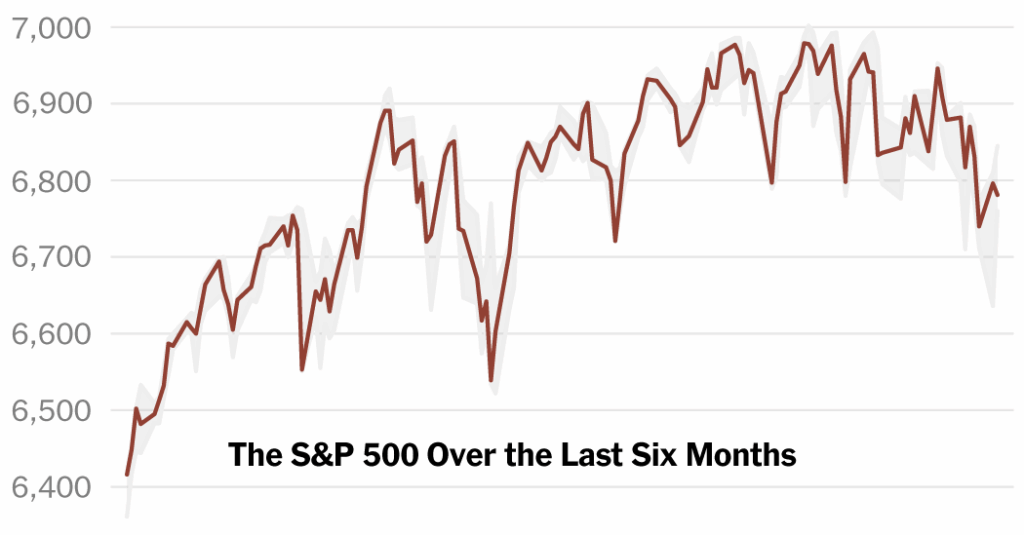
And despite the huge boom in U.S. oil production over the past 15 years, it has not become a more meaningful part of Americans’ stock portfolios. Exxon Mobil and Chevron had long been among the most valuable companies in the stock market. But the entire oil and gas sector now makes up just 3.2 percent of the S&P 500 index, down from 5.5 percent a decade ago. Their stocks had consistently underperformed the broader index, until soaring oil prices lifted their fortunes after the United States and Israel attacked Iran.
“The oil and gas industry’s financial strategy has been ‘pray for war,’ because those are the conditions under which they make money,” said Clark Williams-Derry, an oil industry financial analyst at the Institute for Energy Economics and Financial Analysis. “They have to have a big price spike every few years literally to make ends meet.”
The Americans most vulnerable to an oil-price shock are people with lower incomes who haven’t been able to buy their way out of gasoline dependence. Electric vehicles are more expensive than gas-powered cars, and their owners are disproportionately affluent and well educated, according to a recent paper by researchers at Carnegie Mellon University. As the Trump administration rolls back energy efficiency standards for appliances and fuel economy rules for cars, oil price increases could start to have a bigger impact.
Electricity bills are another substantial cost, absorbing 3.6 percent of budgets for households in the lowest 20 percent of earners, according to the Bureau of Labor Statistics. Although renewable energy sources have been supplying more of that electricity, fossil fuels still account for 60 percent.
“Talk to someone who doesn’t make a lot of money, and see if they’re resilient to oil and gas,” Mr. Williams-Derry said. “In terms of a variable expenditure that you can’t control, it’s up there.”
Karl Russell contributed reporting.
Lydia DePillis reports on the American economy for The Times. She has been a journalist since 2009, and can be reached at [email protected].
The post America Depends Less on Oil Than Ever appeared first on New York Times.