The annual budget for the Rock Volunteer Fire Department, in rural Osage County, Okla., is $180,000. The donation offer was for $250,000.
After many discussions, the department’s decision, widely praised in the community, was unanimous: No thanks.
“Would it help this department? Yes, it would have,” Chief Charley Pearson said of the donation offer, which came from Google. “But it would have been very difficult to take the money and turn against the people who have paid for the two stations and equipment for decades.”
The Fire Department, along with the nearly 20,000 residents of the city of Sand Springs, learned in January that Google was planning to build a data center on 827 acres of farmland that had been rezoned for industrial use.
Sand Springs, a western suburb of Tulsa, is the latest front in a national effort to build colossal data centers, often in rural areas, that are crucial in the race to develop artificial intelligence. Though local officials and Google have pointed to job opportunities and other economic benefits, residents worried about the effects on everything from utility bills to nearby farmland and the area’s water supply, and lament a general lack of transparency in the planning.
A group of Sand Springs residents have filed lawsuits seeking to stop the data center from being built and void the annexation and use of the farmland for its campus, which would be about eight miles north of downtown Sand Springs.
Chief Pearson, who has lived in area his entire life and spent the last 35 years leading the Rock Volunteer Fire Department, said that his team of 28 firefighters in two stations and the department’s board of directors were unanimous in wanting to turn down the Google donation.
Data centers, which technology giants like Google are spending hundreds of billions of dollars to build, consume vast amounts of energy. At least 25 proposed data centers were canceled last year after local protests, according to research by Heatmap, an energy news site.
Several polls have found that Americans are worried about the effect that these projects will have on their utility bills. A 2025 study from Carnegie Mellon University and North Carolina State University estimated that data centers and cryptocurrency mining could lead to an 8 percent increase in wholesale electricity costs by 2030. Data centers use about 5 percent of U.S. electricity, and that could grow to as much as 17 percent by 2030, according to the Electric Power Research Institute.
The issue arose at the North American Gas Forum in December. The U.S. energy secretary, Chris Wright, told energy executives, “In rural America right now, where data centers are being built, everyone’s already angry because their electricity prices have risen a lot.”
Some Sand Springs residents also worry about the amount of water the data center use to cool the computing equipment, something residents of other communities with data centers have complained about. But Mike Carter, the city manager and a former police chief, said that those concerns were unfounded.
“We have a large surplus of water in northeast Oklahoma,” he said, with access to more than 17 million gallons daily, of which less than a third is used. “The residual water we don’t use? It goes over a dam and it’s wasted.”
Large data centers can consume up to five million gallons of water per day, according to the Environmental and Energy Study Institute, a nonprofit focused on climate change solutions.
The data center near Sand Springs would be built on land that, until the start of the year, was not zoned for heavy industrial use. Opponents say that they are not against data centers, but instead disapprove of the location and the process of rezoning it from agricultural to industrial.
“It’s kind of like, ‘We’re taking land in your area and you don’t get a say as to what goes on next to your farms,’” said Todd Autry, a retired Tulsa County purchasing agent who lives in Sand Springs. Some of the farms have been certified by the Agriculture Department to have organic status, he said, and one breeds and trains professional quarter horses.
Melissa Meyers, a resident of Sand Springs and chair of the Tulsa County Republicans, pointed to an empty industrial lot within the city limits as a viable alternative.
“I’m not anti-Google, I use Google everyday,” said Ms. Myers, a mother of two school-age children who owns a landscaping business with her husband. “This isn’t a good deal. We’re not getting R.O.I. on our investment for 20 years.”
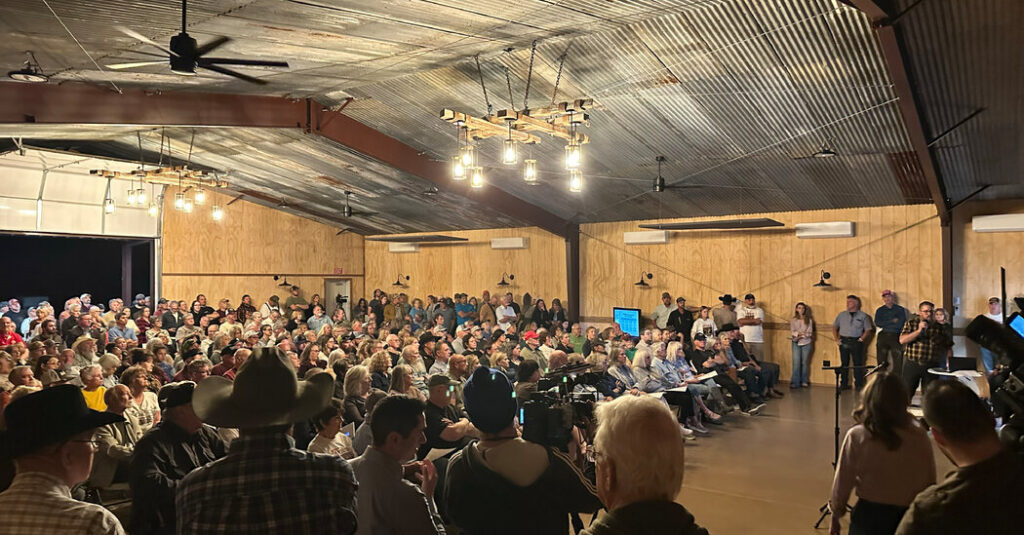
Hundreds of people attended two public meetings about the project, and dozens spoke out against it. The group of residents suing the city, the Protect Sand Springs Alliance, is gathering signatures to recall all seven members of the City Council.
Chief Pearson, 66, became an accidental spokesman for the opposition when he spoke in opposition to the Google project at one public meeting.
“Nobody owns us,” he said in a phone interview.
Some of the anger around the planned data center, he said, is related to the nondisclosure agreement that City Council members signed with Google. City officials say that is standard practice for commercial real estate, and companies say that such agreements are necessary to protect sensitive information in a competitive industry. But critics lament the lack of transparency.
“They made people mad. They felt that they were keeping secrets from us,” Chief Pearson said. “I chose no secrets. I told Google that I would not sign the N.D.A.”
He added that the Fire Department itself does not have a position on the data center.
City officials said that they were acting in the best interest of residents.
“We had multiple boards look at this, and say it was a good thing,” Mr. Carter, the city manager, said.
He said the city had signed other nondisclosure agreements in negotiations with large corporations, including Chili’s, Olive Garden and Tropical Smoothie Cafe. For example, the city is looking to place four tenants in a shopping center, Mr. Carter said, and none of them wants to be identified.
“We’re not doing anything shady,” he said, adding that the city rejected the first proposed N.D.A. because officials felt that it didn’t leave enough space to comply with the state’s Open Records Act.
Google’s plans show that the data center buildings are slated to take up less than 10 percent of the 827-acre site. There will be private internal roads, parking, equipment yards and electrical transmission facilities. A third of the site will be preserved as a private “vegetative or green open space.”
Up to 1,000 temporary construction jobs will be created, according to Google, and over the long term, the data center will employ HVAC and server operations technicians, as well as people with roles in food, janitorial, groundskeeping and security services. The company did not specify how many permanent jobs would be created.
Mayor Jim Spoon said that Google would “add significant funding” to the city and its schools over the 25-year term of its agreement to run the data center.
“It will also add good jobs to our city that will allow some of our children to live and work in Sand Springs in the future instead of having to leave our area,” he said.
Mr. Spoon has discussed the data center with other mayors of cities where Google has moved in. “Every one of them considers Google a great partner, and the best thing that has ever happened to their community,” he said.
Google has been in Oklahoma for nearly 20 years, having opened a data center in Pryor, on the far eastern side of Tulsa, in 2011. It said that it has invested more than $5 billion in digital infrastructure in the state, and supported many schools and nonprofit organizations. Another half-dozen data center projects are planned in northeast Oklahoma.
“It’s not just a building with computers in it,” Chrissy Moy, a Google spokeswoman, said of the proposed data center. Google’s presence often spurs the creation of new businesses, she said, and the company often donates to local nonprofit organizations.
Google said that its data centers power tools like Google Maps that organizations like the Rock Volunteer Fire Department rely on. “We go to organizations that are aligned with our values and what we’re passionate about,” Ms. Moy said. “We want to be good neighbors.”
For now, Chief Pearson, a fourth-generation cattle rancher whose 2,300-acre farm is not adjacent to the land where the data center would be built, said he would rather rely on the neighbors who donate to his department year-round.
“In the end, we did the right thing,” he said, adding, “We listened to the people.”
Adeel Hassan, a New York-based reporter for The Times, covers breaking news and other topics.
The post ‘Nobody Owns Us’: How Plans for a Google Data Center Roiled an Oklahoma Town appeared first on New York Times.