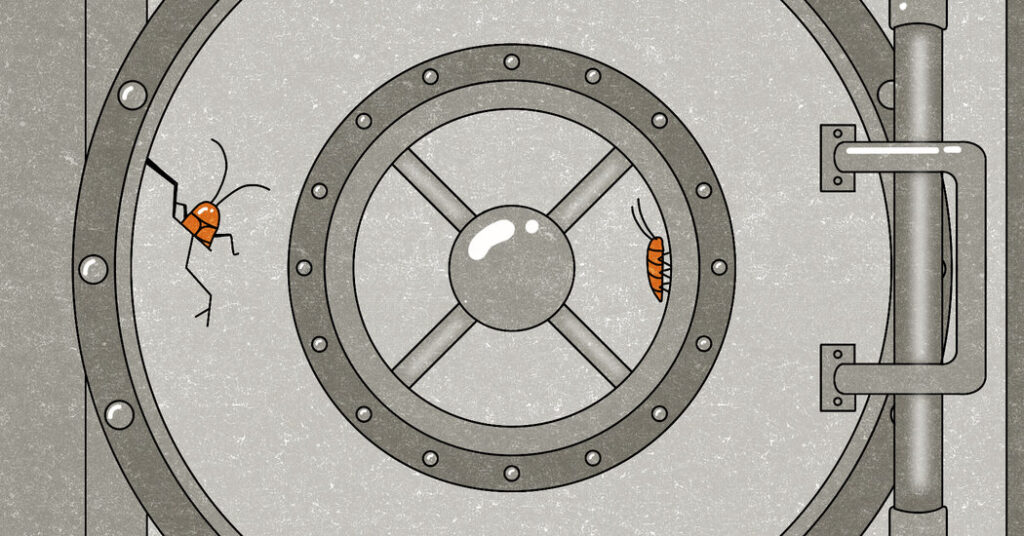
In recent months, Wall Street bankers have grown increasingly concerned about the private credit market, a largely opaque industry focused on lending to risky companies. The anxieties intensified since the collapse of two companies in September that were financed by private credit. Some colorful metaphors have ensued.
“My antenna goes up when things like this happen,” Jamie Dimon, chief executive of JPMorgan Chase, said in an October earnings call, adding, “When you see one cockroach, there’s probably more.” He was implying that the two bankruptcies (one of which his bank was exposed to) were early signs of a broader problem with the private credit industry, and the metaphor was soon repeated all over the financial press. A Financial Times editor even wrote a column in December calling “cockroaches” a word of the year.
Failures in this world are rarely isolated, Amit Seru, a finance professor at the Stanford Graduate School of Business, explained in an email, and one collapse “often reveals deeper weaknesses in balance sheets, valuations or risk management.”
How it’s pronounced
/käk-rōch/
Private credit is a subset of the world of private equity, involving loans to companies that don’t want to deal with traditional banks. The industry has proliferated in recent years, ballooning to $3 trillion. Such firms are not regulated like traditional banks and are not required to tell investors how risky their portfolios are.
These firms traditionally relied on investments from long-term institutional investors such as pension funds. But as the sector has grown, firms have started raising more money from individual investors through mutual funds and other financial products. “The structure of regulations was set up before private credit funds took off,” said Arthur Laby, a vice dean and professor at Rutgers Law School. “In 2026, the investors in these funds have gone beyond wealthy and sophisticated individuals and firms who don’t need these protections.”
Shares of Blue Owl Capital, the largest publicly traded firm dedicated to private credit, have fallen more than 50 percent over the past year. A major worry is that software companies, which rely heavily on private lending, will falter because of advancements in artificial intelligence. Lately, “the system is moving from a period of benign conditions to one where underlying risks become visible,” Dr. Seru noted.
Financial regulators and concerned onlookers are “always looking for warning signs of potential distress,” Natasha Sarin, a professor at Yale Law School and the president of the Yale Budget Lab, said in an email. Because financial firms are enmeshed with so much of the economy, any “weaknesses in the financial architecture have potentially seismic effects.”
The scare over private credit has spawned other metaphors: In November, Jeffrey Gundlach, a billionaire bond investor, likened the market to “the Wild West.” He continued: “And it starts out with the sheriff in town and things are going pretty well. But then, as the frontier town grows, more people come in trying to exploit opportunity.”
Lloyd Blankfein, the former chief executive of Goldman Sachs, said at an event last month, “I don’t feel the storm, but the horses are starting to whinny in the corral.” And Boaz Weinstein, a hedge fund manager who helped bring down JPMorgan Chase’s “whale” trader in 2012, said at a conference, “All you need is the snowball to start going down the hill, and it started.”
These metaphors may serve a purpose beyond just flowery expression. In the world of Wall Street, Mr. Laby reflected, such language allows insiders to talk to each other in ways other in-group members will understand, and, crucially, offers “a way to communicate a problem with some emotional salience but without a sense of panic.”
The post Fears of ‘Cockroaches’ in the Private Credit Market appeared first on New York Times.