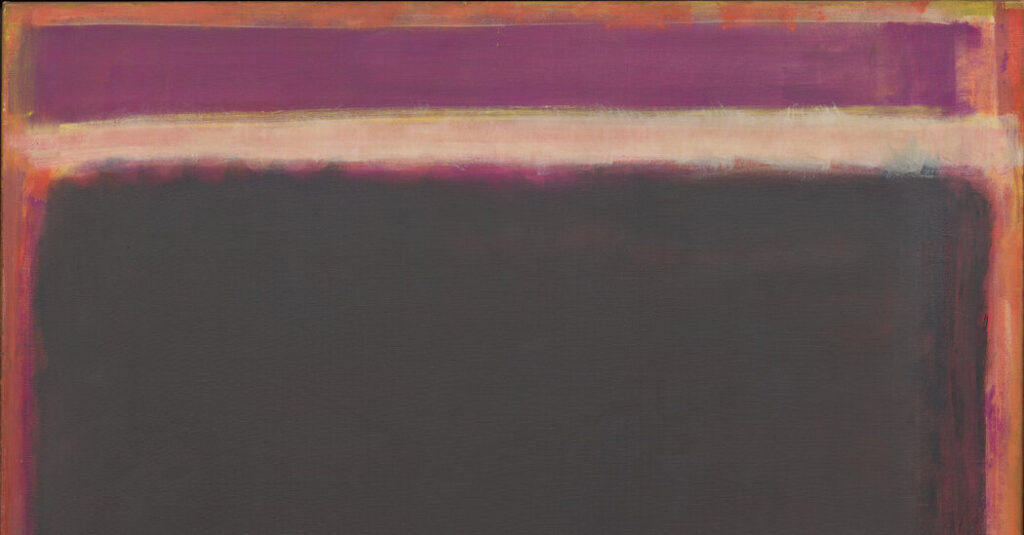
In 1950, the American artist Mark Rothko traveled to Florence, Italy, with his wife, Mell, the first of two trips he would make to the city during his lifetime. By his own account, he was especially struck by two Renaissance-era monuments: the devotional frescoes by Fra Angelico at the former Convent of San Marco and the vestibule in the Laurentian Library, designed by Michelangelo.
Both sites are hosting works for a major Rothko exhibition that opens in Florence on Saturday, with a robust core of more than 60 works installed at the 15th-century Palazzo Strozzi.
At San Marco, five Rothkos are placed in monk’s cells, which enchanted Rothko so much in 1950 that he couldn’t drag himself away from the convent, and came back the next day. At Michelangelo’s vestibule, the curators have placed two studies for the Seagram Murals, a commission by the Four Seasons in New York that Rothko pulled out of when he learned that the paintings would be displayed in the hotel’s restaurant.
The exhibition, “Rothko in Florence,” explores the notion that Rothko’s attachment to the Renaissance city ran deep and directly affected his output.
Rothko was influenced “by the art of the Florence,” said Christopher Rothko, the artist’s son and a co-curator of the exhibition — not just the paintings, but also the city’s “atmosphere and “broader scope.”
“It’s not like you come and see ‘Rothko in Florence’ and he’d done sketches of every piazza or the hillsides,” he said. “It’s more what has gotten into his head.”
In the exhibition catalog, the show’s other co-curator, Elena Guena, writes that early Renaissance artists in Florence believed that “geometry was a pathway to grace, that proportion might reflect a divine order, and that the placement of color on a wall could alter the soul.”
During a recent tour of the show at the Palazzo Strozzi, Guena said that Rothko’s paintings had “this spiritual humanistic desire to communicate with the viewer” that is rooted in European art. He “transfused” that into postwar New York art, she added, with “large canvases and color — not at all what was happening in Europe at the time.”
Along with painters like Jackson Pollock, Barnett Newman and Willem de Kooning, Rothko is considered one of the principal artists of the New York School, which radically changed American art after World War II.
The exhibition brings together Rothko works spanning more than three decades, tracking how his figurative works of the mid-1930s pass through a neo-surrealist phase to gradually dissolve into swaths of color — a change that was the artist’s leap into history.
The curators suggest that even those early works, painted years before Rothko visited Europe, emulate the art and architecture of the continent and its understanding of space through balance and scale.
Rothko was largely self-educated, his son said, but knowledgeable of European art via the Metropolitan Museum of Art and the Frick Collection in New York. He was also a voracious reader, “generating his own philosophy, his own point of view, through the process,” he said.
During Rothko’s three trips to Italy — in 1950, 1959 and 1966 — the artist was fascinated by history and art history, his son said, and also “the passage of time as that’s reflected in the landscape, as that is reflected in cityscape.” Walking the streets of Rome and “literally seeing layers of architectural history built one upon the other” shaped Rothko’s thinking as he simplified the format of his paintings, which were increasingly characterized by large flat areas of color, Christopher said.
Guena added that “the classical ruins of Paestum and the deep reds of the frescoed villas in Pompeii” were also “very important.”
In Florence, Rothko found the self-contained universes he sought in spaces like the vestibule or the cells where friars prayed in San Marco. Speaking of Michelangelo’s entrance to the library — where the interior walls are treated as if they were an exterior facade turned inside out — Rothko told a friend: “He achieved just the kind of feeling I’m after — he makes the viewers feel that they are trapped in a room where all the doors and windows are bricked up, so that all they can do is butt their heads forever against the wall.”
Rothko similarly sought to envelop the viewer.
In the last decade of his career, Rothko worked on several large-scale mural commissions, including the Rothko Chapel in Houston. “But rather than making a tremendous space,” Christopher said, “he tries to make these spaces as intimate as possible and have you surrounded by the artwork and really sort of lose yourself in that kind of space, much as you do on a smaller scale in San Marco,.”
The exhibition in Florence was many years in the making as Christopher — who gave up a profession as a clinical psychologist to oversee his father’s legacy — and his sister, Kate Rothko Prizel, sought an appropriate venue in the city. They finally found what they were looking for in the Palazzo Strozzi and its proportioned, vaulted rooms defined by plaster and the gray stone used in many Renaissance spaces.
“The galleries themselves are so beautiful and so quiet. It’s the perfect marriage,” Christopher said. “The galleries both stay out of the way of the paintings and, I think, add some support,” he said.
The show comes three years after a major retrospective at the Fondation Louis Vuitton that was one of the hits of the Paris season. That show was “grand opera,” Christopher said, whereas in the new display “each room is like a movement of a string quartet.”
At the Strozzi, the exhibition is on the heels of another blockbuster show of works by Fra Angelico split between the Palazzo and San Marco. That was intentional, said Arturo Galansino, the director of the Fondazione Palazzo Strozzi, who added that work on both exhibitions began about five years ago. “There’s a strong connection, clearly,” he said.
It is the first time that paintings have been placed in the cells of San Marco, honoring “this centuries-old relationship between the great American master and the great Florentine master,” Galansino said. And by placing works in the Laurentian Library, “for the first time, we are creating a concrete link between this relationship, this strong inspiration with this claustrophobic architecture,” he added. “A very powerful moment.”
Many of the works in the exhibition come from the private collections of Christopher Rothko and Kate Rothko Prizel, which they came into after a notorious lawsuit after their father’s death that became known as an epic, cautionary tale about greed and the art market.
Sixty years after his last trip to Florence, Rothko is back in a way he might never have imagined. Laili Nasr, who has been working on a scholarly compilation of his work at the National Gallery of Art in Washington, wrote to Christopher to say that she could imagine how excited the artist would have been about the show. “To hang in a place that’s this historic” is “amazing,” Christopher said.
“He was so clear that his art was not a break with what came before, it was an evolution,” he added. “It allows that context to continue.”
Elisabetta Povoledo is a Times reporter based in Rome, covering Italy, the Vatican and the culture of the region. She has been a journalist for 35 years.
The post The City That Inspired Rothko (It’s Not New York) appeared first on New York Times.