This is an edited transcript of “The Ezra Klein Show.” You can listen to the episode wherever you get your podcasts.
I have found myself struggling to describe the war President Trump has entered into with Iran — and the strange lightness with which he seems to have chosen this.
I would say the war is spiraling out of control, but there was never any real pretense that it was under control. I find it hard to say Trump’s plan for the war is failing because it is not clear there was any plan at all.
There was a decision to strike. There was perhaps a belief that Iranians would rise up and overthrow their government as Trump invited them to do. But there appears to have been an almost opposite belief, held by the same people, at the same time, that the Iranian regime included senior figures who might take power and make a deal with America, just as Delcy Rodríguez did in Venezuela. To the extent America imagined who those leaders might be, there was no policy to identify, empower and work with them. Quite the opposite — Trump himself has said the leading candidates were killed in the initial attacks.
We are so used to American wars failing because of the presence of bad assumptions and bad information and bad plans. We’re less used to what this appears to be: an almost absence of planning or information at all.
There’s almost a pride this administration takes in it. Trump appears to believe that it is not his job to know about the world — it’s the world’s job to know about him. Trump acts, and the world reacts.
To do the work of planning, learning, building coalitions, considering consequences — all that is beneath him, beneath his superpower.
But now we are at war. And any better future will require a fuller understanding of how America, Israel and Iran got to this place. So I wanted to have someone on who could describe that history — or to be more specific, those histories. Because the three countries’ narratives are very different.
Ali Vaez is the Iran project director at the International Crisis Group. He was involved in the negotiations that led to the 2015 Iran nuclear deal. He’s, in fact, a nuclear scientist, and he’s also a co-author of “How Sanctions Work: Iran and the Impact of Economic Warfare.”
Ezra Klein: Ali Vaez, welcome to the show.
Ali Vaez: Great pleasure. Thanks for having me.
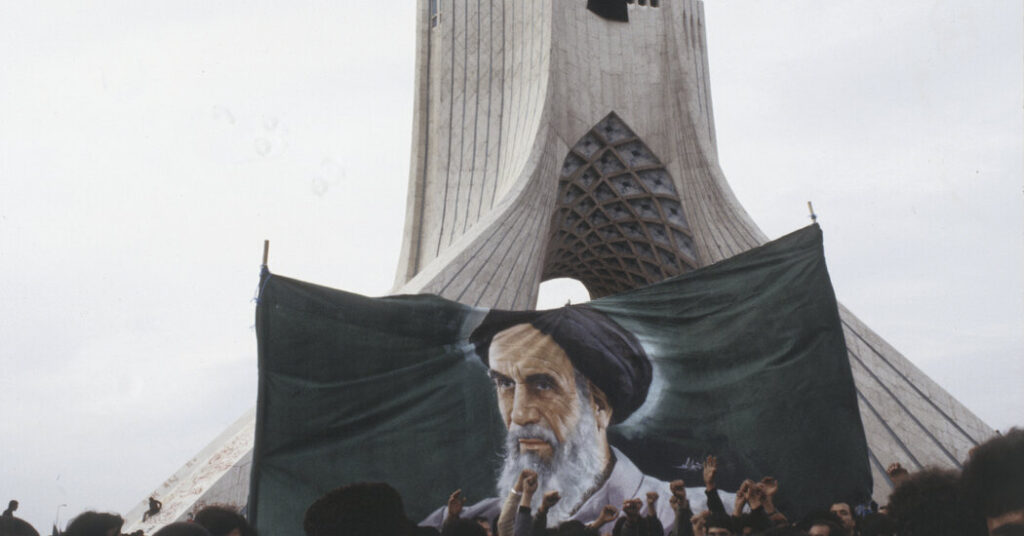
I want to start with the Iranian revolution, which begins in 1978 and topples the shah in early 1979. We remember it now as an Islamic revolution, but at the time, it had liberals, leftists, feminists, nationalists.
What did these groups want out of the revolution? And then how did it take the form it ultimately took?
The Iranian people had a lot going for them before the revolution. The country was prosperous economically. It had very good relations with the outside world.
It’s really stunning to think of it, Ezra, but the shah really didn’t have any serious enemies. Iran had good relations with the Soviet Union. It had good relations with the U.S. It was the strongest military in the Middle East.
Iranian society was opening up, and a lot was going for the Iranian people — except one thing: They didn’t have political freedom. The power was strictly in the hands of the shah and his political elites, who were also very much corrupt.
There was also this impression that he was a puppet of the United States, that he was not acting independently. That was an incorrect perception, but it was widespread among the population.
What happened was that there was a consensus formed that he should go, without really having a sense of what would come after.
Ayatollah Ruhollah Khomeini was seen as a transitional leader, not as the leader of the country in the future. He was clever enough to portray himself as a transitional leader. He did say all the right things before assuming power. He said that women would be able to have equal rights in society. He banned the clerics from having any role in politics.
This is why we had this extraordinary situation in which you had leftists and Maoists and Communists and conservatives and religious people — everybody coalescing around him as the leader of the revolution.
But, of course, as soon as he touched down in Iran and there were three million people on the streets welcoming him, he realized that his power was basically unchallenged.
At that point, he started monopolizing power, eliminating and purging the coalition that came together. And he established an Islamic republic in the form of a theocracy.
Very quickly from there, we have what gets remembered, at least in America, as the hostage crisis.
This is something that Donald Trump talks about in his video announcing and explaining the beginning of the war he has launched in Iran now.
Archival clip of Donald Trump: For 47 years, the Iranian regime has chanted “Death to America!” and waged an unending campaign of bloodshed and mass murder, targeting the United States, our troops and the innocent people in many, many countries. Among the regime’s very first acts was to back a violent takeover of the U.S. Embassy in Tehran, holding dozens of American hostages for 444 days.
What is that? How do you understand the decision to storm the U.S. Embassy as both a political decision and as a historical event, resetting American and Iranian relations?
That is a seminal moment because it created a rupture in Iran-U.S. relations that has not been healed in the past 47 years.
Archival news clip: The U.S. Embassy in Tehran has been invaded and occupied by Iranian students. The Americans inside have been taken prisoner.
Archival news clip: The students want the deposed shah returned to Iran for trial.
The U.S.’s first response to the hostage crisis was to impose sanctions. Iranians wanted those assets released, wanted the shah to be returned to Iran to stand trial, and wanted the United States to recognize their independence and promise not to interfere in their internal affairs.
But it really goes back to another event — to 1953, when the U.S. and the U.K. helped topple the popular government of Mohammed Mossadegh, the Iranian prime minister, who had nationalized Iranian oil.
Archival news clip: Iran, where the government of Premier Mossadegh with pro-Red tendencies is overthrown by royalist supporters of the shah. Iran, with its rich oil resources, focal point of dispute with the British, is strategically important to democracy. Mossadegh held power at the crossroads of conquest in the very heart of the Middle East.
Therefore, there was always this sense of vendetta among segments of Iranian society against the United States.
So the embassy hostage crisis was an opportunity for Iran to demonstrate that it no longer was going to be subjugated to the United States. It also allowed Khomeini to appropriate all means of power in Iran.
He wanted to get rid of the more moderate forces of Iranian politics. And he used the embassy crisis to do that. The entire government resigned, and he could bring his own people to power.
I think it’s important to stop on what you said a minute ago about the U.S. and the U.K. participating in a coup in Iran.
As we unspool this story, there can be a sense in America that we are hated by the Iranian government for no obvious reason. But the counternarrative is that there has been a longer war of America and the West against Iranian self-determination.
I’d just like to hear you talk for a minute about how those dueling senses of: Who started what? — and: Who has what interests here? — have persisted and shaped the decisions of the actors for decades now.
It’s a very good point, Ezra, because I think it’s important to understand that Iran was one of the only countries in the world that did not become a colony of a Western power.
There is a very strong sense of Iranian nationalism. In the same way that the Chinese have this Middle Kingdom thinking, that sense of Iran having its own dignity and pride is really built into the DNA. That created resentment toward the United States that then again showed itself in 1979.
Some of these historic events have a long tail, especially when you’re dealing with ancient civilizations. They have long memories. It is important to understand that many in the U.S. might not even know what happened in 1953, but every schoolchild in Iran has heard of this event, and it is sort of built into their psyche.
To your point that the history has a long tail here, even now — it seems unlikely — but one of the people being talked about for a leader in Iran, if the current regime collapses, is the shah’s son, who is in exile, has become a more popular opposition leader, has a better relationship with Israel and is more favored by the West.
I don’t think that many people think it would work to install him, but you’ve certainly heard that hope voiced quite often by people who wish that the current regime would fall.
Absolutely. And there is precedent. Reza Pahlavi’s grandfather, Reza Shah Pahlavi, founder of the Pahlavi dynasty, came to power with British interference in another coup in the earlier 20th century. His father was restored to power by the United States. And now he’s trying to regain power through help from Israel.
This is why, even if a formula like this succeeds — which, I agree, is a low chance — we have to see these short-term gains in the longer perspective of how often they come back to haunt us.
Let me bring us back to the hostage crisis. How does Iran and the Ayatollah Khomeini ultimately agree to give up the hostages?
This, again, has a lot of patterns that have been repeating themselves throughout these years.
They engaged in negotiations, and talks dragged on until President Reagan was inaugurated. Just a few minutes later, he released the American hostages.
Archival news clip: Now Day 1 of Ronald Reagan’s presidency and Day 1 of freedom for 52 Americans. The new president had not been in office an hour when the former hostages became free men and women again.
But the U.S. did not deliver on its promise of not interfering in Iran’s internal affairs and did not deliver on its promise of returning most of Iran’s frozen assets.
There’s an odd pattern that recurs here. There is this tendency for Iran to act in ways that empower the right-wing of the countries that they’re in conflict with.
Reagan was going to be, in many ways, much more hard-line over time than Carter was. Iran has, in many ways, been central to Benjamin Netanyahu’s career, and, certainly, some of the proxies that Iran has funded did a lot to try to destroy the Oslo Accords and the peace process.
What is behind that?
I think it really can be boiled down to: What comes around, goes around. Hard-liners on all sides feed each other. They empower one another.
It’s not just that the Iranians have empowered the hard-liners in the West or in Israel, but the other way around is also true. In the 1990s, the reformist president Mohammad Khatami started on a conciliatory tone toward the United States. Khatami was discredited.
The same happened to Hassan Rouhani with the nuclear deal in 2015 — he was burned by that. And that gave way to more hard-line Iranians coming to office.
It is, unfortunately, a pattern in which this enmity has become institutionalized — in a way that always benefits the hawks on all sides more than the moderates who have tried to change course.
As the hostage crisis is ending, another thing is beginning: Saddam Hussein, the then leader of Iraq, invades Iran in 1980. It’s complicated, but the U.S. basically backs Iraq.
Take me through both that war and U.S. policy in that moment and in that era.
I was growing up in Iran at that time, and my first memories are of the Iran-Iraq war. It was also the formative experience of most of Iran’s leadership.
It was an unequal war in the sense that Saddam was clearly the aggressor, and he was backed by almost the entire region and world powers, whereas Iran was alone.
Of course, all revolutions want to export their model, and almost always they create a backlash. If you look at the French Revolution, the Russian Revolution, they always scare neighboring countries and mobilize them to try to nip them in the bud and prevent them from spilling over their borders.
Iraq is another country with a majority Shia population, ruled by a Sunni minority at the time. So Saddam felt threatened, but he also saw an opportunity. This was a revolutionary regime that had come to power, had the biggest American arsenal in the region, but it was purging and killing a lot of U.S. trained pilots and generals and commanders. And it appeared that it was not in a position to be able to fight back.
So Saddam went in thinking — kind of similar to Putin’s calculation in 2022 in the Russia-Ukraine war — that this would be a quick win. Iraq was also supported by other Arab gulf monarchies because they were afraid of a revolutionary system in Iran, a republic and a system that had politicized Islam. So they all saw Saddam and Iraq as a shield to contain this Iranian system.
For the United States, it was also a means of containing Iran, making sure American weaponry would be degraded and not used by jacobins in Iran.
That sense of strategic solitude really framed and shaped Iranian strategic thinking for years to come. This concept of having proxies away from Iran’s borders to deter attacks on its soil was really born out of this sense of strategic solitude.
That is the beginning of Iran’s own ballistic missile program. It was desperately trying to fight fire with fire.
What’s important to understand about that war is that it actually helped consolidate the power of an infant revolutionary regime, which was undergoing a lot of turmoil. A lot of the purges that we talked about before were happening in conjunction with this war.
Economically, Iran was on its knees. The price of oil had dropped significantly, and Iranian oil facilities were targeted. It was a very, very dark and difficult period. And yet it not only survived the war, it also consolidated the revolutionary system.
This is the first war in almost 250 years in which Iran didn’t lose territory. It didn’t win territory, but it also didn’t lose anything. That created a narrative of martyrdom, of sacrifice, that really consolidated the regime’s power.
You mentioned a minute ago how something that people are hearing a lot about now — Iran’s ballistic missile program — has its origins in that moment. There’s something else they’re hearing a lot about now: The Islamic Revolutionary Guard Corps was formed by that war.
Tell me about the I.R.G.C., how it emerged and what it became over time.
When the revolutionaries came to power, the moment of the revolution’s victory was the moment when the shah’s army declared itself neutral in the fight between the state and the society.
The United States did play an important role in convincing the army — which was trained by the U.S. and modeled after the U.S. Army — to take a step back. But the Iranian revolutionaries didn’t trust the army. They thought it was too aligned with U.S. interests. So they had to create a parallel army to do their bidding, and that’s the origin of the Revolutionary Guard.
Even look at the title: Islamic Revolutionary Guard Corps. It doesn’t have the word “Iran” in it because it is really designed to safeguard the revolution.
They were really trained in the crucible of this horrible, traumatic war from 1980 to 1988, which was almost trench warfare similar to World War I — a dragged-out, terrible affair in which chemical weapons were used. It was just very, very ugly.
So it created very hard men with very fixed views about the world, the region, the United States, Israel and how Iran should safeguard its interests.
There’s another dimension of this in the 1980s that I think is worth bringing in: The Islamic Revolutionary Guards Corps gets very involved in Lebanon after the Israeli invasion of Lebanon. It begins to support and help with what becomes Hezbollah.
At the same time, Israel is also, in the ’80s, selling weaponry to Iran. So there’s a complicated relationship going in both directions here that I think defies the way we think about the relationship today.
What was happening between Iran and Israel in the ’80s?
I don’t think Israel saw Iran, immediately out of the gate, after the revolution, as an existential threat. In fact, Saddam was a bigger threat to Israel.
There is this famous saying: It’s too bad that both sides can’t lose in this war.
In the initial phases of the war, when Iraq actually had significant territorial control in Iran, and the Iranians were using their bigger numbers to try to push back, but they were not succeeding, Israel believed that it would be useful to try to change the balance and make sure that the Iranians would not lose.
Part of the broader arrangement that turned out to be the Iran-contra scandal, which has its own complicated story.
But it is really after the fall of Saddam as a serious threat to Israel, after the first gulf war, that Israel’s threat perception about Iran changes . To a large extent, Saddam was neutralized, but Iran was still standing and was becoming more aggressive toward Israel and was putting in place all the tools that it needed to carry on that challenge to Israel’s power in the region.
By that time, Iran also has a different leader. Khomeini dies in 1989. Ali Khamenei becomes the second supreme leader. Who is he at the moment of that elevation, and how does he become the successor?
He’s an absolute underdog. He’s the president of the country at that point, but someone whom nobody took seriously because the presidency was a symbolic position. There are these famous stories of Khomeini chastising Khamenei in public speeches, and Khamenei going to the roof of the presidential palace and crying out loud because he was humiliated.
The second most powerful man in Iran after Khomeini was Akbar Hashemi Rafsanjani, the speaker of Parliament, this very wily statesman, sort of like Cardinal Richelieu, the éminence grise of the system. He’s the one who ends up becoming the kingmaker. He makes Khamenei the next supreme leader. He says that Khomeini was very close to him and had designated Khamenei as his successor. There’s no evidence to back that up, but everybody believed Rafsanjani at the time because he was so powerful.
Long story short, Khamenei becomes supreme leader because Rafsanjani believed that he would remain an underdog, and Rafsanjani would be able to run the show without much challenge from Khamenei. Khamenei wasn’t even an ayatollah when he became a supreme leader, so they had to make him an ayatollah overnight.
But Khamenei turned out to be a calculating, very clever man, who over several decades managed to outwit and outwait everybody else in that system. Because he didn’t have the right religious credentials, he quickly looked for another source to back up his power. That became the Revolutionary Guards. This is why he started militarizing Iranian politics in ways that Khomeini had actually banned. Khomeini had banned the Revolutionary Guards from entering into politics.
It’s really an extraordinary turn of events how Khamenei managed to sideline Rafsanjani and everybody else. He reached the pinnacle of power in a way that no other Iranian ruler did. Not even the shahs of the recent past had that much institutional power.
I think it’s easy, doing the kind of work I do, to focus endlessly on the institutional maneuverings of people in power. But what is life like for Iranians at this point? What are the divisions of Iranian society?
We’ve gone in just a decade or two from, as you say, a very modern country with good relations with the outside world, a revolution, the Iran-Iraq war and incredible amounts of suffering and death — to now, when you have this I.R.G.C. and successor government.
What is life like? What is life becoming like for Iranians? How has it changed?
Look, the 1980s were really dark. There was repression at home. There was a war of aggression against the country. It was a terrifying period.
But in a decade after one of the most popular revolutions in the world, the system still had sufficient good will and support to move forward. But people wanted the change to become much more institutional.
This is why, in an upset election in 1997, they opted for gradual change rather than radical, revolutionary change by voting for a reformist president. When Mohammad Khatami was elected — that’s the first election that I voted in and the last election I voted in [laughs] — there was a real sense of hope that he was saying all the right things, he wanted to do all the right things.
From that point on, I would say it was a downward spiral because the deep state in Iran, by that point represented by Khamenei and his office and the Revolutionary Guards, were absolutely against reforms.
You can understand psychologically where that came from for Khamenei. He came to power in 1989, when the Soviet Union was falling apart because it had opened the door to reforms. So Khamenei’s view was that if you start playing with the pillars of an ideological system, the whole thing will unravel.
So that’s the beginning of ruptures between state and society. The society wanted gradual reforms, but the fact that Khatami’s experience ended in failure, I think, was the beginning of a lot of people losing hope in this regime’s ability to change course.
Bill Clinton is president in the United States for most of the 1990s, and his focus in the Middle East is on the Israeli-Palestinian peace process.
You’ve already had the Oslo Accords. Iran enters into this picture, funding terrorist attacks in Israel through Hamas and others meant to destroy the peace process, meant to destroy Oslo.
Why?
One has to understand that, again, going back to the Iran-Iraq war, Iran realized that one of the few ways that it could project power beyond its borders, as a Shia nation surrounded by Sunnis, as a Persian nation surrounded by Arabs and Turks, was to pick up a cause that would allow it to transcend all of these inherent limitations. And that was the Palestinian cause, which was left on the ground by the Arabs.
That’s why, as of the early 1980s, Iran became the champion of the Palestinian cause.
Israel’s invasion of Lebanon in 1982 provided Iran with an opportunity to create Hezbollah in Lebanon. And then, with the attack in Beirut that killed 241 U.S. service members, Iran saw its first impressive victory.
Archival clip of Ronald Reagan: I have no regret at the fact that we went in there to try to bring peace to that troubled country.
Which was that someone as hawkish as President Reagan packed his bags and left the region.
Archival clip of Reagan: We are redeploying because once the terrorist attacks started, there was no way that we could really contribute to the original mission by staying there as a target, just hunkering down waiting for further attacks.
So any solution to the Palestinian cause that would not include Iran and its interests, by definition, would be a threat to this agenda. This is why Iran was trying to sabotage any solution along those lines.
The fact that processes like the Madrid conference, for instance, which explicitly excluded Iran, played into those fears that whatever comes out of this would be at their expense — and therefore they should try to prevent it from happening.
Is your understanding that the Palestinian cause for them was geopolitical? Was it a case of rational self-interest? Or was it ideological, and their ongoing support reflected values-based commitments, as opposed to geopolitical calculations?
I do believe that it had an ideological veneer, but deep down it was a geopolitical instrument — that the Iranians were willing to fight Israel to the last Palestinian or the last Arab, but they really did not care much about the Palestinian cause.
And this is why you see the rupture between Iran and the P.L.O., for instance, over the years. It was very clear that Iran was instrumentalizing the Palestinian cause for its own interests.
I feel like there is this tension that you see emerging here and also in the way we talk about Iran here.
There’s a vision of Iran you’ll hear from the American right and from mainstream Israeli society, which is that Iran is an Islamic theocracy. It is a society that remembers itself as an empire and is patiently and strategically plotting to find its way back to that level of power.
And the counter you’ll hear to that is: No, it’s a rational regime that is oriented toward survival. It calibrates its diplomacy, its projections of power, its actions in order to survive, to thrive, to protect itself. It should be understood as someone you can negotiate with.
And in consistently funding attacks on Israel, and to some degree against America, too, it is making itself the target of the world’s sole superpower military and the strongest military in that region — even as other countries in the region are cutting deals and beginning to moderate relations.
So how do you understand this tension between the vision of Iran as focused on regime survival and the Iran that is consistently making itself an irritant, an aggressor and a target for Israel and the United States by funding proxy attacks and terror?
It is a very pertinent point, Ezra. It’s a question of this double identity in Iran’s strategic thinking: On the one hand, it plays like any other chess player in a strategic manner, but there is also an ideological element.
A very good example is the story of its engagement, or lack thereof, with President Trump. A lot of other countries, including Kim Jong-un, North Korea’s leader, figured out how to cater to President Trump’s ego — how it actually doesn’t take much to try to open up a channel of communication with him and change his perspective on the country.
And yet the Iranians were not able to do so because of that ideological rigidity.
I think one of the main criticisms of the Iranian regime is that there have been eras or episodes in the last few decades when it failed to capitalize on its leverage and doubled down in a way that actually ended up not only burning its leverage but also hurting itself.
There have been instances, for sure, that one can understand — during the Iran-Iraq war or when the U.S. had invaded their neighbor to the east, Afghanistan, and their neighbor to the west, Iraq — that they felt so insecure, that they were doing something that was destructive but that they saw as critical to their national security.
But then there have been periods when they were not that insecure. In the run-up to Oct. 7, they were pretty powerful and well-established in the region. They could have negotiated, for instance, with the Biden administration from a position of strength and found a way out of the deadlock. But they didn’t.
And that, too, has a long history. It’s very Persian, I have to say. Just to give you a few historic anecdotes to help you understand the mentality: In Isfahan, there was an attack, which has damaged parts of on a Safavid-era palace, a UNESCO World Heritage Site. And it has a magnificent fresco at its entrance. It’s about a war between the Iranians and the Ottomans called the Chaldiran conflict. It is such an epic painting.
And if you don’t know, you wouldn’t realize that this is a war that the Iranians lost. What the painting is showing you is not about the victory; it’s about the courage and the valor and the fact that the Iranians were outnumbered and outgunned and nevertheless did fight and tried to defend their country.
But I think this gets to an important, fundamental point, which is this question of: What does Iran want?
When I speak with Israelis — and these are not just Israelis on the right, these are Israelis on, certainly, the center left — they will say: You Americans do not understand Iran. You do not understand this country. Iran does not just want to survive as a regime. It does not just want a stronger economy. It does not just want better relations with the West. If it wanted that, it could have had that long ago. It ultimately has ideological and imperial ambitions. And as such, deals will only ever be temporary, and they will only be in the regime’s interest.
That comes across in this moving back and forth that you’re describing here, between acting like any other geopolitical chess player at the chessboard and these more ideological moments. It’s not just that they’re projecting power out or trying to take up the Palestinian cause — but they’re imperiling, arguably, their own regime.
And so the Israelis have said to me for a very long time — and I think this helps explain Benjamin Netanyahu’s position on Iran — that when they hear “Death to Israel,” they take Iran seriously. They take it at its word. And in their understanding, there is no safety for Israeli society and the Israeli government so long as the Iranian regime, as it has been composed in these decades, persists.
I think you can’t understand this war and how hard Netanyahu has been pushing for it for so long without understanding that. So it raises this question of whether or not he and the Israelis were right.
There is no doubt that what the Iranians might see as defensive could be seen as offensive from the Israeli point of view. There is no doubt that we are in a vicious cycle. Whatever Israel does deepens Iran’s threat perception and pushes them to double down on policies like their missile program or their support for proxies — which then deepens Israel’s threat perception. That, in turn, would then drag the U.S. further in and put more pressure on Iran to engage in covert operations and sabotage and so on. That, again, deepens Iran’s threat perception. And the cycle goes on.
The way that Israel and the West have largely treated Iran in the past four decades can really be summarized in one word, which is “containment.” The real question is: Has it resolved the problem or made it worse?
It’s a very simple question. And even by Netanyahu’s own metrics, the problem has become worse. The nuclear program he has been warning against for many, many years: When he went to war last year, he said it had become an intolerable, existential threat. In June last year, he said that he had set back Iran’s missile program. Eight months later, he’s back at war because the missile program is now an existential threat.
So again, it’s a question not necessarily of the concept — I’m not challenging that. I understand why the Israelis see Iran as an existential threat. I understand why the Iranians believe that Israel is a threat to them.
But I’m talking about the means of trying to resolve the problem. And again, throughout the past 47 years, with the exception of a very short period of three to four years, we have tried tools that have not worked — or made the problem worse. And I think we should learn from that experience.
You mentioned the Iranian narrative that much of what looks as an offensive to the rest of the world to them is understood as a defensive. Iran does not understand itself as a threat to Israel. But Israel and — to some degree, particularly right now — America is a threat to Iran.
So if I were talking to a member of the Iranian government, and they were giving me their narrative of this or trying to persuade me that the Israeli narrative is wrong: How is the support for Hamas, the support for Hezbollah, some of the actions we see in this period, understood in the Iranian perspective? How is the race to nuclear weapons seen as defensive, as opposed to offensive?
It’s very simple. They would say: The proof is in the pudding.
When Hezbollah had hundreds of thousands of rockets and missiles aiming at Israeli population centers, Israel did not dare attack Iran. When Iran was powerful in Syria, there were no routes for Israeli fighter jets to come and bomb Iran through Syrian airspace.
So their argument is that actually this policy worked and protected them for a long time. And now that their regional deterrence has been degraded, this is why Israel is coming after them.
If you talk to Iranian officials, they would say that the reason they were locked into this pathway — there was basically a path dependency — was because they never saw a viable alternative. It is not as if they were willing to give up on their proxies or whatever Israel found threatening, whether it’s their missiles or their nuclear program, that the world would then recognize them, would allow this theocracy to thrive in the way that Arab gulf states have, that all of these were aimed at undermining and toppling them.
Nobody was willing to give them conventional weapons to be able to defend themselves. Nobody ever recognized that they had some legitimate security concerns. And so they had no choice other than to continue down this path. That’s the argument that they would make. And even in areas that they had compromised, like on their nuclear program, it resulted in the U.S. not delivering on its promises.
And, of course, that’s just one example. There are multiple other examples, as well. The Iranians helped release U.S. hostages in Lebanon in the 1990s. And the George H.W. Bush administration didn’t deliver on its promises to them. Bill Clinton sanctioned them and canceled the oil contract that they had put on the table for U.S. companies.
Barack Obama didn’t fully deliver on sanctions relief. Joe Biden, with whom they had a prisoner deal — as part of which there was a humanitarian arrangement that moved $6 billion of their assets from South Korea to Doha, Qatar — pulled the plug on their ability to access that money after Oct. 7, even though the money had nothing to do with Iran’s regional policies.
So there is a long list of reasons that they would bring up to say: This was always existential from the other side, as well, and so we had no choice other than doubling down.
There seemed like there was this moment where things could change.
After Sept. 11, Iran is, for a moment, on the side of the U.S. It’s offering intelligence. It’s against the Taliban and Al Qaeda.
Colin Powell, then the secretary of state, shakes hands with the Iranian foreign minister at the U.N. And Sept. 11 was a geopolitically disruptive event, and a lot can change in the aftermath.
So what was happening then? And how did that set of possibilities, if you think they were real, fall apart?
So the story of Iran-U.S. relations is really a history of missed opportunities — and is replete with misunderstandings. And this episode is one of them.
It’s quite stunning that there was a real opportunity for a new beginning. Now in retrospect, it is really quite something when you think about the fact that Qassim Suleimani, then the commander of the Islamic Revolutionary Guard Corps expeditionary force — the Quds Force — was the first man to arrive in Afghanistan to prepare it for U.S. fighter jets to land, in the operation to get rid of the Taliban. This is the same commander that President Donald Trump assassinated in 2020.
But Iran believed that by cooperating with the United States — even at the military level, the intelligence level, to get rid of a common foe — it would be the beginning of a new chapter.
And then, all of a sudden, President Bush, in his 2002 State of the Union address, designated Iran as a member of the “axis of evil.”
Archival clip of George W. Bush: Some of these regimes have been pretty quiet since Sept. 11. But we know their true nature. North Korea is a regime arming with missiles and weapons of mass destruction while starving its citizens. Iran aggressively pursues these weapons and exports terror, while an unelected few repress the Iranian people’s hope for freedom. Iraq continues to flaunt its hostility toward America and to support terror.
Archival clip of Bush: States like these, and their terrorist allies, constitute an axis of evil, arming to threaten the peace of the world.
And that shut the door to further improvements of relations.
North Korea responds to the “axis of evil” speech by accelerating its nuclear program and eventually tests a weapon that is now a nuclear power.
The U.S. invades Iraq, which had no nuclear weapons. Later on, Libya will give up its nuclear program and Muammar el-Qaddafi will eventually be decapitated from power in U.S. airstrikes and will die in a ditch.
So how do the nuclear experiences of other countries that are named in the “axis of evil” end up shaping Iranian politics and thinking?
So that’s not linear, in the sense that Iran revived its nuclear program in the mid-1980s, during the Iran-Iraq war, primarily out of fear that Saddam Hussein was going to use nuclear weapons against them. He had already used weapons of mass destruction in the form of chemical weapons and was believed to be developing nuclear weapons.
But, you see, based on U.S. intelligence, the organized Iranian push to develop nuclear weapons stopped in 2003. What happened in 2003? Saddam was toppled, a threat was gone.
So that’s the first phase in Iranian calculation: that the immediate threat was gone, but they could now continue to hedge their nuclear policy, basically develop this dual-use technology, put all the elements together. And then maybe at some point down the road, if they needed a nuclear weapon, it would be a quick political decision to cross the Rubicon and develop a nuclear program.
They also used their nuclear program as leverage at the bargaining table with the West, to try to get sanctions relief. This was way before they saw what happened to Qaddafi, and way before they saw how North Korea was treated with a tremendous amount of respect by President Trump.
And this is why I do believe that now that they have gone through this experience, especially with the Ukraine war — that Ukraine also gave away its nuclear arsenal in return for security guarantees, only to be invaded by Russia — that Iran has concluded that they’ve paid the price of a nuclear bomb as the ultimate deterrent, both economically, through years of sanctions, and also from a security perspective of being attacked.
And I think that the religious edict that Ayatollah Ali Khamenei had against nuclear weapons probably died with him. And if this regime survives, and if his son remains the supreme leader at the end of this war, I almost have no doubt that the regime will be determined to try to develop nuclear weapons. Because every president that you look at historically, in addition to their own experience, teaches them that’s the only way to try to create a shield for their own survival.
I want to come back to that thought, but I think before we sit there for a moment, we should talk about the effort — a nuclear deal — which you had some role in helping to negotiate or trying to bridge the gaps on. This happens under Obama, and happens after the Bush administration after there’s an Iranian effort to have negotiations with the Bush administration that is sort of ignored in 2003.
Obama comes in. He has promised a different approach to Iran.
Archival clip of Obama: Rather than remain trapped in the past, I’ve made it clear to Iran’s leaders and people that my country is prepared to move forward. The question now is not what Iran is against, but rather what future it wants to build. I recognize it will be hard to overcome decades of mistrust, but we will proceed with courage, rectitude and resolve.
Take me through the thinking that leads to the Joint Comprehensive Plan of Action.
That doesn’t happen until 2015, so there’s a lot of preparatory work and a lot of thinking that goes into it before that. But what is the basic orientation of the Obama administration toward Iran?
Look, I think in his first term, President Obama listened to those who were telling him Iran doesn’t respond to pressure.
It responds to huge pressure. And so if you mobilized the international community to put massive financial sanctions on Iran, cut them off from the U.S.-dominated global financial system, bring international sanctions against them — even the Russians and the Chinese, if they join at the U.N. level to impose sanctions — eventually the Iranians will come to their knees. They would accept giving up on having access to nuclear fuel-cycle technology, which is a dual-use technology with which you can fuel reactors or nuclear weapons.
Toward the end of his first term in office, I think President Obama was smart enough to understand that it’s not going to work — that a pressure-centric approach without an open door, and without some sort of a reasonable endgame, is an exercise in futility. He decided to change course and sent William Burns and Jake Sullivan, to Oman for secret negotiations with the Iranians, during which he made the first concession.
That concession was that, for the first time since the beginning of the nuclear crisis in 2003, the U.S. agreed that zero enrichment is not a realistic policy goal. It allowed Iran to have a very limited, but very tightly and rigorously monitored, nuclear program on its own soil.
That’s what eventually led to the Joint Comprehensive Plan of Action in 2015. But between 2011 and 2015, it took a long time and a lot of work to get to that stage. But that is what made the difference.
What was the theory of the Joint Comprehensive Plan of Action? I think to the extent that people followed this, even in America — which I think most people didn’t — it was hard to know what to think of it, because people disagreed on what it did or didn’t do.
It was sold as a deal that would prevent Iran from getting nuclear weapons. It was criticized as a deal that would be unable to prevent Iran from getting nuclear weapons. Israel’s main interest in all this is that Iran doesn’t get nuclear weapons, but they were aggressively opposed to the deal under Netanyahu.
And Netanyahu did everything he could to scuttle it.
Archival clip of Netanyahu: This deal won’t be a farewell to arms. It would be a farewell to arms control. And the Middle East would soon be crisscrossed by nuclear tripwires. A region where small skirmishes can trigger big wars would turn into a nuclear tinderbox.
What was in the J.C.P.O.A.? What was the actual technical approach? And what was the broader theory of it?
The J.C.P.O.A. is a 159-page, very complex document. But it really boils down to a very simple bargain: nuclear restrictions and transparency measures in return for economic incentives.
That’s really it. And Iran agreed to limit its nuclear program, roll back its nuclear activities, ship out 98 percent of its stockpile, dismantle most of its centrifuges — to accept the kind of inspections that no other country in the world has ever accepted. It made itself an exception to the norm.
Among the nonproliferation treaty member states, you already have two classes: nuclear weapon states and non-nuclear weapon states. Iran agreed to create a category of its own, in terms of restrictions and transparency measures that it had agreed to.
So this guarantees that Iran would not be able to have a nuclear weapon for at least a period of 15 years. But a lot of these restrictions had sunsets, meaning that they would expire after a period of time. And that is because no country would ever be willing to make itself an exception to the norm forever.
That is giving up a right, internationally, that again, a regime that had come to power based on the concept of trying to safeguard Iran’s independence, went through a very bloody war in which it lost half a million of its people in order not to lose an inch of the country — it didn’t want to give away that right.
And the J.C.P.O.A. did secure that right. But it meant that the can was only kicked down the road. The problem was not resolved forever.
The other problem with it was that it didn’t really address other areas of disagreement with Iran about its ballistic missile program, about its proxies. At the time, I used to say: The good news is that we have a nuclear deal; the bad news is that we only have a nuclear deal.
But the concept for the Obama administration was that you resolve the most urgent problem. Then maybe, based on that, you can build trust and improve relations and then try to address other areas of disagreement.
But we never really got a chance, because the deal was implemented in January 2016. President Trump was elected in November of that year. And as soon as he walked into the Oval Office, he started undermining the agreement.
So when you say the agreement guaranteed that Iran would not get a nuclear weapon for at least those 15 years — one thing that Republicans said was that they’ll just do it in secret. They’ll create secret facilities, they’ll be underground. We won’t know where to inspect.
So what were the safeguards there?
So the entire nuclear inspection regime, since World War II, has always been designed to look at the fissile material — nuclear material with which we can make a bomb. For the first time, in the J.C.P.O.A., mechanisms were defined to also look after the equipment — so every nut and bolt that goes into the centrifuges, which would enrich uranium, or any other machinery involved in Iran’s nuclear program.
There were online smart detectors. There were inspectors who had access to them around the clock.
There was no way that Iran would be able to cheat. And when the deal was being implemented for — as I said, from January 2016 until Iran started rolling back its commitments a year after the U.S. withdrew from it, so that’s May 2019 — the International Atomic Energy Agency conducted very rigorous monitoring and issued quarterly reports.
So there were about 15 reports in this period. And in all of them, the I.A.E.A. confirmed that Iran was fully committed to all of its obligations under the agreement.
Now we can choose not to believe the I.A.E.A., but even the U.S. intelligence, even the Trump administration’s own intelligence officials, were saying that there is no evidence of Iranian divergence from the agreement. Whereas, of course, the same could not be said about the United States.
So there’s also a political theory to the deal, which is that it was the beginning of trying to create a different relationship over time between the U.S. and Iran. It would pull Iran further into the international system, unwind some of the sanctions so there’s more economic development, maybe strengthen moderates inside the regime.
How did you think about that side of the deal — and some counterfactual history, where Hillary Clinton wins the 2016 election, and there’s time to build on it? Do you think that there was another possible path there?
There’s also, of course, those who say this would have just given Iran money and time to strengthen proxy networks. It would have given it more freedom to pursue expansionistic objectives.
How do you think about what was possible — and what was not possible — building on that deal?
I’ll tell you how I perceived it. In my view, Iran, at the time, was a country that, despite years of sanctions, mismanagement and corruption, still had a middle class that was about 65 percent of the Iranian society. And the Iranian middle class, for anyone who has been in touch with them, is extremely open-minded, pro-Western, even pro-American, despite the years of being subject to anti-American propaganda by the state.
It’s moderate, and it’s basically the best ally in that part of the world. And my concept was that if you get 5 percent economic growth over a period of 10 years, you can grow this middle class from 65 percent to around 80, 85 percent. And that would coincide with the time that the ruling elite of the Islamic Republic, the original Jacobins of the 1979 revolution, are dying out just by the force of nature.
So you have a situation in which these two lines will cross one another, and the country by definition, would be in a better position to transition to something better. Even if that transition requires a degree of upheaval. So that was the concept.
That was the theory of change. It wasn’t supposed to, magically, in a year or two, make Iran change all of its policies, but it was supposed to put the two countries on a better pathway in which eventually, with building trust, they would be able to address other areas of disagreement — so that when Khamenei would die, there would be enough material to work with to put the country on a better trajectory.
When Trump wins the election, he — somewhat over the objection of some in his own administration — rips up the deal and begins a policy of what he calls “maximum pressure.”
Archival clip of Trump: We will be instituting the highest level of economic sanction. Any nation that helps Iran in its quest for nuclear weapons could also be strongly sanctioned by the United States. America will not be held hostage to nuclear blackmail.
So we’ve talked about the theory of the J.C.P.O.A. What is the theory of “maximum pressure”? What is the substance of that policy and what is the political thinking beneath it?
I think the theory of “maximum pressure” was once very clearly described by Mike Pompeo, the former secretary of state, who said Iran should reach a stage where it should choose between feeding its own people or continuing the policies that are problematic from the perspective of the United States.
That really turned the concept that I was describing to you on its head, fundamentally. In the sense that it really weakened the middle class and strengthened the hard men in the Islamic republic.
And in this period, again, according to the United States State Department and the intelligence community, the Revolutionary Guards have become even more powerful than before. So we completely changed the dynamics, weakened our best allies and strengthened our worst adversaries in that system through “maximum pressure,” which was supposed to bring Iran to its knees.
Now the Iranians not only didn’t surrender, but they doubled down across the board. They doubled down on supporting proxies, they became more aggressive in the region — more repressive toward their own people.
They resumed their nuclear program, first gradually and then really ratcheted it up significantly. It reached levels that we could not even imagine in the past — again, enrichment to 60 percent or having advanced centrifuges. Which, eventually, of course, ended up in the conflict that we’re currently in.
One of the rupture moments in the Middle East that I think leads to where we are now in this period is, of course, Oct. 7. Hamas is understood by many to be an Iranian proxy — not fully under Iran’s control, but Iran is a major funder of it.
What to your understanding now is the relationship between Iran and the Oct. 7 operation? How much did Iran know? Did they give it the green light? What was the communication between them and Yahya Sinwar? Because that explodes all of this.
Right. So this is precisely when you can see the major shortcoming of Iran’s policy, as a state, to subcontract its regional foreign policy to nonstate actors. Because they have fundamentally different interests at the end of the day.
And you could see that Ayatollah Ali Khamenei, very quickly after Oct. 7, came out and tried to create distance, even though he supported Hamas.
But he wanted to say Tehran was not involved. But the reality is that it really was a distinction without a meaningful difference by that point. Hamas was clearly in the Iranian orbit — clearly financed, trained and supported by Iran. By that point, Israel was going to go after not just Hamas but everybody who supported Hamas.
And so Israel was going to come after Iran, and Iran had failed to adopt its strategy accordingly. Not realizing that the so-called “octopus doctrine” was already in place, as of 2021, way before Oct. 7: of going after not only Iranian arms in the region but the head of the octopus by targeting Tehran directly.
The Iranians failed to adopt their strategy — at every point they miscalculated. They either responded in a bold way when they had to be cautious or were too cautious when they had to be bold. And this created the circumstances that led, eventually, to this war.
When you say they miscalculated, what was the nature of the miscalculation?
What did they not understand about Israel, or what did they not understand about Donald Trump?
They did not want to be here. What was the misperception that led them to miscalibrate?
It’s a series of miscalculations. But let’s start with the fact that in 2023, the Iranians were trying to put in place a mechanism that they called the ring of fire, which was this concept of being able to open four fronts against Israel all at once. The concept was that this would be so difficult for Israel to deal with that it would never be able to project power beyond its immediate near abroad.
They tested this concept in April 2023. And the Iranians concluded that they were not ready. They were not there yet. And of course, they failed to communicate that to Sinwar, and they failed to hold Sinwar back.
One explanation was that the elimination in 2020 of Suleimani, who had personal relations with a lot of these leaders and the so-called “axis of resistance,” this network of proxies that Iran has in the region, and who had the charisma and the authority to be able to push them in the directions that he wanted, did provide more space for freelancing for people like Sinwar. That was the first mistake.
The second mistake was that, although Khamenei took distance from Oct. 7, he did endorse it. And he did not try to hold Hezbollah back from entering into this conflict because Khamenei was subcontracting a lot of these policies to Hassan Nasrallah, the leader of Hezbollah. He truly believed in his strategic vision, and he thought that as an Arab in that part of the world, he understood it better than the Persians 1,000 kilometers away. That, too, I think, was a mistake.
Then, the biggest mistake of all: Israel started going after Iran’s assets in a much more aggressive way, especially in Syria, and went higher and higher up the ranks, killing commanders in the field. Eventually, in April 2024, they targeted Iranian consulates in Damascus and killed senior Iranian military officials who were there. That’s the moment that Khamenei decided to put aside his cautiousness and become bold.
He fired hundreds of missiles and drones toward Israel, for the first time a direct attack from Iranian soil toward Israel. And that opened the path to direct confrontation with a military power that is much more capable and much more superior than Iran. Which I think — and again, in retrospect — was a major mistake.
He did it in a way that it also didn’t really signal strength. It just signaled willingness to cross a red line. But he telegraphed it in advance so that there would be minimal Israeli casualties and fatalities so that this doesn’t escalate.
Again, if you put them together, these are all a chain of miscalculations that led to Khamenei’s killing at the beginning of this war.
And what is happening with the nuclear program during this period?
So during this period, the nuclear program is advancing very quickly. The Iranians, again, in a major miscalculation, failed to revive the agreement with the Biden administration.
I mean, there’s plenty of blame to go around. Biden, I think, missed an opportunity to revive the deal in the short overlap that he had with President Rouhani, who had negotiated the J.C.P.O.A. in 2015. He postured and was too hesitant, and that burned a lot of bridges with the Iranians. And then in 2022, the Iranians and the Russians were responsible for not reviving the agreement.
But since then, Iran quickly accelerated its nuclear program. And every time Israel tried to set it back through sabotage or covert operations, the Iranians doubled down on accelerating the program.
There is a metric in the J.C.P.O.A., which is the so-called breakout time — this is the amount of time that it takes to enrich enough uranium for a single nuclear weapon. That timeline, when President Trump walked into the Oval Office in 2017, as a result of the J.C.P.O.A., was more than 12 months. In January 2025, when President Trump walks into the Oval Office, that timeline is six days.
I’ve never quite understood what this breakout line means, if I’m being honest. Because if the timeline is six days, and Iran’s leaders have, on some level, concluded that there is safety to be found in having a nuclear deterrent, that’s January 2025. They’re not attacked for at least some months after that. So why didn’t they just run over the line? Or is the six-day line not everything you need for a nuclear weapon?
You’re right. This is like having the ingredients for a cake — you still have to bake it into a cake. That’s the weaponization process that takes six to 12 months, depending on which timeline you want to believe, and depending on whether you want to have a crude nuclear device or a more sophisticated one. But that can happen in secret in any facility, in any underground laboratory.
The part that could be monitored is the enrichment part, which was done under the I.A.E.A. supervision. That’s why the breakout time was important — we were trying to prevent the ingredients from being prepared. We knew that the weaponization part would not be done in a visible way.
So then, on some level, is Donald Trump, right? That the only way to stop Iran from going nuclear is to attack, first the 12-day bombing that we saw some months ago and now what we’re in?
Or were these negotiations that were happening on and off — most recently with Jared Kushner and Steve Witkoff — could they have succeeded? Was there still a diplomatic path that was viable, or was that over now?
I’ve looked at some of the briefings that Jared Kushner and Steve Witkoff have done since the end of the negotiations, and I’ve now concluded that these negotiations were always doomed to fail. They went in expecting not a complex, technical deal, but a yes or no kind of answer from the Iranians.
I was shocked that Steve Witkoff was surprised that the Iranians were able to manufacture their own centrifuges. He describes one of Iran’s advanced centrifuges — the IR-6 model, which is a pretty powerful centrifuge — as probably the most powerful centrifuge in the world, which is not true. So the technical understanding was never really there.
The patience to find solutions that would be mutually tolerable and presentable was never really there. They often didn’t even take experts with them to these negotiations. So they were not serious, they were not professional. And it was not going to work unless and until Iran was willing to capitulate, and that was never on the books. So in retrospect, I think these negotiations could have never worked.
But let me ask a counterfactual question, which is: What if the Trump administration had sent more serious negotiators? What if, instead of Trump’s real estate buddy and his son-in-law, he had sent — under Marco Rubio, the State Department does have a lot of expertise. There are people there. They could have sent a special envoy who had more experience with this question.
Would the Iranians have been open to that? Do you think there was openness on the Iranian side? Or do you think, in addition to the Trump side not being that serious about negotiations, that the Iranians at this point weren’t that serious?
I mean, they had watched the Trump administration tear up a diplomatic agreement they had made with the Obama administration. They were now under tremendous pressure from Israel and the United States. Maybe they were biding time, and they would eventually one day say: Well, the negotiations have failed, and we have a weapon now.
That was certainly Israel’s view on what would happen.
Well, I do believe that the Iranians were actually desperate for a deal. I base that, again, on experiences I’ve had with this process. It’s been very rare for the Iranians to come up with their own initiatives. You can ask any European or other negotiator who has been involved in this process. They often prefer to react to other people’s ideas. And yet, in these negotiations, they were coming up with one working paper after another, putting ideas on the table in the hope that it would work.
I do believe that they were willing to give President Trump way more than they gave President Obama. Maybe not last year, but certainly this year. And he could have gotten a better nuclear deal if he wanted to.
But again, it was not about marginal improvements. It was about Iran surrendering to America’s terms. And from the Iranian regime’s perspective, the only thing that was more perilous than suffering from a U.S. strike would have been surrendering to U.S. terms.
Again, all of this history — the raison d’être of this regime — of safeguarding Iran’s independence, of not being subjugated, especially by an American president — all of that would be undermined. For a regime that, in the process, over all these years, has also lost its core constituents — starting from that very high point of popularity at the beginning of the revolution, to a point that it now relies on maybe 5 percent to 10 percent of the Iranian society who constitute its core constituents — it cannot afford to alienate them. Because then it has nothing to stand on. That’s why it could not ever afford to capitulate to the United States.
But if Trump wanted a better deal than what Obama got, that was certainly on the books.
I think part of Trump’s calculation — I mean, he said this explicitly — is that the Iranian regime was under tremendous pressure at home, as well.
It wasn’t just Israel. It wasn’t just America, although the sanctions from America were meaningful here. There were huge protests. The Iranian regime had killed thousands of Iranian protesters just in January.
And there was a sense, certainly in America, that it was weak enough that if America pushed, if it bombed, if it began to destroy and degrade the regime’s capacity to exert force, that there might be another revolution. Trump explicitly invited the Iranian people to rise up and take their government back.
So what can be said right now of the relationship between the state and the society? You say this is a regime with only 5 percent to 10 percent support by this point. Now it’s a regime that doesn’t have much support and does not have the leadership it has had for some time.
Is it weak? Will it crack? Is there some possibility of an Iranian revolution coming from the ground?
This is now an example of an American miscalculation. It is true that the Iranian regime, especially with its recent act of massacre against his own people, created the kind of rupture that is really irreparable.
Nevertheless, it is a regime that is very entrenched and is also deeply benched. One has to understand that there are two elements that keep this regime in place. One is the fact that its political elite and security establishment don’t see a Plan B, don’t see an exit ramp, don’t see a day after for themselves. These are not the shah’s elite who had their villas in Côte d’Azur or in the Swiss Alps or in Southern California. These people have nowhere to go.
Second is that with bombs and missiles, of course you can degrade ministry capabilities and kill political leaders, but you cannot manufacture a viable political alternative. And that alternative does not exist in Iran today. There is no opposition with a ground game, with organizational capacity.
For these two reasons, regardless of how weak the Iranian regime is or how hated it is, it is very difficult to get rid of it, especially through the sole use of air power, without boots on the ground.
Iran’s strategy since the beginning of this assault has been to expand the war in both time and space. They cannot effectively strike Israel or the United States, but they can strike Bahrain, they can strike the U.A.E., they can strike Dubai.
So they are setting much of the Arab world on fire, which is, I think, destroying many of their relationships.
There also seems to be some schisms in the regime around this. There was an apology from one leader, but they’re continuing the missiles and the drones.
How do you understand that strategy? What do they get out of that or not get out of that? Is it working for them? How would you assess where we are at this point?
I think the Iranian strategy can be summarized in this way: They know that they’re outgunned, but they think that they can outlast Israel and the United States.
It is true that the U.S. and Israel, as the world’s most powerful army and the region’s most powerful military, have the upper hand in terms of inflicting pain on Iran. But the Iranians believe that they have a higher threshold for pain.
The 12-day war last year: Iran lost about 1,000 of its citizens, and yet it portrayed that war as a victory because it survived. If there were a thousand American or Israeli casualties, there’s no way that this could be portrayed as a win.
And this time, the Iranians, I think, based on the lessons of the 12-day war, decided to escalate in a horizontal manner and spread the pain — not just to the rest of the region but to the global economy.
That has resulted in energy prices shooting up, and this is only because the export of energy out of the region is disrupted now. If this crisis continues and production is also affected — either because countries would have to shut down production as storage spaces fill up or if production facilities are targeted and destroyed — and then you have long-term shortages in the market, definitely, the price of oil would go above $200 a barrel, and that will be an economic disaster for the world.
And it’s a policy that is also based on stretching out the timeline. Based on the 12-day war, they realized that there is another shortage — a shortage of interceptors to shoot down their ballistic missiles and drones.
So in the first few days of this war, they have tried to deplete the gulf states’ interceptor arsenal as quickly as they could, as well as Israel and the United States, so that once they bring out their more powerful missiles, they can hit targets much more effectively and end the war on their terms.
Now this is their calculation. I am not sure if it stands the test of time. It is quite possible that the U.S. might be able to completely neutralize their retaliatory capacity, especially against Israel, by taking out their launchers. So it might turn out to be another Iranian miscalculation.
But one thing that they can do over a long period of time — and we’ve already seen this move in Ukraine — is that they can probably continue to fire drones into the gulf states and target shipping through the Strait of Hormuz. And the only way that the U.S. can maybe stem this is to invade the southern shore of Iran and put boots on the ground. And that has obvious political and human implications of its own.
For now, the Iranians, I think, believe that this has turned into an attritional conflict and they have more staying power than the United States and Israel.
But even if it ends more or less in the way that it did last year, which is that both sides would come up with a narrative of victory, when President Trump decides to pull the plug, he would say: I killed the supreme leader. I degraded Iran’s ministry and nuclear capabilities. The problem is solved for the foreseeable future.
And the Iranians will declare victory just by the fact that they survived. But that would create a very unstable situation, which is vulnerable to opening up again a few weeks or a few months down the road.
Well, that’s the situation I’ve been wondering about.
If the war ended in the near term with a bit more degradation of Iran’s military capabilities, but fundamentally, with this regime, now operating with Khamenei’s son as its leader, then what is left behind here?
What has been achieved? What kind of regime do you think that might turn out to be?
Well, I think if, at the end of this war, all President Trump has been able to achieve is to replace one Khamenei with another and leave behind a country that is wounded and angry and determined that this should never happen again, it’s a very dangerous situation. We still have a stockpile of almost half a ton of 60 percent enriched uranium, which is enough for 10 nuclear warheads and four Hiroshima-type rudimentary nuclear weapons and dozens of dirty bombs.
And I don’t think the way this war ends would take care of that problem unless there’s some sort of negotiated settlement at the end of it, which at this point looks very unlikely. That problem is still there. And as I told you, it is quite possible that the younger Khamenei might decide that his father was wrong about hesitating to take the last step of going for the ultimate deterrent and might try to do so. And that, in and of itself, could be the cost of life or another attack.
So this can go on for much longer. And obviously, it’s very unsettling to the gulf countries, which would like to see stability in order to fulfill their long-term plans for economic development. If this regime stays in place, it would also be a stab in the back to the Iranian people, to whom President Trump promised that help is on the way — but who has only managed, again, to leave behind a wounded and angrier and probably more aggressive and repressive regime in place. So it would be a very difficult outcome.
It kind of reminds me of where things ended up with the first gulf war, in which Saddam was defeated but remained in power. And during that period, from 1991 to 2003, the name of the game was containment. It was imposing sanctions and weakening Saddam.
But in that period, the fabric of Iraqi society was torn apart. So even when Saddam was forcibly removed, it became very difficult to put the country back together. And again, America paid a very high price for that — in blood, treasure and reputation.
Are there other pathways though? I look at where things are now, the Iranian regime does not appear to be on the verge of collapse, and it’s not clear what that would mean. There’s not some organized opposition rising up to hand power to.
You could imagine things cracking in a way that created internal conflict, civil wars, factional battling. But the idea of some smooth transition to some other regime does not seem viable to me.
Or is there something I’m missing?
No, I think your skepticism is well placed. I think President Trump’s ideal scenario — and he has said this repeatedly, and that’s why I’m characterizing it in this way — is a Venezuelan model, in which he says everybody kept their job except two people.
The problem in the case of Iran is that in Venezuela, I think the administration started the negotiated transition prior to the taking of military action. Whereas now, that kind of negotiation would have to ensue military action.
And there’s very little trust because President Trump has burned Iranians three times now: He got out of a deal with them in 2018, he bombed them in the middle of negotiations last year and this year. So no Iranian official, I think, is going to trust him. He also humiliated Venezuela in the way that he portrayed himself as the new president of Venezuela on Wikipedia and forced Venezuela to sell its oil to Israel instead of Cuba.
All of those things would make it very difficult for any Iranian politician to think that they would be able to survive bending a knee to President Trump. If he had played it in a smarter way, maybe there would have been a viable Venezuela scenario. But I don’t think that’s really available.
So all we are left with is either Iraq post-’91 — or continuing this and ratcheting it up in ways that we haven’t seen so far during this conflict, in a way that would actually break the state. Of course, the U.S. has the power to do so. But then, what that leaves behind is probably Libya post–Gaddafi’s removal, in which you would have the country breaking apart along ethnosectarian fault lines or in between rival generals, similar to what is happening in Sudan right now. That would be a disaster for the rest of the region and world security, as well.
All that’s left, as some sort of soft landing, is a cease-fire now, followed by some more reasonable negotiations aimed at either a series of smaller deals that would be beneficial for both sides or an out-of-the-box idea in which political change is also put on the table.
As much as that’s hard to imagine at this moment, if the Iranian regime survives, it would have a really hard time governing. I mean, these people were really struggling to keep the lights on even prior to the war. And now, with the cost of this conflict, it would be very difficult for them to govern.
So survival is certainly victory from their perspective, but it’s not enough for sustaining themselves. And that’s when there will be potentially a chance for some sort of negotiations. But again, it would require a fundamentally different approach that President Trump, so far, has demonstrated no sign that he has the appetite or the ability to pursue.
And then, there is another great power competition element here, Ezra, that I will add to the table. I’m afraid that if Iran survives this, which is not a mean feat — I mean, it’s a David and Goliath kind of situation — if they survive it, I think Russia and China will start looking at Iran in a different way.
We know already Russia has been helping Iran and targeting U.S. assets in the region. We know China has been providing Iran with weapons and with financial support. But they haven’t really gone the extra mile of trying to go all in supporting Iran as a shield against the United States and against U.S. domination of the Middle East. The majority of hydrocarbon resources in the world are located there and will be for the foreseeable future.
That, too, is not necessarily a good outcome, because it turns Iran into an arena of great power competition — without the United States having any plan other than containment.
So you’re saying that, in much the way that the United States thinks Russia is now bogged down in Ukraine, that Iran could look to Russia and China as an opportunity to bog down the United States in an unending conflict that would distract us, that would take our missiles and our interceptors, and that would spend down our capital.
Other Arab states are not happy about what is happening to them. You don’t have to have ground troops to be engaged in a quagmire of sorts.
Precisely. And there is also another consideration here, which is that as much as the Arab gulf states and Iran’s neighbors are angry at Iran for firing at them — and they’re also angry at the United States, by the way, for starting this — they’re also worried about a region in which there is no power left to challenge Israel’s ability to project its influence and power beyond its borders.
They were against Iranian hegemony, for sure. But they’re also uncomfortable and against Israeli hegemony in the region. They see the collapse of Iran as the last obstacle to that prospect. This is also another thing that one has to consider with regard to what comes next.
America really seems to have entered into this — forget an endgame — without an actual plan.
Trump’s initial video invited the Iranian people to rise up. There’s been some talk about arming the Kurds to have a sort of ethnic insurgency.
I think we do care if there’s a civil war or an out-migration crisis that destabilizes nearby regimes. We do have relationships with these other Arab states that very much do not want that to happen.
But I cannot actually, for the life of me, tell what Donald Trump thought would happen, and what he now believes will happen.
I couldn’t agree more with the way you’re reading it, Ezra. I think the U.S. followed Israel into this and was hoping that the day after would arrive very quickly and would magically work in a way that things would be better and the problem would solve itself.
And hope is not a strategy. The U.S. does not have a strategy for the day after.
And the game, I think, is very clear on the Israeli side. Whatever comes out of this, if Iran is weak and wounded but still standing, that’s fine. There will be enough reason to “mow the lawn” again a few months down the road.
If the regime collapses and the country descends into civil strife, that’s also fine. That’s too far away from Israel. Others would have to deal with the consequences of refugees or instability spilling over borders.
If, magically, the Iranian monarchy is restored, or Iran rejoins the Western orbit — well, so be it. That’s fine, too. Whatever outcome comes out of this, I think Israel is comfortable with.
But the United States has not thought this through. It’s not aware of the long tail of events that we started this conversation with, about how short-term victories, even if they are achievable — and at this point in the conflict, I’m not even sure of that — sometimes come back to haunt you down the road.
I think that is the place to end. Always our final question: What are three books you’d recommend to the audience?
The first book I want to recommend is called “The Persians: The Age of the Great Kings” by Lloyd Llewellyn-Jones. This is a really interesting book because most of the histories that have been written about ancient Persia have been based on Greek sources. What this author has done is actually go to the Persian sources. And you see how the history recounted through the original references and Persian books is actually quite different than the way that the Greeks perceived Iran.
It helps you also understand that a lot of the problems that we’re talking about, Ezra, in this episode are not new, that Iran has always been the other of the West, this bellwether state that the West has had difficulty understanding, whether they were Greeks or Romans or Ottomans or Europeans and so on.
The second book is “The Mantle of the Prophet: Religion and Politics in Iran” by Roy Mottahedeh. It also does something rare: It adds texture to Iranian society and helps you understand post-revolutionary Iran with all of its contradictions and societal trends and culture. It really defies this caricature of things being black and white. And how sometimes U.S. policy completely papers over all of these things, and that’s why it results in the U.S. committing mistakes.
And, finally, is a book that is not about Iran but fits into this trend that these conflicts endure when every side clings to their own narrative, whether it’s victimhood or virtue. It’s called “Tomorrow Is Yesterday: Life, Death and Pursuit of Peace in Israel/Palestine” by Hussein Agha and Robert Malley.
One thing I really appreciate about this work is that it helps you understand how, in complex situations like this, there’s plenty of blame to go around, how tragedies that happen are not often the result of one side being evil or making a mistake, but that there are plenty of mistakes by everyone that lead to the kind of Gordian knots that we are unable to untie.
Ali Vaez, thank you very much.
Great pleasure.
You can listen to this conversation by following “The Ezra Klein Show” on the NYTimes app, Apple, Spotify, Amazon Music, YouTube, iHeartRadio or wherever you get your podcasts. View a list of book recommendations from our guests here.
This episode of “The Ezra Klein Show” was produced by Jack McCordick. Fact-checking by Michelle Harris with Kate Sinclair. Our senior engineer is Jeff Geld, with additional mixing by Isaac Jones and Aman Sahota. Our executive producer is Claire Gordon. The show’s production team also includes Marie Cascione, Annie Galvin, Rollin Hu, Kristin Lin, Emma Kehlbeck, Marina King and Jan Kobal. Original music by Aman Sahota and Pat McCusker. Audience strategy by Kristina Samulewski and Shannon Busta. The director of New York Times Opinion Audio is Annie-Rose Strasser. Transcript editing by Sarah Murphy, Andrea Gutierrez, Filipa Pajevic and Marlaine Glicksman.
The Times is committed to publishing a diversity of letters to the editor. We’d like to hear what you think about this or any of our articles. Here are some tips. And here’s our email: [email protected].
Follow the New York Times Opinion section on Facebook, Instagram, TikTok, Bluesky, WhatsApp and Threads.
The post What Trump Didn’t Know About Iran appeared first on New York Times.