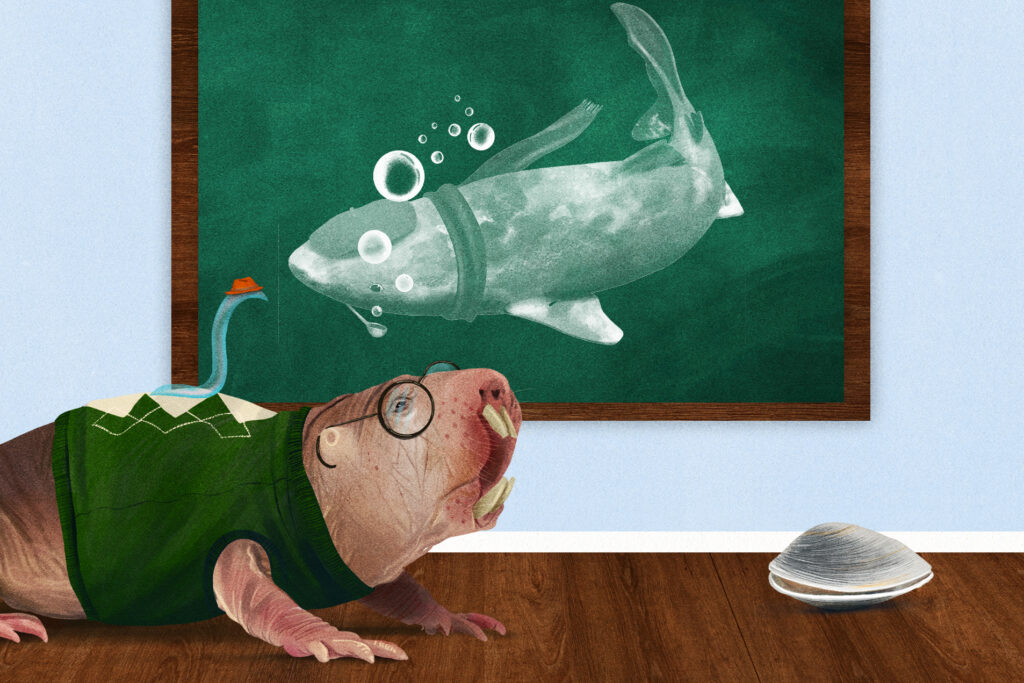
A humble mollusk can live to 507. The oldest Greenland Sharks navigate deep, dark Arctic waters for longer than America has existed. And the wrinkly, cancer-resistant naked mole rat can live well into its 30s, a veritable rodent Methuselah.
Human centenarians excite a deep fascination. What are their secrets? Do they eat breakfast? Skip lunch? Exercise every day? What genes helped keep them strong and disease-free, years longer than most people? But across the animal kingdom, evolution has given rise to much vaster age gaps — and a growing scientific quest to understand what a menagerie of creatures with the extraordinary ability to defy the ravages of time can teach us about to make human aging better.
For more than two decades, longevity researchers have been testing interventions to extend the lives of lab mice, a step toward antiaging drugs for humans.
“We can make mice live 30 percent longer. It doesn’t really work for anything greater than that — but if you look at the wild kingdom, you can find 100-fold differences within mammals that are similar to us,” said Vera Gorbunova, a biologist at the University of Rochester and a leader in the field.
Scientists like Gorbunova scour the natural world for exceptionally long-lived outliers, from beavers to bats to sharks, to learn more about how they stay cancer-free, resist infections or retain their eyesight for centuries. They also look for consistency — specific genes, proteins or enzymes that exist in a variety of animals and might be a basic component of long life.
“Nature has had several billion years to experiment with ways of making animals resist aging better,” said Steven Austad, an aging researcher at the University of Alabama at Birmingham and author of the book “Methuselah’s Zoo.” “If we look at animals that do things better than we do, maybe we could get some better clues about how to keep ourselves healthy longer.”
Roundworms
Clues about extending lifespan
For decades, antiaging research was a fringe area among serious scientists. Then, a tiny, wriggling microscopic roundworm changed the paradigm — showing lifespan was malleable.
In 1993, molecular biologist Cynthia Kenyon discovered that mutations to a gene called daf-2 in the roundworm C. elegans could more than double their lifespan, from 18 to 42 days.
Even after Kenyon published her striking finding, she recalled, there was skepticism that a complicated process like aging could be substantially affected by a single gene. What worked in tiny worms also seemed unlikely to hold true for more complex animals.
“Sure, genes control [lifespan], but there would be many genes. And each would have a tiny little effect — for the skin, the heart, the liver, the intestine, the brain,” said Kenyon, now vice president of aging research at Calico Life Sciences. “Just because you changed one gene, you get a liver that lives longer, it would be so many genes, so you’d never find them.”
In 1996, a research team discovered a gene mutation that caused dwarfism in mice could markedly extend the lifespan of a mammal.
“Once it became clear you could slow aging by relatively simple means, it was no longer considered silly to try to do that,” said Richard Miller, a biogerontologist at the University of Michigan.
Much of the energy in the field focuses on experiments to extend the lives of lab animals by severely restricting their calorie intake, giving a drug or creating mutants. But a growing cadre of scientists are interested how evolution pushes lifespan’s limits.
“It’s slowly becoming more popular, and it’s an approach that deserves to be popular,” Miller said. “The question is how often does extreme longevity — weird longevity — evolve? Longevity like us, and the porcupine and seabirds that evolves over and over again.”
Naked mole rats
Resisting cancer and other chronic diseases
A hairless, prune-skinned, mouse-size creature that spends decades living in dark underground tunnels may not conjure images of eternal youth, but the naked mole rat has long fascinated scientists. These weird rodents don’t generate their own body heat and can’t feel pain. But they can live well into their third decade, an order of magnitude longer than mice or rats.
They don’t just survive — they thrive. Usually, the risk of dying increases as organisms age (or senesce, in the parlance of biology). Brains and bodies fall apart. Naked mole rats, in contrast, display a characteristic called “negligible senescence.” They don’t decline. They reproduce well into old age, resisting cancer and other chronic diseases.
In 2011, scientists sequenced the genome of a naked mole rat, a first pass at trying to understand the factors that could give rise to its extraordinary longevity.
Ensconced in burrows, naked mole rats have lost a slew of genes involved with sensory functions, scientists found. But they also found genetic candidates that might contribute to their long lifespans or their remarkable ability to resist cancer.
Years of research into this one animal show that there is likely no singular cause of extremely long life. Longevity is tied to genes that have multiple functions, which reflect the particular lifestyle and environment of the animal. What makes one animal live longer could have negative consequences for another.
A study published in the journal Science last year found that four changes to the building blocks of an enzyme that’s part of the first line of defense against pathogens help naked mole rats repair mutations in its DNA. Fruit flies lived longer with those mutations. Scientists transferred the naked mole rat gene into mice, and they aged healthier — less frail, less gray hair and reduced markers of cellular aging. But there’s a flip side.
“With the naked mole rat being able to deal with DNA damage better — these are the same pathways for monitoring viral infections and foreign invaders into your cells,” said Ryan Tewhey, a geneticist at the Jackson Laboratory not involved in the Science study. “There are trade-offs.”
Bowhead whales
Repairing damaged DNA
Bowhead whales swim in cold Arctic waters for upward of two centuries. Weighing up to 200,000 pounds and stretching 62 feet long, their giant bodies put on display a conundrum called Peto’s paradox.
Larger bodied animals with long lives seem like they should be more prone to cancer — bigger bodies means more cells, and it’s a number’s game — over time, mutations accumulate. Eventually those aberrant cells can get out of control and seed cancers.
But they are not. A study last year in the journal Nature found that in the bowhead whale, cells have a remarkable ability to repair DNA, allowing its genetic code to stay intact and avoid getting jumbled.
First, spelling errors in the genetic code of the whales were slower to accumulate over time than in other mammal cells.
Then, when researchers tried to induce damage by cutting the DNA with CRISPR molecular scissors, their repair mechanisms were better than other mammals. A specific protein appeared to contribute to this superior repair, and when scientists increased production of that protein in fruit flies, they lived longer and were more resilient to damage from radiation.
Greenland shark
Keeping vision sharp for centuries
In 2016, scientists used radiocarbon dating to show that the oldest known Greenland shark was 392 years, plus or minus 120 years. Dorota Skowronska-Krawczyk, an associate professor of physiology and biophysics who studies vision and aging at University of California at Irvine, was watching a documentary about the sharks when she became fascinated by how well they appeared to follow the divers taking video of them.
The sharks had long been thought to have poor vision because of parasites that cling to their eyes and because they lived in dark waters.
“There is no way it’s blind,” she thought. Skowronska-Krawczyk studies the aging visual system, the first sense to decline, and she was curious how well these sharks could see in the first place — and how they kept the ability for centuries.
She emailed John Steffensen, a biologist at the University of Copenhagen, to ask if he had any samples of eyes that he could share. He had some in the freezer but also promised some from his next trip, which meant text messages to coordinate the logistics of getting shark eyeballs from Disko Island, Greenland, to her lab in California.
Her team discovered that the eyeballs of the shark, though they were over 100 years old, showed no signs of degeneration. They had only rods, the retinal cells involved in detecting light, and not the cone cells involved in color detection — suggesting an adaptation to the dark environment. The study, published in the journal Nature Communications in January, also found that genes involved in DNA repair were highly active, possibly giving a clue about how the shark’s vision can stay functional over so many centuries.
“The first question was how does the eye look? Is there any degeneration, anything about those eyes we can learn? More and more data were coming to the conclusion this was an extremely well preserved system for almost 200 years,” Skowronska-Krawczyk said. “This is actually guiding us toward thinking about therapies.”
Long-lived clams
Keeping proteins from getting tangled and clumped
Last year, a team of scientists received a National Institutes of Health grant to support their study of Arctica islandica, an outlandishly long-lived clam. In its thick, rounded shell, this species can grow to about four inches in diameter and live anywhere from 35 to 507 years, buried in the muddy seabeds of the North Atlantic Ocean.
What does a clam have to do with human health? Matthew Harris, a genetics professor at Harvard Medical School, and Stephen Treaster, a group leader at the Gloucester Marine Genomics Institute, are particularly interested in the genetic and biochemical tactics the clam uses to subdue or suppress the changes that typically accrue with age.
They’re particularly interested “proteostasis” — the ability of proteins to remain stable over time, instead of getting misfolded and aggregating into clumps, which happens in many human neurodegenerative diseases. If they can unravel how the clam protects itself from these kinds of aging-related changes, they hope those insights could provide clues that could benefit human health.
“When you find something in science you grab hold and see how far you can take it,” Harris said. The goal is “betterment of health span — how our tissues can maintain themselves over time. … If we ask these questions in a clam, maybe there are some secrets that can be revealed.”
Rockfish
Highlighting the importance of evolutionary adaptations
It was interest in human diseases that led Peter Sudmant, a biologist at the University of California at Berkeley, to the animal kingdom. Cancer, neurodegenerative disease, heart disease: Aging was the common risk factor. He started to study aging itself.
“I tried to find species that are closely related, but with the largest difference in lifespan possible,” Sudmant said. He found them in the ocean.
“Rockfish are bonkers,” Sudmant said. Dozens of species of rockfish live off the West Coast of the United States, living anywhere from 11 to 200 years. They follow a bizarre form of growth called “indeterminate growth,” meaning they just get bigger and bigger each year. They don’t have menopause. A 150-year-old yellow-eye rockfish can have 1.5 million babies in a year — Sudmant calls it the “BOFFF” hypothesis — “big old fat fecund female” fish contribute most of the offspring to the population.
His laboratory’s study of 88 rockfish species found genetic pathways involved in immune responses, sensing nutrients and DNA repair seemed to play an important role in rockfish with longer lifespans. But the bigger takeaway from his work and others is that, as with naked mole rats, “longevity” is woven together with other evolutionary adaptations that allow animals to occupy their particular ecological niche. Larger rockfish that live in deeper waters tend to live longer than their smaller-bodied relatives, and the researchers found that genes that are involved in body size, for example, were also entwined with long lifespan.
Like many in the field, Sudmant is driven by curiosity and wonder at how different species use different molecular strategies to live long and healthy lives. He notes the GLP-1 drugs used for diabetes and obesity were inspired by a hormone in Gila monsters. The engine behind gene-editing, CRISPR, came from ancient bacteria’s immune systems. Why not, one day, an insight from rockfish that could help people stay healthy as they age?
The post What Earth’s longest-lived animals can teach us about aging better appeared first on Washington Post.