Thousands of satellites orbit the Earth, creating constellations that some space watchers like to describe as a mesh net around the globe. And it’s about to get more crowded up there.
Canada plans to launch hundreds of satellites as part of a national defense agenda that, since President Trump’s trade war began last year, has focused on lessening the country’s reliance on the United States.
Over the past few months, Prime Minister Mark Carney has been calling for the world’s middle powers — countries like Canada that are influential but not superpowers — to unite and renew relationships. He has discussed security and defense cooperation with Japan, Australia, India and, this week, Norway and Germany. Back home, Mr. Carney has promised more spending on defense.
Telesat, a satellite communications company whose headquarters are in Ottawa, plans to launch about 200 satellites next year and recently signed a deal with the government and another Canadian company, MDA Space, for systems to support the military.
But scientists are increasingly concerned that space, vast as it seems, is becoming cluttered with satellites and debris. My colleague Sachi Kitajima Mulkey, a climate reporter at The New York Times, wrote last month that greenhouse gas emissions were affecting Earth’s upper atmosphere in ways that could further increase the amount of space junk.
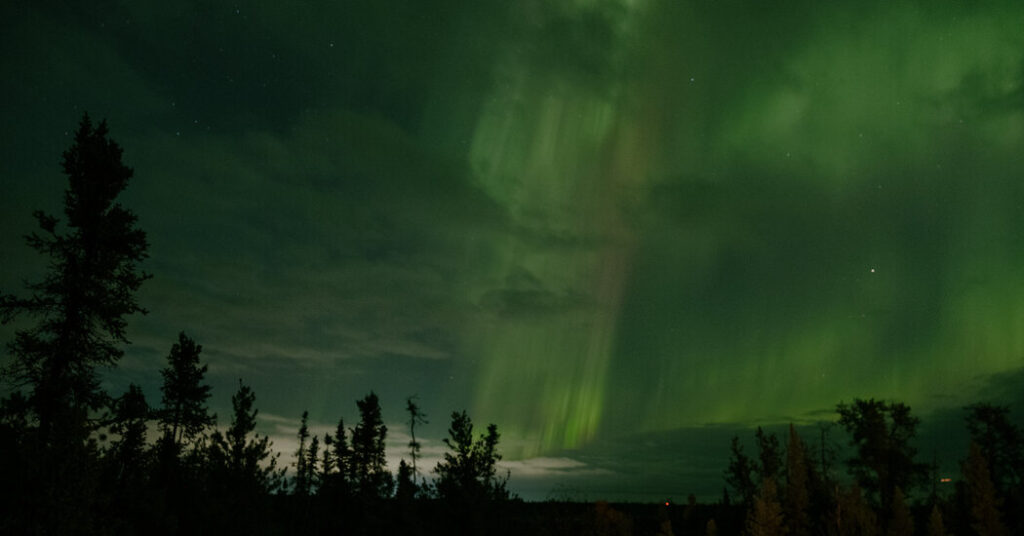
Most people can’t see this transformation in space because they live in light-polluted areas, said Aaron Boley, co-director of the University of British Columbia’s Outer Space Institute.
“You don’t see how the cosmos is changing globally as a result of this growth in satellites,” Dr. Boley said.
About two-thirds of the nearly 15,000 satellites in space were launched by SpaceX, the company owned by Elon Musk, to run his satellite internet service, Starlink.
Starlink is the dominant internet provider in Canada’s remote areas and has roughly 500,000 users in Canada, according to the company.
Launching domestic satellites would benefit the thousands of Canadians for whom Starlink access has been critical and even life-changing, Dr. Boley said — though he acknowledged that as an astronomer he had mixed feelings about firing more things into space.
“If something were to suddenly cause SpaceX to turn off communications with these communities that now depend on that service, we would have our own options,” he said.
Ontario took a step back from Starlink last year when Premier Doug Ford announced he was tearing up the province’s $73 million contract with the company, which would have delivered internet to First Nations reserves and around mining camps.
This week, Mr. Ford defended his decision to kill the deal, but the government said it wouldn’t reveal the fee it paid to end the contract.
Prime Minister Carney said on Thursday that satellites would be crucial pieces of defense equipment that support communications in the Arctic, where he intends to expand Canada’s military presence.
[Read: Canada to Expand Military Presence in Arctic, Following Trump Threats]
Mr. Carney made the announcement from the Northwest Territories, the first stop on his latest global tour focused on strengthening defense partnerships and touting Canada’s military muscle in the Arctic.
He traveled on Friday to Norway, where he observed a NATO exercise in the country’s Arctic region, and will head to the United Kingdom to meet with Prime Minister Keir Starmer.
Ian Austen, our Ottawa correspondent, is traveling with the press corps, having recently returned from Mr. Carney’s Asia-Pacific tour this month. On that trip, Mr. Carney reiterated Canada’s satellite push before Australian lawmakers.
“We’re working with other like-minded partners who possess similar capabilities to build out a deep, resilient, sovereign system that we can all share and we can each control in our territories,” Mr. Carney told them.
And here’s a little more news for space enthusiasts: NASA announced on Thursday that after some delays, it now plans to launch Artemis II, its mission to send four astronauts around the moon, on April 1. One of the crew members is Canadian: Jeremy Hansen, a former fighter pilot. Reporters from the Science desk will cover the launch from the Kennedy Space Center in Cape Canaveral, Fla., and I’ll be reporting from Toronto on what the mission means for Canada’s space program.
Talk to Us About Trade
Our bureau in Canada has been collaborating with colleagues in Washington and Mexico to cover the upcoming review of the United States-Mexico-Canada Agreement, the successor to NAFTA.
Ana Swanson, a trade reporter in Washington, is inviting readers to help us understand the influence of the trade deal on their lives.
“Whether you are a business owner, a farmer, a trucker, a customs broker or a particularly adept consumer, if you have experienced the effects of this trade deal firsthand, we want to hear from you,” Ana says. She’ll read every submission and pass the Canadian mentions on to us.
Fill out this form to send in your submission.
Trans Canada
-
I visited Mississauga, where I grew up, to tell the story of how a once-quiet neighborhood became an improbable hub for nightlife, dining and culinary tourism at a huge plaza called Ridgeway.
-
Two people died after donating plasma in exchange for money at clinics in Winnipeg. The deaths have raised concerns about the safety of frequent plasma donation.
-
Emily Baumgaertner Nunn, a health reporter at The Times, traveled to Alberta to report on the high rates of cancer among Indigenous people who live near oil sands tailings.
-
The Toronto-based company Thomson Reuters provides a surveillance tool used by immigration agents in the United States, drawing criticism from the company’s employees in Minnesota.
-
The Canadian director Ian Tuason made “Undertone,” his debut horror film about podcasters facing the supernatural, entirely in his parents’ home in Toronto. “That which you can only hear is terrifying,” writes Alissa Wilkinson, a film critic at The Times.
-
The mother of a student who remains in the hospital after she was critically wounded in the Tumbler Ridge shooting has sued OpenAI.
-
Police are searching for two men who they say fired shots at the U.S. Consulate in Toronto on Tuesday.
-
A day of ice fishing for a group of 23 Canadians began with a search for salmon and trout, but ended in a helicopter rescue.
-
More cold weather is expected across Eastern Canada.
Vjosa Isai is a reporter at The Times based in Toronto.
How are we doing? We’re eager to have your thoughts about this newsletter and events in Canada in general. Please send them to [email protected].
Like this email? Forward it to your friends, and let them know they can sign up here.
Vjosa Isai is a reporter for The Times based in Toronto, where she covers news from across Canada.
The post Canada Takes Its Sovereignty Push to Space appeared first on New York Times.