CAMAÇARI, Brazil — Colorado Road was never a place where much happened. Set off on the impoverished fringes of this obscure Brazilian city, it bore little of note beyond a small ballet school, a few sun-scorched shrubs and a row of humble dwellings hidden behind decaying walls — until one day in May 2024, when Daniela de Oliveira opened her iron gate and heard a ruckus across the street.
Dozens of Chinese men were getting off a bus and heading into a pair of squat two-story buildings at the end of the road. Oliveira assumed the outsiders had some type of meeting and would soon be on their way. She’d been inside the structures, painted dark green, and knew they weren’t nearly big enough to house them all.
But one day turned to the next, and soon Oliveira realized her new neighbors — 56 itinerant Chinese laborers, none of whom spoke any Portuguese — were here to stay.
As weeks passed, Oliveira’s curiosity deepened. Their food was prepared in an improvised kitchen in the garage, amid industrial detritus and vermin, and they never seemed to do anything for fun. All they did was work.
“Seven days a week,” Oliveira, 35, recalled. “Sunday to Sunday. I never saw any taking a day off.”
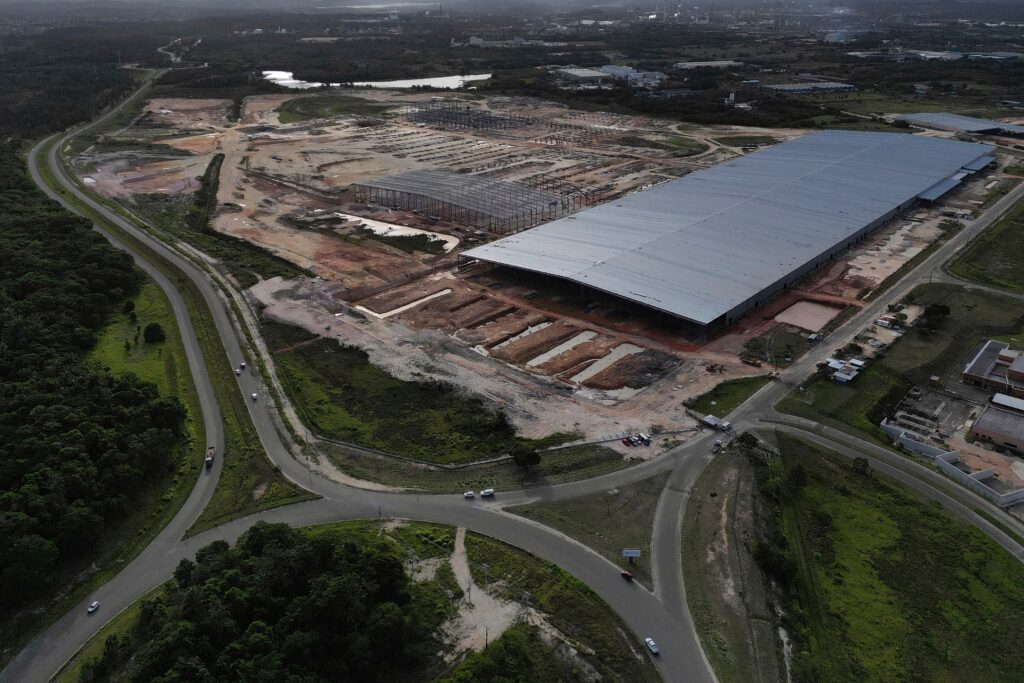
They departed every morning at dawn and didn’t return until dusk. The hours in between were spent helping to build Latin America’s largest electric car factory for the world’s biggest electric automaker, China’s BYD. Constructed on Camaçari’s Henry Ford Avenue, on land formerly used by the Ford Motor Company, the plant represented one of China’s boldest bets yet in its bid to control the future of automaking.
It also reflected China’s rise in South America and America’s receding influence. China has replaced the United States as the continent’s top trading partner, expanding its annual total trade from $8 billion in 2000 to more than $365 billion in 2024, according to the World Trade Organization. One of South America’s largest ports, in Chancay, Peru, was built with Chinese money. Chinese funds are bringing a metro line to Bogotá, Colombia, and powering a hydroelectric revolutionin the Amazon forest. And now its signature automaker has leapfrogged Tesla in global sales, owing in part to its rapid expansion in Brazil.
But the change has not come without human consequences.
One evening in December 2024, a phalanx of government cars descended on Colorado Road. Federal police formed a perimeter around the workers’ living quarters. Government investigators hustled inside. They were stunned by what they found.
Chinese men were inhabiting practically every square inch. Most slept without mattresses. Trash lay everywhere. Food was stored on the ground. In one of the buildings, 31 laborers shared a single bathroom; it was coated with an “excess of sludge,” government inspectors reported.
This went far beyond labor violations, the inspectors concluded. The workers enlisted by BYD to build its keystone factory in the Americas had been forced, they wrote, into conditions that recalled “slavery.”
The Washington Post reviewed more than 5,000 pages of court records in Brazil and China, and interviewed 41 people with direct knowledge of the case and labor conditions, including Brazilian investigators, former and current BYD employees, and workers who traveled here from the Chinese countryside in search of opportunity. They show how one of China’s most consequential international projects turned into a geopolitical clash over worker rights and human dignity.
The Chinese companies involved in the project have denied the slavery allegations and deemed them culturally insensitive.
The dispute has offered a rare glimpse into labor practices that advocates and scholars say Chinese firms often impose on migrant workers in far-flung locations, but which are normally obscured by patchy law enforcement, corporate secrecy, cultural misunderstanding, byzantine employment structures — and fear of Beijing’s rising power. Advocates have estimated that hundreds of thousands of Chinese laborers have suffered abuses while toiling abroad to realize the country’s global ambitions. But few had spoken to local investigators about it — until that evening raid in December, on the outskirts of Camaçari.
The laborers were sent back to China. Quiet returned to Colorado Road.
A ‘systemic fraud’
In May, following one of the most complex and politically sensitive investigations in its history, Brazil’s Public Labor Ministry accused Brazil BYD Auto and two of its Chinese labor contractors, China Jinjiang Construction Brazil and Tecmonta Intelligent Equipment Brazil, of “trafficking” manual laborers into the country and subjecting them to “conditions analogous to slavery” — defined in Brazilian law as forced labor, restricted freedom of movement and “degrading” conditions.
In a civil suit, authorities alleged BYD and its partners had preyed upon 220 vulnerable laborers — some of whom were illiterate — duping them with false promises of high pay. They were then pressed into punishing labor from which they could not escape. Many had their passports confiscated, prosecutors alleged, and much of their promised pay was withheld. At night, prosecutors alleged, they were locked inside fetid dormitories patrolled at times by armed guards.
The ministry sought $49 million in damages to compensate workers and fund improvements to labor conditions and social welfare.
“The company perpetrated a conscientious and systemic fraud,” labor inspectors wrote in one citation report that preceded the suit. They called it “a manifest affront to the principles of the dignity of human beings.”
Neither BYD’s corporate office in China nor the two contractors named in the suit responded to a series of detailed questions submitted by The Post.
In public, the companies denied the allegations and, striking a note of nationalistic umbrage, blamed mistranslations and unidentified forces conspiring against China’s rise.
“We have seen firsthand how certain external forces have maliciously worked together and deliberately slandered us in an effort to smear Chinese brands, smear China, and sabotage China-Brazil friendship,” Li Yunfei, BYD’s public relations director, wrote in late 2024 on the Chinese social media platform Weibo. “I trust that everyone can see clearly what has happened.”
The construction giant Jinjiang, which employed most of the workers who were freed by authorities, said on Weibo that the allegations were the result of “cultural differences,” “biased” questioning and “distortions” in translation. “The claims that Jinjiang’s workers were treated as ‘slaves’ and were ‘rescued’ are completely inconsistent with the facts,” the company said in a statement. The contractor Tecmonta has not commented publicly on the case.
In late December, the Labor Ministry signed a deal with the companies to work toward dismissing the suit. The defendants agreed to assume corrective actions and pay a combined $7.5 million — half to the laborers who allegedly suffered the abuses and the other half to funds of the ministry’s choosing. BYD, which would act as a guarantor of payments made by its labor contractors, federal prosecutors said, did not have to admit culpability as part of the agreement.
“There has been an agreement,” Marcus Pilão, a publicist representing BYD Auto Brazil, told The Post. “We consider the matter closed.”
Ford pulls out
In early 2021, workers at the Ford auto plant in Camaçari were optimistic. Their employer was the country’s oldest and most established American automaker. Its 102-year history in Brazil had included the construction of four car factories, the production of millions of cars and even a brief, disastrous episode in the Amazon rainforest, where Henry Ford tried to build a rubber plantation utopia.
The company was then on the cusp of rolling out an upgrade to its immensely popular EcoSport, which was forged in Camaçari and had become a bestseller across South America.
So Júlio Bonfim, president of the city’s powerful metalworkers union, wasn’t particularly worried when he was called to a virtual meeting that January to meet with Ford’s executive team. It didn’t take long, however, for him to realize something was off. The mood was funereal.
He texted a colleague: “I think Ford is going to pull out of Brazil.”
When the executives confirmed his premonition, blaming the coronavirus pandemic and an “unfavorable economic environment,” Bonfim imagined a “terrible crisis” for his city.
The automaker’s 2001 arrival in Camaçari — an historic get for Brazil’s impoverished northeast — had heralded a new beginning for the municipality, viewed until then as a provincial backwater on the periphery of the Bahia state capital, Salvador. Soon other manufacturers were coming to town. The population doubled to around 300,000 people — 12,000 of whom were employed directly or indirectly by Ford — and Camaçari became one of the region’s wealthiest cities, with expansive shopping malls and a thriving nightlife.
Ford’s departure threatened all of it. Mass layoffs shook the municipality. Tax revenue, officials said, fell by $25 million. Shops, private schools and health clinics closed. Roughly 60,000 workers in Camaçari alone were estimated to feel the impact.
“We need to form a delegation,” Bonfim recalled thinking.
He soon traveled to Brasília with other local business and political leaders. Their mission was simple: Find another automaker to take Ford’s place. They embarked on a tour of embassies — India, South Korea, Japan and, finally, China.
The delegation decided against visiting the U.S. Embassy. It seemed as if it would be a waste of time, Bonfim said. He figured America was done expanding.
“The Asian automakers are now the ones who are interested in Brazil and South America,” he said.
In July 2023, BYD bit — agreeing to take over the Ford plant and spend $620 million to build a colossal three-factory complex here. The company, founded by Chinese chemist Wang Chuanfu in 1995 as a battery manufacturer, was then using engineering wizardry and billions of dollars in government subsidies to become a leading manufacturer of electric vehicles. Its budget models — kept off America’s highways by high tariffs — were swarming roads from Bangkok to Tel Aviv.
But for all of its global ambitions, the company did not yet have a passenger car factory outside of Asia.
Camaçari would be the first.
Imported labor
After BYD said it had chosen this city as its launchpad into the Americas, Brazilian state and federal officials rejoiced, vowing to help realize BYD’s ambitions. In return, the Chinese company promised to bring jobs back to Camaçari and “prioritize” regional outfits in the construction of its mammoth project.
“We want to hire local labor starting this year,” Tyler Li, president of BYD Brazil, said in July 2023.
But instead, BYD turned to a Rolodex of Chinese construction firms. The list included its longtime business partner, Jinjiang Construction Group, which BYD had hired more than a dozen times since 2017 to help build electric car plants, renewable battery factories and BYD monorails in dozens of locations across China, according to statements from both companies and Chinese state media.
Laborers in China have sued Jinjiang repeatedly, court records show, alleging unsafe working conditions and unpaid wages. Many have lost, not because they couldn’t produce evidence — but because they couldn’t prove they worked for Jinjiang. The use of nebulous subcontractors is common across China’s construction industry, labor advocates say, shielding businesses from accountability.
“Many workers don’t even know who their legal employer is,” said Li Qiang, founder of the New York-based nonprofit China Labor Watch. His team recently interviewed 50 Jinjiang laborers working on the BYD factory in Hungary. In a letter to local authorities shared with The Post, the organization alleged “clear indicators of forced labor,” including 12-hour workdays and granting rest only when it rained.
For the Brazil job, BYD again deployed its network of foremen and labor recruiters, according to Brazilian court records and interviews. They targeted some of China’s poorest regions — places such as Hanzhong, a haze-cloaked city of 3.2 million people in the plains of Shaanxi province that has been hit hard by the country’s recent economic downturn. Nearly half of its working-age population has left to find jobs elsewhere.
In Hanzhong, recruiters found two longtime friends. One was Wang Gang, 37, a sober-faced man with a crew cut. The other was Li Xiaojie, 37, whose hairline was starting to recede. Both men recounted their experiences in rare, extensive interviews with The Post.
Wang said he needed the money. China’s real estate market had cooled. Construction jobs were harder than ever to come by, and they seemed to pay less and less. He’d never worked abroad, but with a young daughter to support, he said he had no choice but to gamble on Jinjiang and the BYD job.
Li had worked outside of China and believed the opportunity was as advertised: “The company and the foreman didn’t tell us about any risks,” he recalled. “I didn’t think there was anything to be worried about. My ability to adapt is really strong.”
The Jinjiang foreman, the men said, promised more than $2,800 per month, far more than they’d earn at home. And virtually everything, they were told, would be included in the package: visas, flights, accommodation and food. In early 2024, the friends went to the airport, among hundreds of migrant workers from across China en route to northeastern Brazil.
“I have to keep going through the hardship,” one worker wrote on social media, before repeating Chinese President Xi Jinping’s popular phraseon the importance of personal sacrifice: “Persistence is victory.”
‘A bomb waiting to go off’
Wang and Li arrived in a country that has responded to its notorious history with slavery by enacting some of the developing world’s strongest labor protections. Brazil, which in 1888 became the last country in the Americas to abolish slavery, now funds aggressive antislavery law enforcement, publishes an annual “dirty list” to shame violators and has taken on multinational corporations. In 2003, it expanded the definition of slavery to include “degrading” conditions, enshrining the right to human dignity in the workplace.
So when 500 or so Chinese laborers began streaming into the abandoned Ford property throughout 2024, the few Brazilian workers present grew increasingly nervous, according to interviews with six Brazilian BYD and Jinjiang employees. Most spoke on the condition of anonymity due to fears of retaliation. Many of the details of their accounts were confirmed by photographs or videos reviewed by The Post.
None of the Brazilians had ever seen laborers work like the Chinese. They often arrived around 5 a.m. — “well before the traditional hours,” one BYD staffer said — crammed into small cars so tightly that some were relegated to the trunk. On the job, they took risks that Brazilian workers said they could scarcely believe, braving dangerous heights without safety equipment, or working perilously close to heavy machinery. “It’s like they’re not scared of danger,” one worker said. Some donned little protective gear and walked around barefoot.
“I saw some working in just their underpants,” one worker recalled. “Their underpants.”
Three Brazilians said they saw Chinese bosses strike their subordinates. Video reviewed by The Post appeared to show one foreman violently kicking a bottle at a worker as he lay on the ground. Reached for comment, the foreman said the worker had laid down deliberately following a disagreement.
Laborers toiling in the heat were driven to the point of collapse, Brazilian co-workers told The Post. One day, Luzinalva da Conceição Santos said, she saw several asleep on top of a table. She tried to communicate with them through Google Translate.
“I asked, ‘Are you tired?’” she said. “And they said, ‘Of course, we’re working Sunday to Sunday. We have to come.’”
On Dec. 1, 2024, according to labor inspectors, metalworker Pan Gao’s hand was crushed in an accident and one of his fingers was amputated. Another laborer named Wu Lei broke his left leg — an open fracture — that same Sunday. A few days later, a carpenter identified as Tang Faquiang suffered a mishap with a chainsaw and lost full function in his right hand. He later told investigators he’d been exhausted. The Post was unable to reach the injured men.
Li told The Post that the treatment laborers received was determined largely by luck and caprice. Some foremen were lenient; others were brutal. His friend Wang said that his was in the latter group. The worker felt tricked and trapped. There was a marked difference, Wang said, between the conduct of the Brazilian and the Chinese managers.
“The ones who didn’t treat the Chinese people like human beings were the Chinese themselves,” he said.
Two Brazilian BYD employees, fearful that workers might die on the job, they said, launched their own clandestine investigation into labor conditions. “I went home sobbing,” one recalled. The employees said they repeatedly warned BYD Brazil’s senior leadership, in reports, emails and meetings, not only about the safety risks, but about the company’s legal exposure in a country where managers can go to prison for severe labor violations. Both recalled the same reaction.
“They said, ‘Don’t worry, [President Luiz Inácio] Lula [da Silva] is with us, the government is with us,’” one said. “‘I said, ‘But we have legislation here.’”
Lula’s office told The Post that the Brazilian government is committed to the “human rights of immigrants, national law, labor rights and rigorous oversight of labor conditions.”
One Brazilian carpenter recalled arriving to the jobsite optimistic. He’d seen BYD’s cars all over the roads in Brazil and expected an operation that was commensurate with its global stature. He was amazed at how wrong he’d been.
“This,” he said he told his co-workers, “is a bomb waiting to go off.”
The investigation
In late 2024, a prosecutor at Brazil’s Public Ministry of Labor was reviewing messages to the tip line when he came across a curt message alleging “degrading” conditions imposed on the Chinese workers at the BYD jobsite. At first, the federal attorneys dismissed the complaint as far-fetched, according to federal attorneys who spoke on the condition of anonymity to discuss the case. With so many political interests involved, the BYD project seemed to them like a prime target for misinformation.
“We had to proceed with caution,” a different prosecutor recalled.
The ministry dispatched a small squad to the jobsite, accompanied by federal police. Normally, such teams access workplaces without hassle. But to the surprise of the prosecutor leading the mission, BYD tried to stop them from entering. Hours passed in a standoff before investigators were allowed inside.
By then, the site had been vacated. Instead of the hundreds of laborers they expected, they came across only a handful of Brazilian contractors, who seemed equally baffled. The Chinese laborers almost never took breaks, the men said.
“It’s intense here,” Anderson Souza, one of the Brazilian workers, told them, according to a subsequent report. “They don’t stop.”
Having lost the element of surprise and suspecting BYD had been tipped off by someone in the government, Luciano Aragão, the national coordinator of the ministry’s slave labor division, despaired. The investigation had already been compromised.
“We’ll build a team, do our due diligence,” he remembered thinking. “But we’re not going to find anything, right?”
Instead, over the course of December 2024, the specialized task force identified dozens of labor infractions, interviewed at least 43 Chinese workers, inspected six housing facilities, scoured the worksite and uncovered what investigators described in subsequent reports as the “construction and execution of a scheme to systematically violate workers’ rights.”
The alleged scheme, as described in court documents, began in China, where job postings and foremen issued false promises of good pay — usually more than $1,700 per month — often without committing them to writing. At the Brazilian border, workers were brought in on visas sponsored by BYD that identified them incorrectly as specialized technicians rather than manual laborers. The alleged deception reached its culmination in ramshackle, improvised hovels sprinkled throughout Camaçari, where laborers were packed in by the dozen.
They didn’t speak Portuguese. Many of their passports, investigators found, had been locked inside a drawer at the jobsite. Most of their pay — around half of what was promised, prosecutors said — was deposited in China, not Brazil. Some of the housing structures were patrolled by an armed guard, according to investigators.
Laborer Zhang Yonggang told agents he “would leave today if he could.” Another worker said he’d left the dormitory only “to work, never to do anything else.” A laborer identified as Liu Zhan Feng said he’d been warned to stay put, “during the day, during the night, during the weekend.”
Wang and Li said they were placed first in a grimy hotel, then moved to distant accommodations, where they shared a single room with between 20 and 30 people. There weren’t enough beds, so some slept on the floor; others in the kitchen.
“We couldn’t get enough to eat,” Wang added. “We were hungry every day.”
The worst conditions of all, investigators reported, were on Colorado Road. Cintia Mendes Rosa, 33, whose family rented the twin structures to Jinjiang for $1,200 per month, told The Post she’d been unaware how many workers would be housed there. She thought privately that they were appropriate for a bit more than a dozen people — not 56. Mendes said she contacted Jinjiang to offer another building to “distribute” the laborers but never heard back.
“We were worried,” she said. “About fines, about our neighbors.”
Oliveira, the resident who’d watched the saga unfold for months, said Colorado Road was transformed overnight. It became “a sea of orange,” she said, the color of the laborers’ construction hats.
“I thought, ‘How could there be so many people?’” she said. “I just thought it was their way. I thought they liked to live in small places.”
The future
After the laborers were “rescued,” in the words of the Labor Ministry, and sent back to China, BYD and Jinjiang launched a social media blitz to counter the allegations. The corporations said the ministry’s claims were not only inaccurate, but a grave offense.
Jinjiang called the claims a “human rights” violation and “serious harm to the dignity of the Chinese people.” The company posted a video on social media showing what it said were workers from the BYD jobsite.
One man read a joint statement that said neither their pay nor freedoms had been withheld. Their passports hadn’t been taken but stored to process Brazilian identity cards.
“We had to speak out about the true situation ourselves,” the statement said. “We are willing to express our views in media interviews.”
The Post contacted 48 laborers who’d worked for Jinjiang at the BYD jobsite. Three agreed to speak about their experience. The rest either declined to comment, said the scandal had been a misunderstanding or didn’t respond.
Their reticence made sense to Li Qiang, the Chinese labor rights watchdog. It’s almost impossible, he said, to persuade laborers who have returned to China to speak out against powerful corporations. “The police will come to find them,” he said. “It’s a matter of the national image now.”
On Oct. 9, that image appeared all but restored in Brazil as hundreds of people crowded into an assembly hall in Camaçari on what was now BYD Avenue. There was much to celebrate. One of the factories, where an estimated 1,400 were already working, had begun production. The budget electric car model under assembly, the Dolphin Mini, appeared poised to be the next EcoSport. And BYD, which had quickly become Brazil’s most popular electric automaker, selling more than 110,000 hybrid and electric cars in 2025 alone, said it had doubled the factory’s production goals and would now target international markets across the region.
During festivities attended by Lula, Vice President Geraldo Alckmin and BYD CEO Wang Chuanfu, dignitaries toasted the success of their countries’ joint venture.
“Brazil and China are intimately connected,” Wang Chuanfu said.
In his remarks, Lula mentioned President Donald Trump’s tariffs on Brazilian goods — most of which the U.S. lifted in November — and said he considered Xi a friend “because we treat each other as two important countries of the global south, and we won’t allow anyone to stick their nose in our business.”
“God is always right, even when it’s confusing in the moment,” Lula continued, using a Brazilian idiom. “Ford left us. But it meant that BYD has come.”
No one spoke of the legal showdown between the Labor Ministry and BYD, or the settlement discussions already underway. No one mentioned the fate of the Chinese laborers, many of whom ended up taking other overseas jobs — Wang and Li among them.
And no one raised the new and escalating tensions at the factory, where Brazilian laborers toiling under Chinese managers were seething over labor conditions. Those frustrations would spark eight days of protest in December, stalling production and surfacing complaints about everything the jobsite allegedly still lacked, including water and portable restrooms.
“We’re not animals,” 37-year-old worker Marcos Vinícius Ferreira said during the December protest. “We want to be treated like human beings.”
But inside the assembly hall, the leaders were heralding the beginning of a new era, one they promised would be prosperous and enduring.
“The future is electric,” the BYD chief said. “And the future belongs to all of us.”
Rudy Lu in Taipei, Lyric Li in Seoul, Marina Dias in Brasília and André Uzêda in São Paulo contributed to this report.
The post They came to build China’s EV future. Investigators found ‘slavery-like’ conditions. appeared first on Washington Post.