Soon after President Trump joined Israel in launching a new war against Iran, an A.I. video featuring Secretary of State Marco Rubio circulated online.
Clad in a black turban and robe, he presides over an Iranian military parade, speaks at a mosque and gazes over the Tehran skyline. The caption: “Marco Rubio realizing he’s the new Supreme Leader of Iran.”
Though intended as satire, the video crystallizes a pivotal moment for Mr. Rubio.
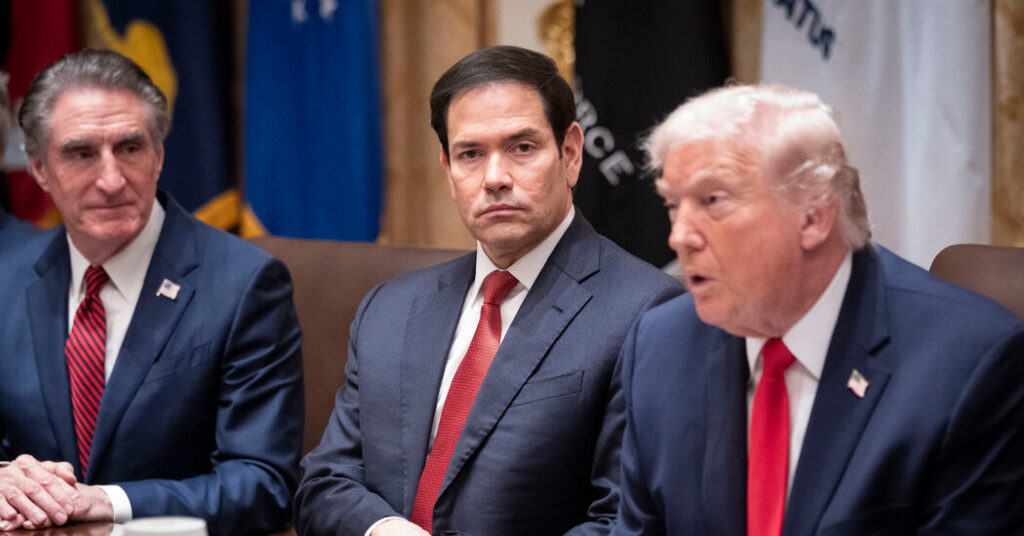
Throughout his long political career, Mr. Rubio has advocated toppling governments hostile to the United States. He was once considered so ideologically out of step with Mr. Trump that many officials and politicians doubted he would last a year in the administration. But today, Mr. Rubio is at the helm of Mr. Trump’s aggressive campaigns to reshape the governments of Iran, Venezuela, Cuba and beyond.
The U.S. president, who promised to end American wars, is now embracing the policies backed by Mr. Rubio and the secretary’s ideological compatriots, dismaying supporters who thought Mr. Trump had ushered in a new era of military restraint.
But Mr. Rubio is not trying to convert Mr. Trump to George W. Bush-era neoconservatism, which sought to remold other nations’ political systems, sometimes with military force, American officials and analysts say. Instead, he seems to be pursuing a new approach built on power free of principle. It is a merger of neoconservatism with Mr. Trump’s transactionalism, and it amounts to using U.S. military and economic power to turn authoritarian countries into client states.
It is regime compliance rather than regime change, a doctrine of destroy and deal.
Traditional neoconservatives saw promoting democracy and doing nation-building in the world as a moral good, even if it was done at gunpoint. And they viewed those as a means of transforming adversaries wholesale and extending American influence by spreading ideas. The Trump administration’s approach, so far, leaves internal politics to the rival nations as long as they show obeisance.
“For Rubio and other members of this younger group, foreign policy isn’t as much about regime change as much as it is about power,” said Emma Ashford, a scholar at the Stimson Center, a research group in Washington. “It is about sustaining American military primacy, making other states fear and respect us.”
Mr. Rubio laid out that idea at the Munich Security Conference last month in a speech in which he lamented the passing of the “great Western empires” and vowed that America would carry on their mantle.
“To be clear: Secretary Rubio is an ‘advocate’ of implementing the America First foreign policy of President Trump,” said Tommy Pigott, the deputy spokesman for the State Department. “As President Trump said, he makes peace wherever he can, but he will never hesitate to confront threats to America wherever we must. That is a policy Secretary Rubio fully supports, and President Trump’s historic results speak for themselves.”
‘Unleash Chiang’
Mr. Rubio’s warning to Iran was violent, if a bit cryptic: “We’re going to unleash Chiang on these people in the next few hours and days.”
The mysterious reference came soon after the war began, as he talked about accelerating the American and Israeli bombing campaign. “You’re going to really begin to perceive a change in the scope and in the intensity of these attacks, as, frankly, the two most powerful air forces in the world take apart this terroristic regime,” he said on Capitol Hill.
“Chiang” points to a little-known tie between Mr. Rubio and the Bush family, whose younger president, George W., was the architect of the two American “forever wars” of this century, Iraq and Afghanistan.
In 2005, Jeb Bush, a younger brother of George W. and then the governor of Florida, handed Mr. Rubio a golden sword at the Florida legislature when Mr. Rubio was poised to become the House speaker. It was the weapon, Mr. Bush said, of “a great conservative warrior,” the “mystical” Chiang.
That was an inside joke: “Unleash Chiang” was a phrase shouted by his father, George H.W. Bush, the former president and ambassador to China, at tennis opponents, and it referred to Chiang Kai-shek, the U.S.-backed Chinese military leader who fought Mao’s Communists but ultimately lost.
Mr. Rubio, whose hawkish foreign policy views have long been aligned with those of the George W. Bush administration, is finally unleashing his inner Chiang and brandishing his golden sword across the globe. He has even spoken about the need to wage pre-emptive war against Iran, citing a nonexistent imminent threat — the same language the Bush administration used to justify invading Iraq.
The influence of neoconservatives reached its zenith under that president and his post 9/11 wars. But their ideas still hold sway in Washington, and some of their views are now at the fore of Mr. Trump’s foreign policy, championed by Mr. Rubio.
One is bolstering the American military partnership with Israel and striking at Israel’s adversaries — Iran in particular. The United States first attacked Iran last June, during the 12-day war started by Israel.
Mr. Rubio, who is also Mr. Trump’s national security adviser, helped plan that assault and most if not all of the administration’s other major military operations. Mr. Trump has ordered attacks in eight countries in the last year.
“Rubio was a top-tier ally,” said Michael Oren, a former ambassador for Israel to the United States who worked with Mr. Rubio when he was a senator representing Florida. “He did not waver. He was always there.”
Mr. Oren disputed any notion that Mr. Rubio was dragging Mr. Trump into a world of war. The two men are partners, he said, and Mr. Trump is taking action to leave his mark on history.
“So where’s the legacy?” he said. “It’s in foreign policy, and an activist foreign policy, not isolationist foreign policy. I think Trump cares about this, and that’s where Rubio is. He’s in lock step.”
Seeking Submission
When Mr. Rubio became Mr. Trump’s secretary of state in January 2025, he dialed back his martial views in public to align himself with the president’s campaign promise of “no new wars.”
He also began speaking in conciliatory terms about the superpower rivals Russia and China, whose autocratic leaders Mr. Trump admires — and whom Mr. Rubio once denounced in the good-versus-evil language of neoconservatism.
But last summer, Mr. Rubio became a spokesman for military intervention against countries the Trump administration views as weak. He supported the June attacks on Iran and stressed the need to make Nicolás Maduro, the autocratic leader of Venezuela, answer for stealing an election and, in Mr. Rubio’s words, leading a “narco-terrorist” group.
That led to lethal U.S. strikes on civilian boats near Venezuela and the seizing of Mr. Maduro in January. Mr. Rubio fully unmasked his inner hawk when the administration joined Israel to start the war against Iran on Feb. 28. And he has made no secret of the administration’s goal of weakening or toppling the Communist government of Cuba, a personal decades-long mission.
But following Mr. Trump’s lead, Mr. Rubio is also willing to make deals with those authoritarian governments.
As Mr. Rubio carries out economic warfare on Cuba by blocking oil shipments to the island, he is quietly negotiating to open Cuba’s economy with Raúl Guillermo Rodríguez Castro, the grandson of Fidel Castro’s brother Raúl.
He is also working closely with Delcy Rodríguez of Venezuela, a leftist authoritarian ally of Mr. Maduro who now governs the country, rather than pushing for a takeover by María Corina Machado, a conservative pro-democracy opposition leader. As a senator, Mr. Rubio co-signed a letter in 2024 supporting Ms. Machado’s nomination for a Nobel Peace Prize.
And he has made contradictory remarks on whether regime change is the goal of the war against Iran. Although he has criticized the “radical Shia clerics” who rule the country, and the first Israeli attack killed Iran’s leading ayatollah, he has not explicitly said that overthrowing them is a war goal. As for Mr. Trump, he has encouraged a popular uprising but has also shown an interest in striking a deal with officials from the current Iranian government.
John Bolton, a national security adviser in Mr. Trump’s first term who promotes the use of military force to secure U.S. hegemony, said the administration needed to commit to regime change.
“On Trump’s resolve, he clearly is playing it day by day, which is no way to maximize the pressure on the regime or to help the opposition,” said Mr. Bolton, who was also a United Nations ambassador for President George W. Bush.
Some conservative restrainers opposed to the war suspect that Mr. Rubio has steered Mr. Trump down a path of bloodshed or did little to keep Prime Minister Benjamin Netanyahu of Israel from leading the president there. But Carlos Trujillo, a Cuban American politician from Miami who served as ambassador to the Organization of American States in the first Trump administration, said that was too simplistic.
Both Mr. Trump and Mr. Rubio are acting against nations that threaten the safety of Americans, he said. “This isn’t regime change for the sake of regime change, or regime change for the sake of democracy.”
Mr. Trujillo said he expected the administration to adopt a gradual approach to transforming Cuba and Venezuela.
“It will be a transition back to free markets, within reason, and a transition back to a representative democracy,” he said. “You stop with the oligarchy. You open up the markets, you allow direct foreign investment, you respect the rule of law and you transition toward a recognized election.”
Cuba and Venezuela are high-wire acts for the administration. But it is the war in Iran that could make or break Mr. Trump’s presidency and Mr. Rubio’s political future as they grapple with a question that has confronted many U.S. administrations since World War II: Can one nation reshape another or force it to submit through a relentless bombing campaign?
“It would be great if with standoff exquisite airstrikes we can fundamentally transform the politics of other countries,” said Justin Logan, the director of defense and foreign policy studies at the Cato Institute, which advocates military restraint. “But we can’t. There’s a certain American stubbornness on this point, and we keep learning these lessons over and over again.”
Patricia Mazzei contributed reporting from Miami.
Edward Wong reports on global affairs, U.S. foreign policy and the State Department for The Times.
The post Trump and Rubio’s Vision of War: The Art of Destroy and Deal appeared first on New York Times.