Before Héctor Cruz Correa left his home in South Florida for an ill-fated boat trip to Cuba last month, he told his mother that he was going fishing. He asked her to make his favorite beef soup for the trip.
Another man, Roberto Álvarez Ávila, a father of three, told his wife that he would see her after his shift as a Walmart security guard. A third, Conrado Galindo Sariol, who had spent eight years in a Cuban prison, told his wife he was going to work delivering packages.
None of them returned home.
The three men were among 10 Cuban immigrants who, according to the Cuban government, stowed a stockpile of weapons on two boats in the Florida Keys, set sail and wound up in an armed confrontation with the Cuban coast guard about a mile off the island’s northern coast. The government called it a foiled terrorist attack.
Four of the men, including Mr. Cruz Correa, died in the firefight on Feb. 25. Mr. Álvarez, who had been shot, died nine days later. The five others were all injured and remain detained in Cuba.
More than two weeks later, what the men intended to do that day remains a mystery. They knew each other from TikTok group chats and fringe organizations dedicated to freeing Cuba from communism. Most of them lived and worked in and around Miami and Tampa, two hubs of anti-Castro sentiment. Their relatives remain skeptical of the Cuban government’s account.
Yet some Cubans in Miami have started to believe that the men might have convinced themselves that a few anti-communist militants could take on the Cuban dictatorship.
Cuba’s economy is on the brink of collapse. Its Communist government looks weaker than at any other point in recent history. After deposing the Venezuelan leader Nicolás Maduro, who had provided Cuba with an economic lifeline, President Trump has said that the Cuban regime may be the next to crumble. The Cuban government confirmed on Friday that it is in talks with the White House over its economic future.
Some in South Florida’s exile community suspect that a handful of their own seized an opportunity to try to provoke unrest in their homeland.
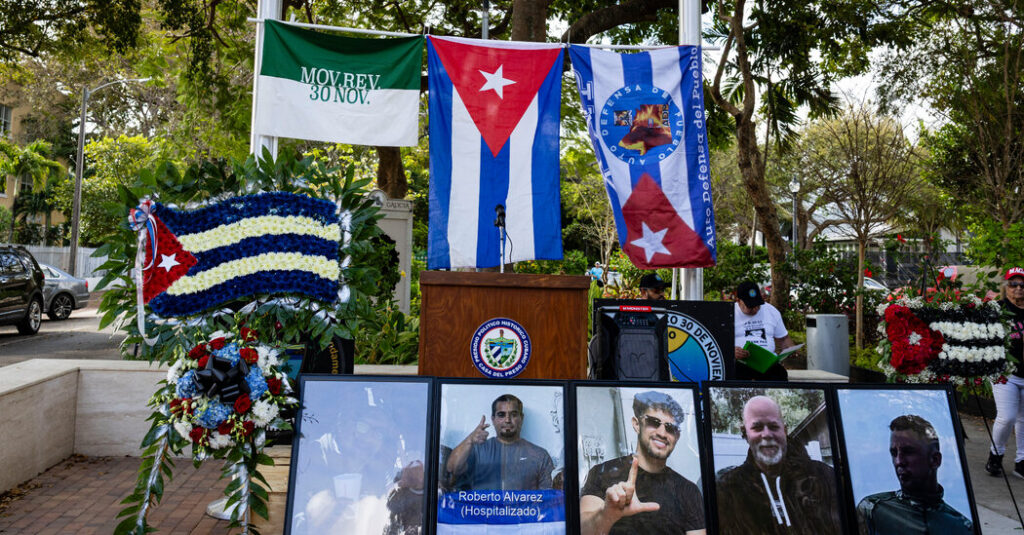
“It was a display of bravery, of courage,” Jorge Luis García Pérez, a well-known activist against the Cuban government who goes by the name Antúnez, said last Sunday during a small ceremony that exile groups held for the men in the Little Havana neighborhood of Miami. “Those men went there to leave everything.”
A Return to Old Ways
For four decades after the 1959 Cuban Revolution, exiles ran guns, planted bombs and tried to subvert the island’s government from their adopted home of South Florida. Miami’s anti-Communist fervor ran so deep that often, the militants were not even prosecuted in the United States.
But those days had seemed long over. The earlier generations of militant exiles had grown old, died or become resigned to never seeing a democratic Cuba.
Last month’s boat plot involved younger Cuban immigrants, many of whom came to the United States much more recently, suggesting that at least a handful of men had sought to pick up the mantle of earlier generations.
Unlike in the past, however, there has not been an outpouring of support for the 10 men who were on the boat. The ceremony in Little Havana drew maybe 50 people, fewer than organizers had hoped, and no politicians.
Yet those who attended treated the men with reverence.
Sergio Rodríguez of the November 30 Movement, which was founded in the 1960s by former supporters of Fidel Castro, said that his group and other exile organizations “will always support any belligerent act or action” against the Cuban regime.
Several attendees mused that if Cuba continued to flail and the White House was unable to reach a deal with its government, like-minded militants might try to take matters into their own hands.
The timing of the shootout led some to initially believe it was the start of another Bay of Pigs, the failed, C.I.A.-backed attempt by Cuban exiles to invade the island in 1961 and depose Mr. Castro. But the Trump administration said it knew nothing about the plot.
It also drew comparisons to an incident that took place exactly 30 years before the men set sail from the Keys, in February 1996, when the Cuban government shot down two planes belonging to a Miami-based exile organization, Brothers to the Rescue. A Cuban intelligence agent had infiltrated the group and warned his government about the planned attack.
Relatives and friends of the men on the boat think it could have happened to them, too.
‘Everything Was Normal’
One of the plot’s masterminds, according to the Cuban government, was Amijail Sánchez González, 48, who was injured in the shootout. He had co-founded an exile group called People’s Self-Defense about five years ago.
His girlfriend, Maritza Lugo Fernández, was accused by Cuban officials of organizing the scheme and allowing the men to train on her ranch near Naples, Fla., where she raises pigs and chickens and grows peppers.
Ms. Lugo, 62, is the head of the November 30 Movement. She was jailed in Cuba in 1999 for anti-government activities and left the island in 2002. In an interview, she said that she had been dating Mr. Sánchez and that she also knew some of other men who were on the boat. But she had no knowledge of their plan, she said.
“We’ve participated in activities together,” she said. “But it’s a lie that I’m the promoter or the boss of anything, nor did I finance anything.”
She said she last saw Mr. Sánchez two days before the shootout.
“Everything was normal,” she said. “I found out from the news, like everyone else.”
A Facebook account that appears to belong to Mr. Sánchez shared posts in recent months urging Cuban citizens to join a “definitive battle” against their government. The account shared photos of people holding Cuban flags while making hand gestures resembling guns. One photo displayed a T-shirt with the slogan, “If the price of freedom is life, I will pay.”
Mr. Sánchez and another man injured in the shootout, Leordan Cruz Gómez, had been wanted by the Cuban government; after the incident, it said the two had previously been involved in the “promotion, planning, organization, financing, support or commission” of terrorist acts against Cuba.
President Miguel Díaz-Canel of Cuba said on Friday that the men had several targets, including military ones, and wanted to “create confusion, to create unease, to sow fear.” He added that an F.B.I. team would soon arrive to take part in the investigation.
Cuban prosecutors have filed terrorism charges against Mr. Sánchez, Mr. Cruz Gómez, Mr. Galindo and the two other survivors, José Manuel Rodríguez Castelló and Christian Acosta Guevara. At the ceremony in Little Havana, Ms. Lugo said that her organization planned to caravan to Washington to demand the men’s release.
The Cuban government also filed charges against another man, Duniel Hernández Santos, who it said had been “sent” from the United States to meet the boat. No one at the ceremony last Sunday seemed to know anything about him.
The Department of Homeland Security said in a statement that Mr. Hernández “entered the U.S. illegally” in 2024, during the Biden administration, using an app that allowed certain migrants to cross the border from Mexico at a port of entry. In December, an immigration judge issued a final order of removal against Mr. Hernández. “He then chose to self-deport to Cuba in February,” the department said.
The Cuban government identified the dead as Mr. Cruz Correa, Mr. Álvarez, Michel Ortega Casanova, Pavel Alling Peña and Ledián Padrón Guevara.
Mr. Alling’s social media posts showed an affinity for writing and performing poetry that later gave way to a singular interest in liberating Cuba. Mr. Ortega, a truck driver and a grandfather, also became “obsessed” with the cause in recent years, according to his brother, Misael Ortega Casanova. Four Cuban state security guards showed up at their sister’s house in Cuba after their brother’s death, he said, “to intimidate her.”
“My sister’s phones are tapped,” he added.
With the surviving men either hospitalized or detained and unable to speak freely, answers remain elusive.
Mr. Galindo’s wife, Ana Seguí, who lives in a small pink house in Miami, said that he had spoken by phone to a relative in Cuba who had told Ms. Seguí about the conversation. He told the relative that he had a shoulder injury, Ms. Seguí said, but he had a minder nearby who did not let him say much else.
‘My Heart Is So Hurt’
In the Cuban government’s telling, the 10 men traveled from the Keys on two boats with a dozen high-powered weapons; more than 12,800 rounds of ammunition; 11 pistols; and other gear, including boots, helmets and camouflage backpacks. One of the boats broke down en route, the Cuban government said, forcing all of the men and their weapons into the other, a 24-foot boat built in 1981.
The boat was reported stolen the same day out of Big Pine Key, in the Lower Florida Keys, according to a report from the Monroe County Sheriff’s Office. It belonged to a contractor who employed Mr. Cruz Correa.
The boat owner had found the vessel gone and Mr. Cruz Correa’s white Chevy truck parked nearby. A neighbor told sheriff’s deputies that she had seen a man park the truck and board the boat by himself.
The owner said that he had assumed that Mr. Cruz Correa had taken the boat to go fishing, though he had never done so before. He also said that Mr. Cruz Correa had been trying to repair a large boat with twin motors in the days leading up to the fishing boat theft.
A spokesman for the sheriff’s office said that no other boats were reported stolen that day, or in the days leading up to the shootout.
Mr. Cruz Correa’s mother, María Antonia Correa Pérez, lived with her son, his wife and other relatives in a rented house in Homestead, Fla. She recalled his request for soup with beef and vegetables the day before his trip.
“He was going fishing and asked for me to cook for him,” she said of her son, a father of three whom she called by the nickname Yayi. “And I did.”
He had some for lunch and took the rest in his lunchbox, she said, leaving in a navy blue pullover. He texted her from his truck when he arrived in the Keys.
Last week, she identified her son’s body via video call from Cuba.
“My heart is so hurt,” she said. “I cannot stand this pain.”
Frances Robles contributed reporting from Miami. Kitty Bennett and Kirsten Noyes contributed research.
Patricia Mazzei is the lead reporter for The Times in Miami, covering Florida and Puerto Rico.
The post Inside a Doomed Mission to Cuba: 10 Men Willing to ‘Leave Everything’ appeared first on New York Times.