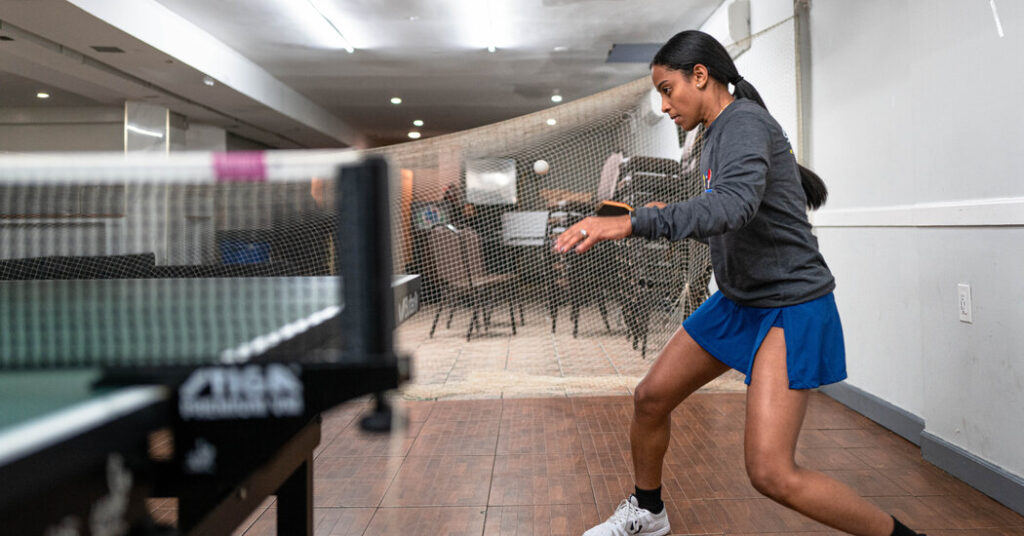
Yasiris Ortiz’s Hollywood debut emerged from a group chat.
In October 2024, Ms. Ortiz’s friends began texting about a movie scheduled to film in New Jersey that was looking for background actors. That movie was “Marty Supreme,” a 1950s romp about a table tennis player’s haphazard quest for world dominance, which is nominated for best picture at this weekend’s Academy Awards.
Just a few weeks later, Ms. Ortiz — dressed as a Brazilian table tennis player competing in a fictional British Open — starred in her first movie.
But Ms. Ortiz, 28, is not an aspiring actress. She’s a table tennis player, who next month will compete in the sport’s ITTF World Team Championships in London.
The movie, which stars a few real-life pros, including Koto Kawaguchi of Japan, shined a spotlight on New York City’s table tennis scene in the 1950s. Its main character, Marty Mauser, is played by Timothée Chalamet, whose game isn’t quite that of a real champion, Ms. Ortiz said: “He was trying.”
In the film, Mr. Mauser is a regular at a dimly lit Times Square club. He also hustles the locals at a New Jersey bowling alley outfitted with a few scattered tables in a bid to fund a career-making trip to Japan.
Today, table tennis in New York looks quite different, with more bright lights and fluorescent pink, less grime and orange. Stand-alone clubs like PingPod, open 24/7, have popped up around the city, as well as a handful of table tennis bars, complementing old-school basement spots like Club Deportivo in Washington Heights.
Those hodgepodge locales formed a landing pad for Ms. Ortiz when she arrived in the city in 2016. Now, she wants to make her own mark on that landscape by creating spaces for New York’s youth to learn how to play table tennis.
Originally from the town of Bayaguana in the Dominican Republic, Ms. Ortiz left home at the age of 9 to attend a table tennis academy in Santo Domingo, the nation’s capital. She went to school in the morning and trained in the afternoon in hopes of playing at international tournaments as a member of the Dominican Republic’s national team. She dreamed of competing in the Olympics.
Ms. Ortiz eventually moved to the city of Santiago de los Caballeros, where she attended college while training for the national team. Ms. Ortiz had just competed in the Pan American Games and the Latin American Table Tennis Championships with the national team when she learned that her mother was moving to New York City with two of Ms. Ortiz’s younger siblings — and wanted Ms. Ortiz to move with them.
She had not lived with her family for almost a decade by the time she moved to the United States.
“I was lost,” she said. “I didn’t know what to do at that point.”
At the age of 18, Ms. Ortiz found herself in Washington Heights in Manhattan with little knowledge of the city and little knowledge of English.
Through table tennis, Ms. Ortiz became more comfortable with her surroundings and her new life. She began frequenting Club Deportivo, where she started to make friends and play in tournaments and exhibitions. The people at the club even helped Ms. Ortiz and her family find an apartment in the Bronx.
Ms. Ortiz flirted with giving up the sport, but found her skills improving as she competed against players from around the world in local tournaments. She returned home and won the Dominican Republic’s national championships in 2017, a year after leaving.
Ms. Ortiz’s career was back on track, but new ambitions had emerged alongside it.
Before her big win, a man challenged her to a game at a SPIN table tennis club downtown. “I destroyed him,” she said.
That man was Jorge Perdomo, the now-retired principal of Public School 1 in the South Bronx. He invited Ms. Ortiz, who was around 19 at the time, to become a table tennis instructor for his after-school program. In a school system where roughly 42 percent of children are Hispanic, Mr. Perdomo thought Ms. Ortiz could be a role model for his students.
“I believe sports are really good for kids and that there is a different way to get students engaged in wanting to be part of the school community,” Mr. Perdomo said. “Yasiris was instantly, automatically in love with teaching kids.”
On her first visit to P.S. 1, Ms. Ortiz was impressed — Mr. Perdomo had three new tennis tables and even a robot that could assist with her training. He began to mentor her and helped her realize that she could earn a living through teaching.
Ms. Ortiz spent about two years working in the after-school program at P.S. 1. When she saw other students coming to the school to play in basketball leagues with branded uniforms and backpacks, she had the idea to start Spin & Learn, a nonprofit that would expand free table tennis programing to children across the city.
Coaches at Spin & Learn, which officially started in 2019, teach table tennis after classes and sometimes during school hours on lunch breaks, working students through drills, showing them how to warm up and focus and encouraging them to stay engaged — both at the tennis table and in class. Ms. Ortiz, one of the club’s coaches, also hosts tournaments for the students to compete in and show what they have learned.
Spin & Learn currently operates in 11 schools across the Bronx, Queens, Manhattan and Brooklyn. Mr. Perdomo said that no student involved in the program at P.S. 1 during his time there had ever missed class.
“Since I learned so much through this sport, I wanted to always combine this with academics,” Ms. Ortiz said. “So not just creating a program that is for table tennis and sports, but for life skills, values, creating like a pathway for students to get to their careers.”
This month, Spin & Learn will expand its operations beyond schools for the first time, beginning with a 12-week program at the Police Athletic League’s New South Bronx Center. Ms. Ortiz’s goal is to open a stand-alone training center with separate areas for student tutoring and homework.
Ms. Ortiz has received opportunities outside of sports. She graduated from the City College of New York in 2023 with a degree in computer science and was offered a software engineering job. But she ultimately decided to stick with Spin & Learn.
“It was the kids,” she said, of what swayed her decision. “It was the impact on their lives.”
Tacia Maxwell-Cameron, a teacher at P.S. 1., said that while students might feel pressure to be perfect in the classroom, with table tennis there is more room for them to be agile and make their own quick decisions while solving problems.
Evelyn Encalada, a second grader participating in Spin & Learn at P.S. 1, said she wanted to be a teacher when she grew up and was enjoying learning to play table tennis.
“When I hit it, I’m proud of myself,” she said.
In the past, when Ms. Ortiz mentioned Spin & Learn, she said, most people would refer to it as a hobby or think that table tennis was purely recreational, not understanding how big the sport was and how seriously she took it. “Marty Supreme” has helped to change that perception, she said.
“Everybody is talking about the movie and even trying table tennis for fun,” Ms. Ortiz said. “It feels really good for our community in creating more awareness of the sport.”
David Silberman, a co-chief executive of PingPod, said that “Marty Supreme” was doing for table tennis what the Netflix show “The Queen’s Gambit” had done for chess, and said he was seeing a sustained bump in demand for PingPods around New York.
As the sport’s popularity has grown, it has only served to help the students enrolled in Spin & Learn, Ms. Maxwell-Cameron said. Table tennis, she said, has allowed them to think outside the box about their futures.
“People go to the Olympics playing table tennis,” she said. “You just have no idea how far they can take this.”
Claire Fahy reports on New York City and the surrounding area for The Times.
The post Forget ‘Marty Supreme.’ Meet the Real Table Tennis Champion of New York. appeared first on New York Times.