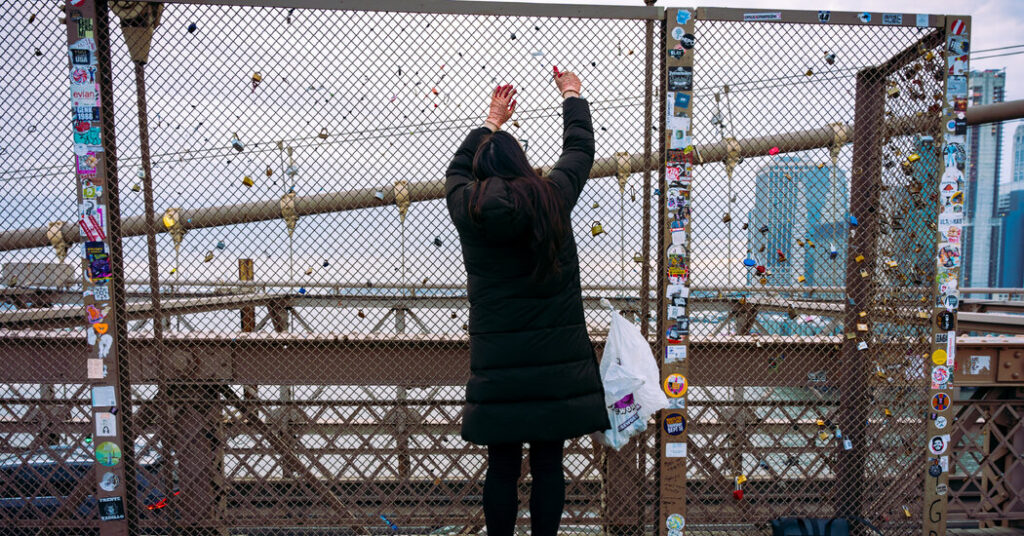
Before Sukhami Sodhi left New York City and flew 7,700 miles home to Indore, India, there was one more tourist activity she wanted to try: partake in a social media stuntby attaching a piece of junk to the Brooklyn Bridge. On a cold afternoon in early March, Ms. Sodhi believed she’d found her chance. Near the middle of the bridge’s famous boardwalk she found a woman standing on her tiptoes, reaching toward a chain-link fence festooned with scrunchies, rusty locks and dirty handkerchiefs.
“Are you selling locks?” said Ms. Sodhi, 26.
“No,” said the woman on tiptoe, whose name is Ellen Baum. “I’m cutting them off.”
The Brooklyn Bridge, famous for its Gothic arches and spider web of cable stays framing incomparable views of the city, has become a central gathering place for tourists looking to leave a memento. The trend appears to have started on the Pont des Arts in Paris in 2008, when couples ceremonially sealed their relationships by attaching padlocks to the Pont des Arts and tossing the keys into the Seine.
Within a year, the first few dozen love locks appeared on the Brooklyn Bridge, according to the city’s Department of Transportation, which owns and maintains the bridge. The locks, some inscribed with the lovers’ initials but many unadorned, proliferated quickly. In 2015 alone, the transportation department said it had removed 11,000 of them.
Visitors to the bridge were undeterred. They added so many locks that a wire snapped under the weight in September 2016, falling to the roadway below and blocking traffic. The transportation department responded with signs warning that anyone caught attaching a lock to the bridge could receive a $100 fine. But the bridge receives about 30,000 visitors on a typical Saturday, a spokesman for the department said, and policing the locks is one regular, but small, part of maintaining it.
No one knows exactly when actual pieces of trash started appearing among the locks, or exactly why. Visitors attached the garbage either by tying it directly to the wire mesh, or by cramming bits into the spaces between the links. Most of the garbage seemed to accumulate along chain-link security fences that were installed before 2020.
Ms. Baum, a Brooklyn Heights resident for a decade, lives a short stroll from the bridge and walks across it most days. Sometime last spring she began to notice the garbage, which seemed to grow incrementally in quantity, like a two-dimensional landfill.
Hair ties, she recalled, formed the first wave. Then came soiled napkins and water bottle labels, followed by dirty socks and underwear, tampons and condoms.
“I was like, ‘This is disgusting,’” said Ms. Baum, 37.
On Feb. 2, Ms. Baum declared on Reddit that she planned to do something about it. “I hate these and I’m going to cut them off the bridge,” she posted.
It was repulsive. The napkins had stains, and the tampons had swelled with rain, but otherwise appeared clean. The condoms flapped in the wind. (Had the condoms been used? It’s a question upon which Ms. Baum chooses not to linger.)
The first day, she attacked the trash with scissors. The handles caused her hands to ache. So she returned with a corkscrew, slicing off trash with the small blade meant for cutting the foil from bottles of wine.
She wore rubberized work gloves. She tied a white kitchen garbage bag to the fence and tossed the junk inside. When that was full she removed it, opened another bag and kept going.
Most people ignored her, Ms. Baum said. A few boldly added new trash to the section of fence that she had just cleaned. One person, hoping to place a piece of trash high on the fence, asked to borrow her stool. Ms. Baum said no.
“People are just so shameless,” said Ms. Baum. “Would you go to Machu Picchu and just tie your dirty old receipt to a fence there?”
Ms. Baum soon learned she was not the only bridge custodian, or even the first.
In January, a month before Ms. Baum arrived, a software engineer named Max Parke started showing up at the bridge with an angle grinder, making quick work of the locks.
On a recent afternoon, he took up his post at the fence. Wielding the angle grinder (a DeWalt with a steel blade coated in diamond dust), he leaned into his work like a heavy metal bassist, sending orange sparks shooting cross the boardwalk. The shackle snapped, and he unhooked the lock. He stood up straight and smiled.
“If the D.O.T. were doing its job, I wouldn’t have to do this,” said Mr. Parke, 39. “But then, if the D.O.T. was doing its job, I wouldn’t get to do this.”
Others have taken up the cause. Pick Up Pigeons, a volunteer group of trash picker-uppers based in Jackson Heights, joined Ms. Baum for a cleanup shift and removed nearly 13 pounds of trash.
There are also pro-garbage voices. No one has objected to their work on the bridge in person, Ms. Baum and Mr. Parke said. But on social media, critiques abounded. Some praised the aesthetic value of the garbage, and urged do-gooders like Ms. Baum and Mr. Parke to butt out.
“That was a community work of art using trash,” a person with the username nonoiseplz wrote on Reddit under a time lapse video of Ms. Baum at work. “Way to go destroying a masterpiece in the making!”
There is a tiny academic discipline that studies how private citizens use guerrilla tactics to take control of public spaces. Among this small group of experts, Ms. Baum’s chosen form of activism looks like something new.
Traditionally, guerrilla urbanists are deconstructionists of a sort, attacking public infrastructure with skateboards, spray-paint or even pop-up playgrounds to make spaces more complex and messy, said Jeff Hou, a professor of landscape architecture at the University of Singapore.
Ms. Baum does the opposite, Mr. Hou said, employing guerrilla methods to restore order rather than dismantle it.
“It’s an interesting reversal of how urban spaces typically are appropriated,” said Mr. Hou, who graduated from Cooper Union and wrote a book titled “Insurgent Public Space: Guerrilla Urbanism and the Remaking of Contemporary Cities.”
And since the snow has melted, the insurgent appropriation of one of the city’s most iconic public spaces has intensified. Tchotchke vendors, banned from the bridge in 2024, were back (sliced melon and mango, $5 per cup; key chains with the city skyline, $1 each). Cyclists were relegated from the boardwalk in 2021 to a protected bike lane on the roadway, but that changes after dark, Ms. Baum said, when men on electric delivery bikes thunder across the pedestrian-only boardwalk.
Even Grammy-winning, multiplatinum R&B stars have staked private claims to public infrastructure. On one of her walks across the bridge last week, Ms. Baum came upon Mary J. Blige, who had appropriated a section of the boardwalk to shoot a video for her latest single and pose for pictures with fans.
Ms. Baum was hardly upset, but she did notice how Ms. Blige’s boardwalk grab made walking slower for everybody else.
“Obviously, if you do that,” she said, “it takes up that side of the walkway.”
Christopher Maag is a reporter covering the New York City region for The Times.
The post Guerrilla Battle Over Padlocks and Tourist Trash on the Brooklyn Bridge appeared first on New York Times.