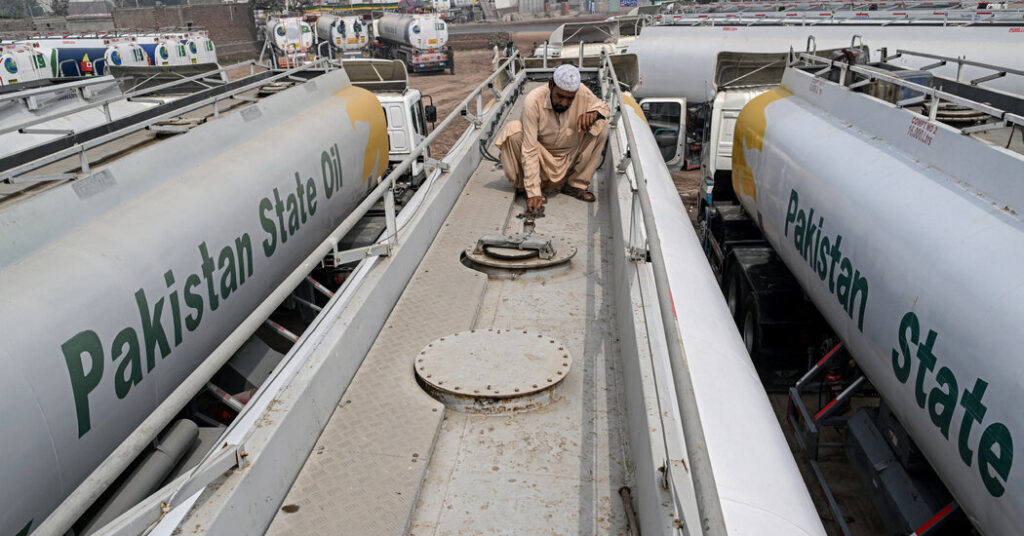
Pakistan imports more than 85 percent of its crude oil from Saudi Arabia and the United Arab Emirates by way of a single maritime route snaking through the Strait of Hormuz. The escalating conflict in the region has blocked that route and shocked Pakistan’s already fragile economy.
Farmers in Pakistan say they will struggle to afford rising fuel prices ahead of the harvest season. Some schools will move online on Monday, but nearly half of the country’s 250 million people are poor, by the World Bank’s estimate, and many children go without a laptop, a tablet or a decent internet connection. And ahead of Eid al-Fitr, many families are canceling trips to their hometowns, clouding what is usually a festive period commemorating the end of the holy month of Ramadan.
“Pakistan is already bankrupt and surviving loan by loan,” said Kaiser Bengali, a Pakistani economist, referring to the loans that the South Asian nation has received from the International Monetary Fund. “Any prolonged disruption could topple its economy.”
Surging energy costs have choked the economies of megacities and rural areas across South Asia, where many live on daily wages with little to no savings to cushion sudden rising costs.
In India, some restaurants have removed slow-simmered dishes from their menus to limit the consumption of cooking gas, and one city has suspended gas-fueled cremations. In Bangladesh, universities have closed to conserve electricity and reduce transportation needs. In Nepal, the government plans to ration cooking gas.
Pakistan has been hit especially hard. Nearly all its fuel arrives through the Strait of Hormuz, a route that is now being strangled by Iran. At least 16 ships, including oil tankers and commercial vessels, have been attacked in the Persian Gulf since late February. Tanker traffic has slowed, forcing ships to remain docked in the port city of Karachi, Pakistan’s economic hub and a stopping point for many of those tankers.
With its supplies cut off, the Pakistani government raised fuel prices on March 6 by 20 percent in an effort to stop hoarding — one of the world’s highest increases since the beginning of the U.S.-Israeli war in Iran.
Rising costs have badly hurt the farmers and daily laborers who drive the bulk of Pakistan’s economy.
Agriculture contributes over 23 percent of gross domestic product and employs 37 percent of the labor force. Farmers in Pakistan’s heartland, who are preparing for the spring harvest, said rising fuel prices would raise the cost of running the machinery to plow fields and the trucks to take grain to market.
“The use of tractors and other agricultural machinery is unavoidable at most stages of cultivation and harvesting, and these largely run on diesel,” said Aamer Hayat Bhandara, a farmer from the Pakpattan district in Punjab, Pakistan’s most populous province and its breadbasket.
Surging prices have also hit people in cities, including taxi drivers and anyone who commutes to work in diesel-powered rickshaws.
Muhammad Roshan, a rickshaw driver in Rawalpindi, said he was upset about the government’s response. “They could have gotten oil from Russia,” he said. “Why haven’t they explored that opportunity?”
With its economy hurting, Pakistan has also walked a fine diplomatic line. It has tried to strengthen ties with the Trump administration and has not condemned the United States for its strikes on Iran. Its economy is heavily reliant on the Arab states in the Gulf for oil and natural gas, as well as remittances from overseas workers. But Iran is its neighbor, and about 15 percent to 20 percent of Pakistan’s population shares Iran’s Shiite faith.
The Pakistani government has asked Saudi Arabia to supply oil via its ports on the Red Sea as an alternative. Pakistan’s energy minister told Reuters on Thursday that he hoped domestic sources of electricity production, including solar, could help cushion supply disruptions for liquefied natural gas.
Pakistan has tried to address oil and gas shortages with domestic measures, including encouraging schools to move online, cutting back on official trips and trimming the workweek to four days.
But economists say trimming the workweek, if carried out, is likely to hurt working- and middle-class Pakistanis who rely on daily wages.
The rising costs are also likely to taint Eid, usually one of the year’s busiest retail periods.
“There is no such rush in the markets,” said Shabbir Ahmed, a clothing trader in Karachi. His customers, he said, are saving their money for essentials.
Ali Akbar, who works for a real estate company in Islamabad, the capital, is looking to cut down on growing expenses.
Mr. Akbar, who said he made $400 a month, plans to postpone a homecoming trip to celebrate Eid with his parents and may move his two children to a school within walking distance. Monthly transportation costs for them have already risen to $48 from $36 over the past week.
The school is scheduled to go online for a few days next week. But Mr. Akbar said he couldn’t afford to buy a laptop or tablet, so his children will have to miss it.
Elian Peltier is The Times’s bureau chief for Pakistan and Afghanistan, based in Islamabad.
The post Surge in Oil Prices Shakes Pakistan’s Already Fragile Economy appeared first on New York Times.