Late one September night in a karaoke bar in northern Spain, two giants of Spanish cinema got into a tiff.
Oliver Laxe, whose work is nominated for best foreign film at the Oscars on Sunday, confronted Rodrigo Sorogoyen, a former Oscar nominee. Mr. Laxe had heard Mr. Sorogoyen had trashed his new movie at a private dinner.
Mr. Sorogoyen owned up to it. He didn’t think Mr. Laxe’s film, “Sirat,” about a father on a journey with his young son through a Moroccan desert hellscape thumping with ravers, was very good.
Mr. Laxe didn’t care enough about its characters, Mr. Sorogoyen said, and made a bad technical choice during a crucial scene. Mr. Laxe, who later called the critiques “the most stupid thing that I ever heard,” responded in the bar by jokingly telling Mr. Sorogoyen that he wasn’t a true director.
“Thank God I’m sure of myself,” Mr. Sorogoyen replied. “Because if not that’d kill me.”
The tiff, both directors said in interviews, was a lighthearted one between contemporaries with different styles. Mr. Laxe, 43, is a champion of transcendental and sensorial cinema. Mr. Sorogoyen, 44, is a flag-bearer for realism.
Their artistic differences, according to both the directors and Spanish film experts, are a sign of a pluralist, sophisticated and mature Spanish cinema bursting with life. A half-century ago, the restoration of Spain’s democracy shaped Spanish filmmaking for decades after. Now, critics say, Spanish film defies easy categorization and includes different voices, styles and stories that have more freedom to transcend the country’s historical trauma.
Spanish cinema is “blooming,” said Jara Yáñez, a film historian and editor of Caimán Cuadernos de Cine, a Spanish film journal.
For years after the death of the dictator Francisco Franco in 1975, Spanish cinema grappled with the country’s emergent new identity — profiting from, but still defined by, Franco’s absence. Filmmakers, especially Pedro Almodóvar, put Spain on the map with a transgressive and visceral vision of a modern, newly democratic Spain that was pointedly trying to shake off its legacy of conservatism.
Ms. Yáñez said those films consciously broke away from the censorship of the Franco era, but in doing so, were inseparable from the transition to democracy and the explosion of new Spanish nightlife, music and fashion, a countercultural movement known as La Movida. When, about 20 years ago, a new crop of Spanish filmmakers less burdened by the post-Franco historical moment emerged, they could not find enough funding or studios.
In recent years, something changed. Subsidies brought women and their perspectives into the industry. European co-productions and new streaming platforms financed more films in a more professional industry. A transforming Spain created a broader market for new stories and voices. “We had the talent, they needed to have the resources and the trust,” said Domingo Corral, who produced films by Mr. Laxe and Mr. Sorogoyen.
In addition to Mr. Laxe and Mr. Sorogoyen, the surging wave of Spanish filmmakers includes Carla Simón — who won Berlin’s Golden Bear award in 2022 and is known for her intimate filmmaking — and Albert Serra, whose provocative imagery, including in his recent documentary about a bullfighter, has won plaudits around the world.
What they, and many others, had in common, said Alauda Ruiz de Azúa, another member of the wave, was a willingness in a deeply polarized country to look at and understand “the other.”
Ms. Ruiz de Azúa’s film, “The Sundays,” which won this year’s Goya award, Spain’s top film honor, generated public discussion and ticket sales for doing just that. A meticulous exploration of a teenage girl’s contemplation of becoming a nun, it avoided placing judgment on feeling a vocation to the Catholic church — an institution deeply associated with conservative Spain. As a result, liberals called it “a total horror film,” she said, but others saw it as an examination of genuine tolerance.
Ms. Ruiz de Azúa didn’t set out “to portray here the zeitgeist of Spanish society,” an artistically limiting goal, she said. Instead, she tried to be “rigorous, respectful with the real stories I know, which are real stories that are happening right now in this society,” she said.
The trajectory of Ms. Ruiz de Azúa, 47, also spoke to the change in the Spanish film industry. Finding no film jobs after graduating film school, she spent about 15 years making commercials until getting her break.
She said that while the proportion of Spanish films directed in 2024 by women was still “embarrassing” at less than 30 percent, she had noticed this year that her work was embraced not as a woman’s movie, but as something that spoke to all of Spain. She felt, she said, “at the adult’s table.”
Mr. Sorogoyen had been there for years. His Madrid office is decorated with Spanish and international prizes and his prestige TV series, “The New Years,” which follows a couple’s tormented on-again, off-again relationship over a decade, is all the rage with French critics.
His upcoming film, “Beloved,” starring Javier Bardem, is a potential candidate for France’s Cannes Film Festival, along with Almodóvar’s new film. He said that while Spanish genius was nothing new, the industry fell behind for decades because of the dictatorship, and it took time for this generation’s filmmakers to finally “kill its fathers” and let new voices emerge.
“The explosion that has happened in the last five years is evident,” Mr. Sorogoyen said. “It’s like everything has come together.”
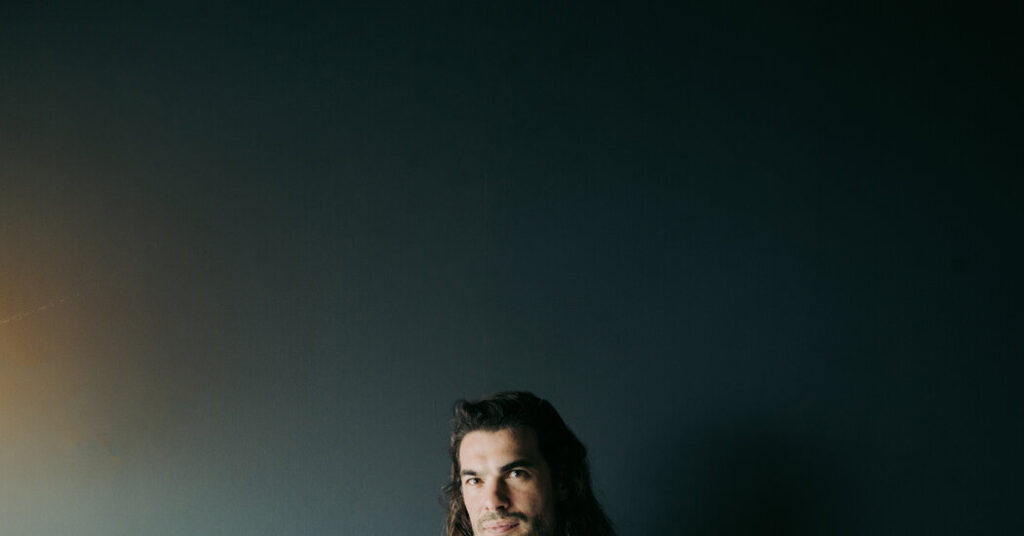
This year, Mr. Laxe has been the face of the Spanish cinema abroad. From Galicia in northwest Spain, he cuts a biblical figure with long, flowing hair, a beard and a basketball player’s height. The gut-wrenching plot twists of his film “Sirat,” which features ravers chasing beats through a desert minefield, have made it the year’s love-it-or-hate-it-but-got-to-see-it film in Spain. Coupled with Mr. Laxe’s taste for deep thoughts and circuitous sentences, the film has made him a lightning rod, teased in countless Instagram memes, some of which he thought were funny.
Born in France to Spanish parents who worked as building superintendents, Mr. Laxe grew up watching his father, an amateur photographer, develop pictures in the basement. The family hit hard times, the memory of which still makes Mr. Laxe cry. He found an outlet in “making films, escaping,” made his way to art school and eventually followed a group of poets to Morocco, where he grew interested in Sufi mysticism.
Mr. Laxe said his Oscar nomination bestowed “legitimacy” on him and his film. That it got made with a significant budget for Spain of more than $7 million — and that Spaniards filled theaters to watch it — was a “sign of maturity” of the country’s film industry, he said.
But he also questioned his film’s place in that industry. “Let’s think about if my cinema is Spanish or not,” he asked on the afternoon of last month’s Goya awards, where fans gathered outside a window and took his picture. While he accepted that he was a Spanish filmmaker, he said that “Sirat” differed from the work of his Spanish peers.
He said that even the seemingly progressive new Spanish films that he technically admired were marked by conservatism because, he said, they wrongly simplified Spanish society to tension between two opposing forces. “I want to transcend duality,” he said.
Mr. Laxe said his contemporaries, including Mr. Sorogoyen, remained saddled by what he called “costumbrismo,” a depiction of Spanish customs that he sees as old-fashioned and clichéd.
Mr. Sorogoyen considered the categorization “pejorative” and said he and other Spanish directors were simply telling the stories of people living in Spain.
But both directors played down any real animosity.
Mr. Sorogoyen laughed at rumors that he and Mr. Laxe had come to blows in the karaoke bar. Mr. Laxe said the two had since joked that they should stage a brawl.
Their artistic difference was “healthy,” Mr. Laxe said. “You know, the ecosystem of Spanish cinema is diverse.”
Carlos Barragán contributed reporting from Barcelona.
Jason Horowitz is the Madrid bureau chief for The Times, covering Spain, Portugal and the way people live throughout Europe.
The post His Film Is Spain’s Submission to the Oscars. He’s Not Sure How Spanish It Is. appeared first on New York Times.