Lionel Messi, perhaps the world’s most famous soccer player, never publicly talks about politics.
He maintained that silence during a meeting with President Trump last week, but that did not prevent the Argentine star from being dragged into a heated political debate at home.
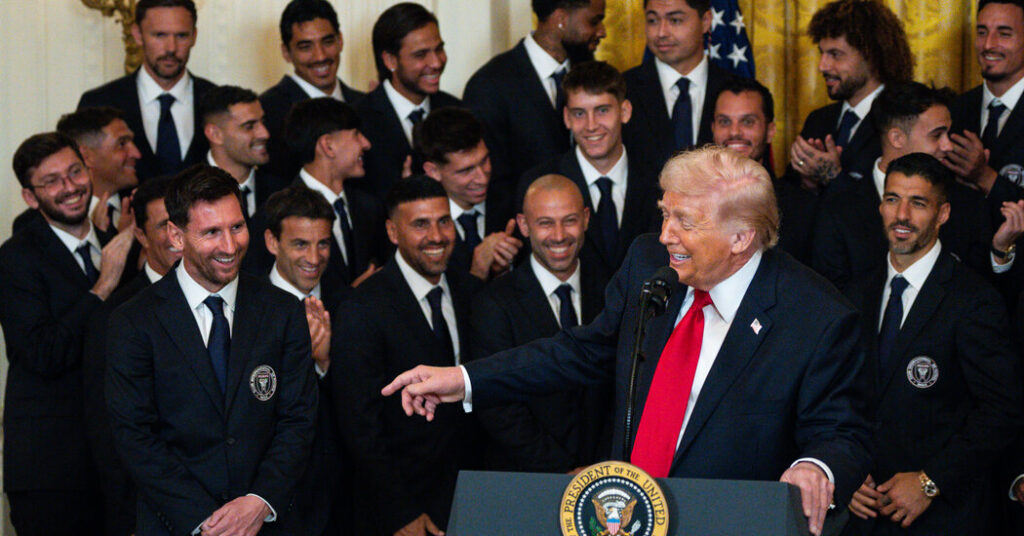
Mr. Messi smiled sheepishly at a White House reception for his U.S.-based team, Inter Miami, after Mr. Trump seized the occasion to talk about the demolition of Iran’s military and regime change in Cuba, turning a routine celebration of Inter Miami’s 2025 MLS Cup victory into a polarizing firestorm.
President Javier Milei of Argentina, a key ally of the Trump administration, applauded a handshake between his country’s most celebrated soccer hero and Mr. Trump. At the same time, Trump critics accused Mr. Messi of cozying up to the polarizing U.S. president.
“It felt like a slap in the face,” Ángel Cappa, a former Argentine soccer coach and longtime commentator, wrote in a blog post titled, “What a shame, Messi.”
Throughout his two-decade soccer career, Mr. Messi has taken pains to stay out of politics, and he has not commented on the White House event. Representatives of Inter Miami did not respond to a request for comment.
Some American sports teams and athletes have skipped visiting the White House to avoid meeting with presidents they don’t agree with or being drawn into the kind of scrutiny Mr. Messi has faced.
On social media, in newspapers and on radio and television programs, Argentines have engaged in a near-forensic examination of Mr. Messi’s body language during his appearance with Mr. Trump to dissect how uncomfortable, or at ease, he seemed during Mr. Trump’s saber-rattling speech.
Mr. Messi’s decades-long commitment to political neutrality seemed to be in vain when Argentines on the left and right conscripted him into the ranks of Trumpism.
“Even Argentina’s greatest national idol is right-wing,” Agustín Laje, a prominent Argentine right-wing intellectual wrote on X.
The debate spanned beyond Argentina’s borders. But among the loudest voices politicizing the meeting was Mr. Milei, who, after praising the soccer champion for years, seemed to have finally found a way to use him as A-list firepower against his enemies on the left.
“The only left that works is Messi’s,” Mr. Milei wrote on social media, referring to the left-footed player while attacking the political left.
Mr. Milei resurfaced a 2018 television clip in which he vociferously defended Mr. Messi against criticism after Argentina’s early exit in the 2018 World Cup. He reviled critics in a post, saying: “They love Maduro, Hamas and Cuba. They hate Messi. They are evil.”
As Mr. Milei has sought to cast himself as a global leader of the right, he has long tried to associate himself with Argentina’s most recognized international celebrity. But he has failed, so far, to get a photo with Mr. Messi, the captain of the men’s national team.
“Messi’s photo with Trump is a proxy satisfaction for Milei,” said Pablo Alabarces, an Argentine sociologist. “It puts Messi in the court of the far right.”
Other soccer experts sought to downplay the debate, with Andrés Cantor — the soccer voice of Telemundo, the U.S. Spanish-language media giant — pointing out that Mr. Messi was the captain of a team receiving an award from a president who wasn’t even his own.
“His boss is the owner of the team — he and his teammates received an invitation to the White House and they responded accordingly,” Mr. Cantor said. “We don’t know which side of politics he is on,” he added about Mr. Messi.
(It was also unclear how much the players, many of whom are not native English speakers, including Mr. Messi, understood of Mr. Trump’s speech.)
Another association that Mr. Messi has struggled to escape is one with his predecessor as the country’s ultimate soccer icon, Diego Maradona. The star, who died in 2020, was dazzling on the field but a polarizing figure off it. He cultivated an image as a leftist champion of the poor, shaped by his upbringing in a working-class neighborhood.
For years, Mr. Maradona’s triumph at the 1986 World Cup gave him an edge in the debate over who was Argentina’s greatest player, but when Mr. Messi led Argentina to win the World Cup in 2022, it effectively settled the score.
The comparisons resurfaced after the White House visit. On Mr. Messi’s Instagram page, a comment with tens of thousands of likes read: “Thank you for shaking Trump’s hand. That way it becomes very clear why Diego is the greatest there is.”
The outcry was amplified by the fact that Messi and his teammates did not visit the Argentine presidential palace after the 2022 World Cup victory, when the center-leftist Alberto Fernández was president. Mr. Fernandez said on a soccer YouTube channel this week that the government did not ask them to come.
Even the experts who were willing to give Mr. Messi the benefit of the doubt over his meeting with Mr. Trump said there was something off-putting about mixing soccer and a presidential lecture on military annihilation.
“Something about football has to do with illusion and magic,” said Marcela Mora y Araujo, an Argentine soccer commentator. “And this was so far removed from the beauty of the game.”
Emma Bubola is a Times reporter covering Argentina. She is based in Buenos Aires.
The post A Messi Political Debate appeared first on New York Times.