For months, members of Mayor Zohran Mamdani’s team had worked on plans to use the holy month of Ramadan to showcase how New York City’s Muslims and its first Muslim mayor practice their faith.
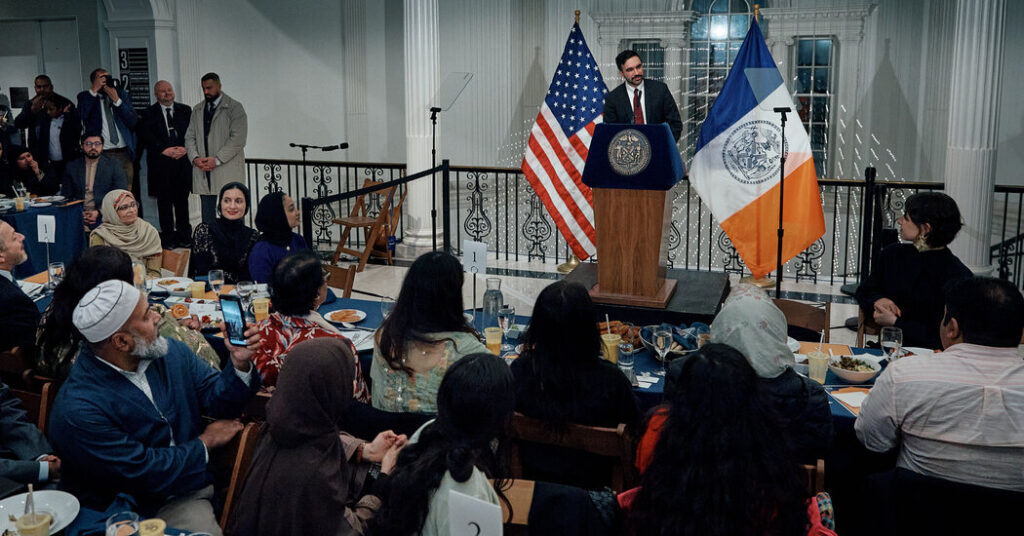
One of the centerpieces was to be a gathering at the Museum of the City of New York, where Mr. Mamdani held an iftar dinner on Thursday to break his fast with hundreds of Muslim city workers.
But at the onset of the dinner, the mayor used his platform to respond to Islamophobic comments from local and national figures, highlighting another aspect of his faith that has long been a part of life for many of the city’s Muslims.
“I have known these experiences as a young man, as a candidate for office, as the mayor of New York City,” Mr. Mamdani said. “And when I hear such hatred and disdain unchecked in its rancor, I feel an isolation and a loneliness that I know that many of you have felt as well.”
On Wednesday, Representative Brandon Gill, Republican of Texas, commented on X that a photo of the mayor at an iftar dinner was “stomach churning.” The next day, Senator Tommy Tuberville, Republican of Alabama, responded to side-by-side images of that dinner and the World Trade Center during the Sept. 11 terror attacks by writing, “The enemy is inside the gates.” And Vickie Paladino, a Queens-based city councilwoman, has shared posts on social media associating the mayor with Islamic terrorism.
Mr. Mamdani addressed each of those instances in forceful terms and called out each politician by name. He said their comments were dehumanizing and threatened the safety of the city’s Muslim citizens. He also referred to a 12-year-old girl wearing a hijab who was hospitalized last month after a woman punched her in the face.
“For many in this museum tonight and those outside of it, there is a hardship that extends beyond this month, simply by belonging to our faith in this city that is our home,” the mayor said to the city workers. “For nearly as long as there has been a New York City, there have been Muslim New Yorkers. And yet for nearly just as long, those with power and platform have sought to dehumanize us.”
The speech was reminiscent of one he delivered in the final weeks of his mayoral campaign, when he held a news conference in front of a Bronx mosque to condemn Islamophobic comments from his opponents and their allies. Earlier this month, when a conservative talk radio host described him as a “jihadist” and “Radical Islamic cockroach” in a post on X, the mayor denounced the hateful language, then argued that attacks on Muslim New Yorkers are often seen as more permissible.
Against the backdrop of Ramadan, however, the attacks seem to have intensified, with the far right responding with vitriol to the visual image of Mr. Mamdani practicing his faith.
In a statement, Ms. Paladino’s lawyer, Jim Walden, said that she “supports the mayor’s right to free speech, as he should respect her right to warn of the dangers of violent jihadists, which was the intention of her tweets. She supports people from all religions living in peace together.”
A spokeswoman for Mr. Tuberville declined to comment beyond the senator’s tweets, and a representative for Mr. Gill did not immediately respond to a request for comment.
Last week, the white supremacist activist Jake Lang held a rally in front of Gracie Mansion, the official mayor’s residence where Mr. Mamdani lives with his wife. The rally led to an attempted bombing that the police said was inspired by the Islamic State, also known as ISIS. The mayor called it “a heinous act of terrorism” in a four-sentence written statement delivered on Monday, two days later.
Mr. Mamdani has spoken more naturally and at length against faith-based attacks. And how he has responded to these instances has also offered a look at the composure that he, as one of the country’s most high-profile Muslims, has had to maintain.
“I think there’s a very strong push to make Mamdani either lose his cool or not be able to rule New York City or govern New York City because of the distractions from the kind of attacks that he’s going to be dealing with,” said Moustafa Bayoumi, a professor of literature at Brooklyn College who has written extensively about Islamophobia in New York. “And I don’t think he’s doing that, and I don’t think anybody around him is doing that.”
For the Muslim leaders present at Thursday’s iftar, the mayor’s reflection was not only a chance to see a fellow Muslim respond to attacks they could relate to, but a possible catalyst for more people at City Hall and beyond to act to avoid them in the future.
“It gives the rest of us a lot of courage to to speak out, but also to be able to encourage our constituents,” said Councilwoman Shahana Hanif, who attended the iftar on Thursday.
Hate crimes or attacks on members of her community are often acknowledged and condemned, but victims rarely receive full restitution, she said, adding that she hoped the mayor’s continued rebuke of these attacks will lead to further policy change and allow more Muslims to feel comfortable in their communities.
“And that’s the piece that I’m working towards,” she said. “And I think all of us are.”
Maya King is a Times reporter covering New York politics.
The post Mamdani Describes ‘Isolation’ and ‘Loneliness’ After Anti-Muslim Attacks appeared first on New York Times.