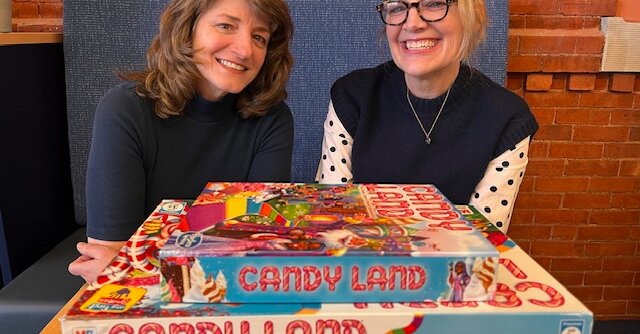
We are neighbors and friends, and also writers who happen to love discovering odd historical details. One of us was trying to come up with a candy-themed joke for a caption contest in The New Yorker when we learned that a woman named Eleanor Abbott had dreamed up the game Candy Land.
And she did it from her bed in the polio ward of a hospital.
Like most Americans, we both played Candy Land as children. Our own children played it, too. Yet we had never stopped to think about who had created the game or why. We needed to find out more.
Soon we realized that not much was known about Abbott. She had a very small social circle, never married and had no children. No journalist had ever interviewed her about her creative process. There was no one to carry the torch of her legacy. Could we be the ones to do that?
We became fascinated — and borderline obsessed.
Abbott had created Candy Land during a polio outbreak in 1948 as a way to bring joy to children who were quarantined in the hospital. And in an odd sort of parallel, soon after we started looking into her, the world went into lockdown as the coronavirus began spreading. It felt strange to research one pandemic in the midst of another.
We did what we could from our living rooms, diving into Abbott’s genealogy online and tracing her family’s path from Canada to California. We took a chance and called the phone number of Abbott’s last known address in San Diego. To our surprise, someone picked up.
No, she hadn’t known Abbott, she said, but she suggested that we speak with a neighbor who had. She also knew of a retired investigative journalist named Paul Krueger who was taking on small local jobs. We hired him.
Krueger pulled documents, knocked on doors in Abbott’s neighborhood and visited the historical society. Among his findings was the devastating report that listed her cause of death as suicide.
But even with those details, Abbott remained elusive.
We secured a copy of her will and contacted the dozen or so people to whom she had left money. The only one to respond was Larry Karman; Abbott had been his babysitter some 70 years earlier.
His fond memories of Abbott breathed life into her story. She was kind and smart, he told us. She wore slacks, never dresses, and always carried a pencil stub in her pocket so she could do the daily crossword or jot down ideas.
Karman recalled that she had tried to invent another game after Candy Land, but hadn’t succeeded.
After eight months of research, we tracked down the only known photograph of Abbott, through the Monrovia Historical Society. (The photo we found online was of a different Eleanor Abbott). The day we saw the picture, from her high school yearbook, we nearly cried. We stared at her image: strong nose, short brown hair, a floppy white collar against a dark sweater. She began to feel real to us.
Abbott had drawn a prototype of her game on butcher paper at her kitchen table and sold it to Milton Bradley. We have spent many long afternoons trying to see if that drawing still exists. If it was stored in the company’s archive in Springfield, Mass., we were told, then it had likely been discarded or destroyed in a fire.
Together, we have speculated, researched and loved this woman into existence.
We have a roll from Abbott’s player piano that Karman sent us, along with a page that she signed in his sixth-grade autograph book. These are the few treasures left of her — besides, of course, her classic game.
The post Tracing the Sweet Origins of Candy Land appeared first on New York Times.