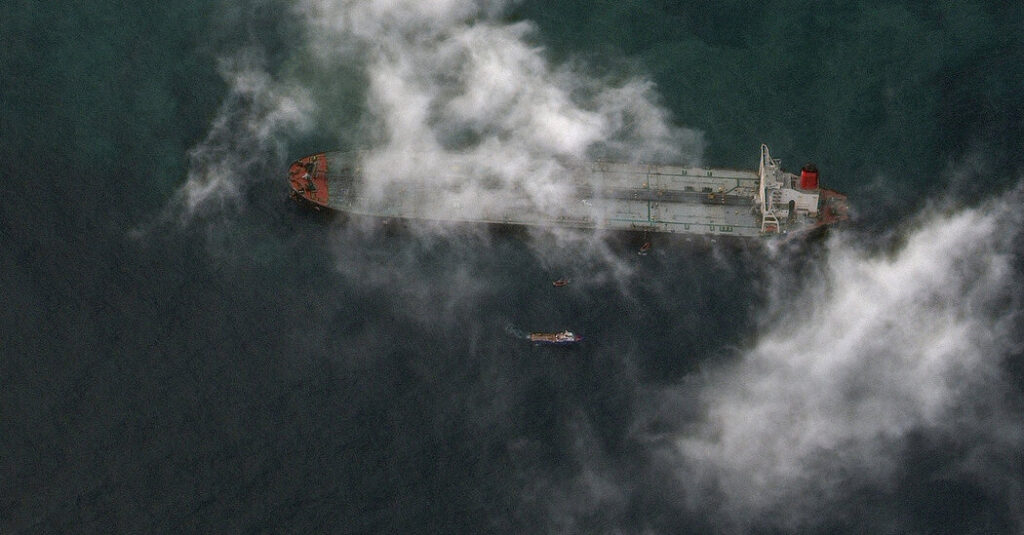
In an effort to crack down on nations it views as promoting terrorism, the Trump administration has been carrying out a campaign of seizing tankers carrying oil, a move the president has repeatedly characterized as a financial boon for Americans.
But there’s a problem.
The seizures have put the U.S. government in a financial bind. The ships are highly expensive to maintain. And the Trump administration cannot legally sell their oil without a judge’s permission.
Maintaining the seized tankers has already cost the United States tens of millions of dollars — in one case, $47 million in only three months — and complicates Mr. Trump’s claims of swift financial victories from his military operations targeting Venezuela and Iran.
The situation is laid bare in U.S. District Court in Washington, where Trump officials are detailing the financial burden of maintaining a seized tanker.
Consider the case of Motor Tanker Skipper No. 9304667.
The United States seized the tanker and its more than 1.8 million barrels of Venezuelan petroleum on Dec. 10 as it made its way from Venezuela to Asia.
Since then, the costs to maintain the tanker and its oil have mounted.
The government has already spent $47 million repairing and maintaining the aging ship, which is only valued at $10 million, federal prosecutors said in a court filing. And it will most likely need to spend another $5 million over the next few months to cover insurance and crew, among other costs.
Moreover, storing the ship’s oil costs the government $15,000 per day, or about $450,000 per month.
“I know that aircrafts, vessels and cargos pose unique challenges in asset management,” Gene Patton, a top Justice Department official, wrote in a court filing. “These assets have maintenance and storage costs that far outstrip standard assets. The larger assets in these categories are particularly challenging to maintain, as crews may need to be retained for around the clock servicing, and only limited locations can store such items.”
The petroleum cargo seized from the ship has a value of $120 million to $135 million, Mr. Patton wrote. On Thursday, federal prosecutors asked a judge to allow the Justice Department to sell the tanker and the oil, even before a final ruling on whether the United States is allowed to keep it. The funds would then be held in a bank account until the judge rules.
In past crackdowns on sanctioned oil, American authorities intentionally avoided seizing the tankers themselves because of the costs involved — sometimes even siphoning off the more valuable oil at sea and letting the ships sail on.
But the Trump administration says it is not always the best plan, legally or operationally, to merely seize the oil, and has instead opted to seize the tankers as well. In its recent crackdown, the United States has seized 10 tankers with ties to Venezuela, although it’s not clear how many it intends to keep.
Two of the ships that the United States has seized were not carrying oil at the time — meaning that the government will most likely bear much of the heavy cost of maintaining, repairing and crewing them. One of those ships is the Bella 1, which led U.S. forces on a lengthy and expensive chase across the Atlantic this winter.
The White House is also formulating a plan to expand the seizure of tankers, including those carrying Iranian oil, part of its effort to destabilize Iran’s government, according to two people with knowledge of the preparations.
Although the Skipper was carrying Venezuelan oil, the United States said it was legally justified in seizing the ship because of its past involvement transporting Iranian oil, which prosecutors have alleged is sold to finance terrorism.
Over the past two years, the Skipper has loaded more than seven million barrels of Iranian crude oil — worth hundreds of millions of dollars — from Kharg Island in Iran, according to a court filing.
Prosecutors said the ship was part of a global fleet of “ghost tankers” that carry oil from countries under U.S. sanctions, including Iran, Venezuela and Russia.
The Skipper was flying the flag of Guyana when it was boarded, but prosecutors said that was a false flag and the vessel is stateless, allowing the United States to seize it.
The Windward Shipmanagement Corporation, which owns the Skipper, is a Seychelles-registered company. It shares a Seychelles address with at least a dozen other companies that have been sanctioned by the U.S. Foreign Assets Control Office under the Iran, Russia, and Global Terrorism sanctions programs, according to prosecutors.
Should a judge approve a sale of the tanker’s oil, some of the proceeds would go to international terrorism victims harmed by state-sponsored terrorism, prosecutors said.
Despite the costs, White House officials say the seizures are worth it because they hold businesses and countries accountable for attempting to get around U.S. sanctions.
A senior White House official said the administration believed the seizures discouraged bad actors from doing business with the government of Nicolás Maduro, before U.S. intervention to remove him, and they are continuing the operation to harm Iranian finances.
Christiaan Triebert contributed reporting.
Luke Broadwater covers the White House for The Times.
The post The Oil Tankers Trump Seized Are Costing the U.S. Millions of Dollars appeared first on New York Times.