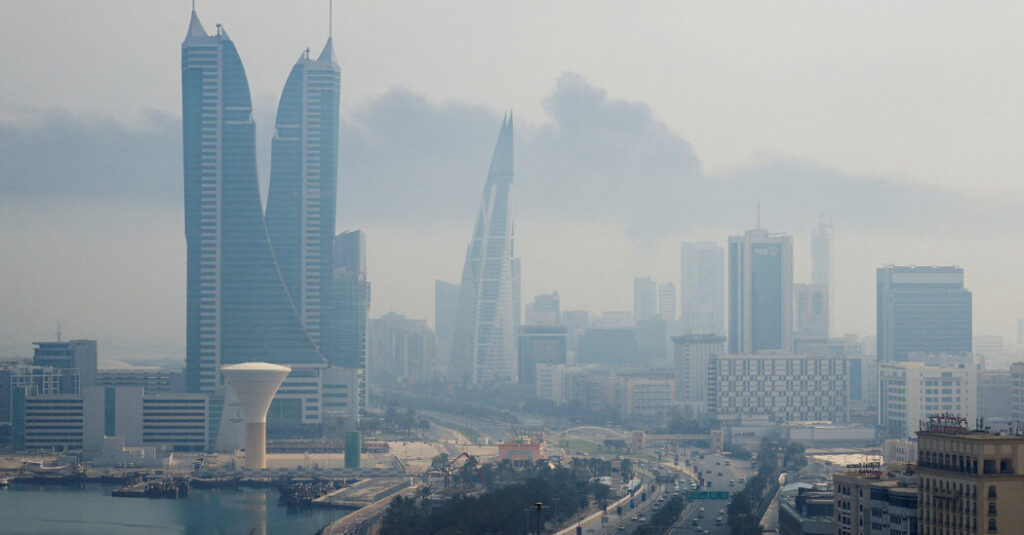
In 2019, Amazon built its first data center in the Persian Gulf in Bahrain. Three years later, it expanded to the United Arab Emirates. In 2024, it began more than $10 billion in new projects across Saudi Arabia.
The moves helped Amazon stake a claim to one of the world’s fastest growing regions, where deep-pocketed governments and investors wanted in on the digital economy and artificial intelligence race.
“We look forward to helping drive innovation and talent development across the kingdom,” Andy Jassy, Amazon’s chief executive, said in a visit to Saudi Arabia last year with President Trump and other tech executives.
But Mr. Jassy’s plans were thrown into chaos on March 1 when Iranian drones damaged Amazon’s data center in Bahrain and struck two others in the U.A.E. Many customers who relied on the data centers for computing power remain in limbo.
American tech companies are facing a new reality in the Persian Gulf two weeks into the U.S.-Israeli war against Iran. The region — seen as a safe haven for investment, cheap energy and hands-off regulation — became a hub for building the data centers needed to create and deliver A.I. software. Google, Microsoft, OpenAI and other American firms flocked to the area for its growing economies and its convenient online transmission links to Africa and Europe.
Across the Middle East, total spending on consumer and business technology reached an estimated $65 billion last year, up from $36 billion in 2020, according to the research firm IDC. Spending on technology for data centers and cloud services rose 75 percent last year to $895 million.
Yet as the war drags on, the tech giants’ bets in the region look increasingly vulnerable.
This week, Iran threatened wider attacks against “enemy technology infrastructure” belonging to seven U.S. tech firms — Amazon, Microsoft, Google, Palantir, Nvidia, I.B.M. and Oracle. On Thursday, Mojtaba Khamenei, Iran’s new supreme leader, raised further concerns with a vague warning that the country would be “opening other fronts where the enemy has little experience.”
Cheered on by President Trump, who helped broker deals between American tech giants and Gulf nations, the tech companies have downplayed the geopolitical risks of putting critical infrastructure in one of the most combustible parts of the world. Now a strategy pushed by the Trump administration as a key advantage in the A.I. race risks becoming a major liability because of a war the administration started.
In the past couple of weeks, the tech industry has learned lessons that oil producers and global banks have struggled to navigate for decades, with billions of dollars of A.I. investment thrown into question.
“The energy sector is much more experienced in dealing with traditional geopolitical risks than the tech sector,” said Steffen Hertog, a professor at the London School of Economics and Political Science, who is an expert on the Gulf economies. “Most non-energy investors in the Gulf underpriced risk before the current war, including U.S. tech companies.”
After Amazon’s data centers were damaged by Iranian drones, many businesses in the region lost access to their networks.
“They got knocked out,” said Simon Williams, a former Amazon employee who is now an executive at the A.I. company Atelic AI in Dubai. “We lost all our access to our servers. It’s had a major impact on our business.”
Mr. Williams is optimistic the region will remain a hub for tech investment. Yet he has not had any luck reaching Amazon representatives to regain access to key materials stored on the company’s cloud.
“It’s been a black box,” he said. “They didn’t have the best disaster recovery system.”
In a statement, Amazon said it was “adjusting operations in response to the evolving situation, including temporary pauses where necessary.”
Google said it was monitoring the situation and that “our focus is on the safety and well-being of our employees in the region.” Microsoft declined to comment.
Dave Komendat, Boeing’s former top security officer, said data centers make attractive targets in a conflict because they are a new form of critical infrastructure. After Amazon’s data centers were hit, companies will give greater consideration to security risks before building, he said.
“This is a low-frequency, high-impact event,” said Mr. Komendat, now a partner at Corporate Security Advisors, a security consulting firm. “It may not happen again or it may happen 10 more times.”
The issues illustrate the centrality of American tech giants to geopolitical clashes, pushing key tech capabilities into areas that could turn them into choke points.
Widening spillover effects of the Iran war are expected to hit the tech industry. That includes disrupted supply chains, soaring prices for natural gas needed to power data centers, and rising costs for commodities like plastic and aluminum that are essential for making electronic components.
“The real weapon is not the drone; it is the insurance cancellation, the rerouted tanker, and the investor who pauses,” Strategy International, a research and policy think tank, said in a recent report.
Tech vulnerabilities are evident in other parts of the world. China controls much of the world’s hardware manufacturing. In Taiwan, which China has threatened to take by force, one company, TSMC, produces the majority of the world’s advanced microchips. And South Korean plants within artillery distance of North Korea turn out much of the world’s memory chips.
Xiaomeng Lu, a director at Eurasia Group, a risk-management consultancy that studies the interaction of emerging technologies and geopolitics, said the Iran war will bruise the efforts of Gulf countries to lure major tech companies, particularly to the United Arab Emirates, which neighbors Iran.
“Their ambitions are built on the assumption of geopolitical stability,” she said.
The magnitude of the war’s ultimate impact may partly depend on how it is resolved. If the war ushers in new Iranian leadership that is less confrontational with the United States and Israel, it could bring more stability and investment, Ms. Lu said. But if the Iranian government is weakened but remains in power, it could create the risk of further disruptions and conflict in the years ahead.
“Time frame is key,” she said. “If the war wraps up within a month, people will forget about this. If it goes on for months and months we’ll be in very different territory.”
Karen Weise contributed reporting.
Adam Satariano is a technology correspondent for The Times, based in London.
The post U.S. Tech Giants Flocked to the Persian Gulf. Now They Are Targets. appeared first on New York Times.