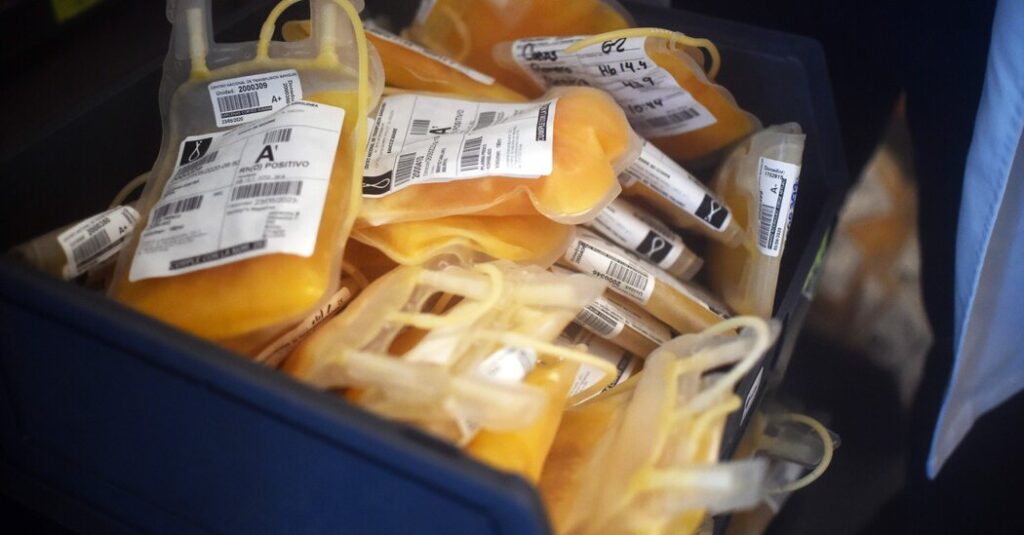
For the past year, Mathew MacMillan, a postal worker in Winnipeg, Manitoba, has had a new routine: dropping by a for-profit clinic twice a week to donate his blood plasma and make a little extra cash.
The clinic is open almost every day, and since he became a regular, Mr. MacMillan has made it a habit to switch arms — using his left arm for the needle on Tuesday and his right one on Friday — so he doesn’t develop scars.
“A hundred dollars isn’t a lot of money, but it does help pay for groceries,” Mr. MacMillan, 47, said of the compensation, which comes to about $85 a week. When he and his wife go out for dinner, he said, he jokes that “this is my blood money.”
Donating plasma, which is used to make lifesaving medicinal products, is widely perceived as low-risk. But questions about the safety of the practice arose this week when Canadian health authorities confirmed they were investigating two recent deaths of people who gave plasma at for-profit clinics in Winnipeg operated by Grifols, a Spanish health care company.
Millions of people donate frequently in North America. An estimated 60 to 70 percent of plasma-derived medicinal products worldwide are made from plasma donated in the United States.
And demand for plasma is growing. The market for plasma-derived medicinal products is valued at $40.35 billion and is expected to double over the next eight years, as the products are used to treat an expanding number of conditions, including immune deficiency syndromes and bleeding disorders.
But the health impact of frequent plasma donation on the donors themselves has not been well studied, and there is no consensus among health regulators about how long donors should wait between plasma draws.
In both Canada and the United States, companies can pay people an honorarium for donating their plasma, and health regulations say that people can donate up to twice a week. But within each country, guidance varies. Two Canadian provinces, British Columbia and Quebec, have banned the practice of paying for plasma. In the United States, the Food and Drug Administration says that donors should wait at least two days between draws, while the Red Cross has a limit of once every four weeks.
The first randomized controlled clinical trials examining the impact of very frequent plasma donation were published only in the last couple of years. They raised concerns, finding that frequent donors had lower concentrations of proteins, antibodies and other bio-markers in their blood after several months, and that the reductions increased when people donated more frequently.
Abnormally low levels of antibodies could put donors at risk of infections, said Dr. Morten Haugen, an author of one of the trials.
The long-term impact of frequent plasma donations is also unclear. Studies that have followed donors over time can be unreliable, experts say, because of what they call the healthy donor bias.
“When you follow blood donors over the years, you find that they actually look more healthy than the rest of the population,” Dr. Haugen said. But that can be misleading, because people have to be relatively healthy in order to qualify to donate plasma. “If you have an infection, you won’t be accepted as a donor, and you will be out of the study.”
Europe takes a far more conservative approach to plasma donation, though it relies heavily on plasma products imported from other countries. The European Union adopted regulations saying that donations of blood products and some other human-derived tissues should be voluntary and unpaid. The European Blood Alliance, an association of nonprofit blood banks, recommended capping donations at twice a month, citing a lack of long-term safety data.
Donating plasma is similar to donating blood, but differs in that once the blood is drawn, plasma — a pale yellow liquid — is separated from red blood cells, which are then returned to the donor’s body. Because the red blood cells are returned, people can generally donate plasma much more frequently than they can donate whole blood.
The practice has long been considered safe, and serious adverse events and deaths are extremely rare.
Dr. Philippe Vandekerckhove, the chief executive of the Belgian Red Cross, said: “The most common incidents we have are bruises afterward, or people who faint shortly after, which can be dangerous if they’re driving home in a car. This is a safe procedure.”
Plasma donors undergo medical screening before draws and are warned about other transient side effects like fatigue, dehydration and dizziness.
A 2020 investigation by the F.D.A. into 34 deaths reported as being associated with plasma donation did not determine that donation was the cause of death in any of the cases. It ruled donation out entirely as a cause in 31 cases.
Some factors that could put donors at risk of severe adverse reactions or death are unknown or undisclosed health problems or heart conditions, experiencing a severe allergic reaction to an anticlotting agent used in the donation process, developing a severe infection, or defects in the machine that could cause an air bubble to enter the bloodstream, experts said.
For many people in North America, payments for plasma donation are an important source of supplemental income. In Canada, the recent deaths of plasma donors have renewed scrutiny of the ethics of the practice, especially as concerns about high cost of living have dominated the country’s politics.
Canadian Blood Services, a nonprofit that manages the country’s blood supply, long opposed allowing private operators to collect plasma in exchange for incentives like cash or gift cards. The organization was worried that private companies would use plasma collected in Canada to make pharmaceuticals sold around the world rather than in Canada.
But by 2022, the organization had changed course and entered an agreement with Grifols — the company now linked to two deaths in Winnipeg — to increase private plasma collection. Grifols is now the largest private plasma company in Canada.
Robert Naumko, 63, a pianist, began giving plasma at Grifols in Winnipeg in January 2025. He relies on the $85 each week to supplement his rising grocery bills and rent payments, especially when he’s not working regularly. “It’s extremely helpful,” Mr. Naumko said.
When asked about the recent deaths, he noted that the clinic’s staff had built his trust over the visits, which last just over an hour. “The staff are gregarious and caring,” he said.
Roni Caryn Rabin is a Times health reporter focused on maternal and child health, racial and economic disparities in health care, and the influence of money on medicine.
The post How Safe Is Plasma Donation? appeared first on New York Times.