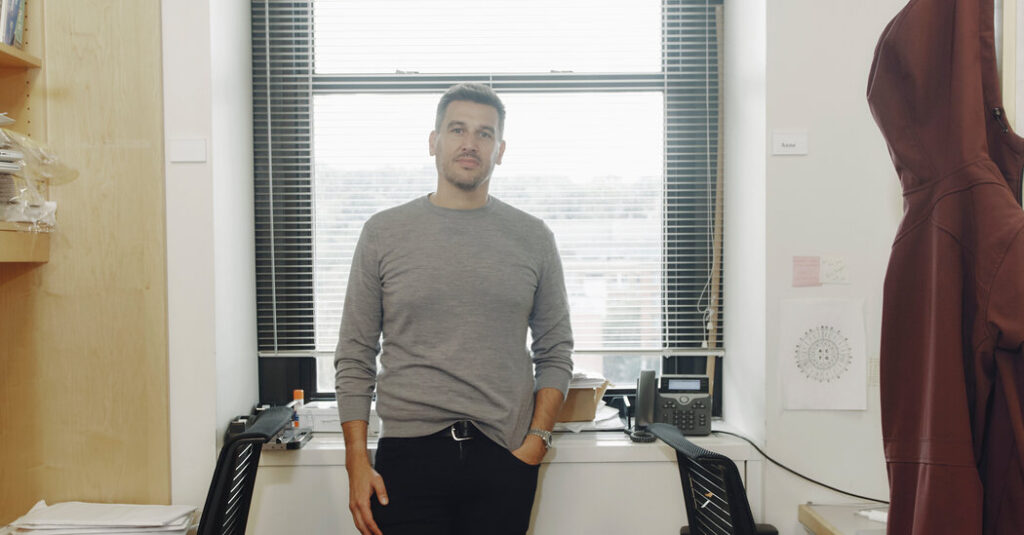
Will Mair, a Harvard University professor who studies aging, was preparing to lead a panel discussion one afternoon last May when he picked up his phone to review the questions he planned to ask.
He was standing in a room at Harvard Business School, near a row of stools set up for the panelists. Peering at the screen, he saw a flurry of text messages, and then an email bearing staggering news:
“You are receiving this email because one (or more) of your projects have been terminated per notice from the federal funding agency.”
Weeks earlier, Harvard had refused to comply with the Trump administration’s demands for sweeping changes to its operations. Now the White House had retaliated, cutting off billions of dollars in research grants and contracts.
Dr. Mair felt a surge of adrenaline. He and his colleagues had feared this would happen; still, seeing it in writing was jarring. “Check your email,” he murmured to the panelists. Yes, they nodded; they, too, had lost their funding.
There was no time to collect himself. Dr. Mair perched on a stool, lifted a microphone with trembling hands, and turned to the unsuspecting audience.
“I was going to talk about aging,” he later recalled telling the group of business leaders, participants in a training program at the business school. “But our federal funding is gone. And I don’t think we can talk about the science without talking about that.”
One by one, the panelists did so. One scientist had lost funding to analyze old baby teeth for clues about how early environmental exposures affect aging. Another faced the shutdown of her research on dementia in poor countries.
An audience member asked why Harvard researchers need federal funding. Couldn’t their work be paid for by private donors, and by corporations that could benefit from their findings?
It was true that sometimes, products emerged from decades of biomedical research and made billions of dollars. Weight loss drugs like Ozempic and Wegovy were recent examples. But the path to such discoveries was long, Dr. Mair explained to the audience, requiring years of costly unplanned detours.
“No for-profit company could possibly withstand all the false leads required by that process,” he recalled telling them, “all the weird, random science that never panned out.”
For Dr. Mair, 47, a native of Britain and a professor of molecular metabolism at the T.H. Chan School of Public Health, chasing breakthroughs felt critical and urgent. A century of scientific progress had added decades to average life spans, yet human bodies were still ravaged by time. He envisioned a new, interdisciplinary research center at Harvard where leading scientists would team up to help people age better, cutting global health care costs and easing suffering.
His dream project had a name — the Center for Healthy Aging — and he had begun raising money for it. He sometimes described it as an “aging moonshot,” a reference to President John F. Kennedy’s push to send a man to the moon in the 1960s.
Given what had just happened to Harvard’s federal funding, including more than $1 million promised to him and others on his research team, such ambitions now seemed fanciful.
To keep his lab afloat, at a cost of $1,000 to $2,000 per day, Dr. Mair would have to find new ways to pay for it. It was tempting to consider fleeing to a university that was not squarely in the Trump administration’s cross hairs. But he had taken great pride in Harvard’s refusal to capitulate. And who could say how safe he would be elsewhere?
“I desperately want to stay here,” he said, “to try and defend this university.”
Everything he had once taken for granted — the assumptions on which he had built his life’s work — seemed to be unraveling. To find a way forward, he suspected, would demand a total transformation.
‘The Place to Do Science’
Dr. Mair had been obsessed with the mysteries of aging since he was in college and spent a summer working in the lab of David Gems, a British biogerontologist who manipulated the genes of worms to extend their life spans. The variability in people’s aging fascinated him. What were the critical differences in their lifestyles, habits, diets, ZIP codes?
He was drawn to pursue his work in the United States, where the patient, open-ended system of funding scientific research was unlike any other in the world. He had qualms about his adopted country: its gun culture, its inefficient health care system. But nothing could diminish the global impact of its National Institutes of Health.
“I came because America was the place to do science,” he said.
Twenty years later, it was hard to imagine a more impassioned champion for academic research than Dr. Mair. He was energetic and animated when he talked about his work and why it mattered, with a gift for simplifying complicated concepts.
He was also impatient and outspoken, blunt about the role he thought Harvard should play. And he felt deeply responsible for those who labored in his lab. He went out of his way to foster bonding, organizing Halloween costume parties and counseling younger scientists long after they had left his staff.
Dr. Mair had been granted tenure in 2024, making his job secure no matter what happened. His employees were much more vulnerable.
A day or two after they lost their funding, Dr. Mair stepped into his lab and asked the staff to gather in a nearby break room.
Their work space stretched along an upper floor at the Chan school. Amid fancy microscopes, shelves of test tubes and white boards covered with indecipherable calculations hung a handmade sign that read “No Science No Future.”
Dr. Mair had been advised to lay off employees. Instead, he told them, he would use money he had negotiated as part of his tenure agreement — several hundred thousand dollars that were meant to be a “rainy day” fund — to keep their team together for as long as he could.
“No one is coming to save us,” he told them.
Among those listening was Anne Lanjuin, the senior research scientist who had worked beside Dr. Mair for a decade. She managed the lab’s daily work while he made the rounds as its public advocate.
Dr. Lanjuin felt hope stir as Dr. Mair laid out his plan.
“It was remarkable,” she said later. “It felt like we were all in it together. And it felt like he was fighting for us.”
Dr. Mair knew what he had to do — find new sources of funding, fast. But it would require new skills and relationships. He wished the university could tap its endowment — then worth $53 billion — to give the Chan school a loan in the meantime, so it wouldn’t lose so much momentum.
Among the schools at Harvard, Chan was especially vulnerable to federal cuts, with about 40 percent of its revenue coming from the federal government. And its alumni, employed in the relatively low-paying field of public health, had less to donate than other Harvard graduates.
Dr. Mair had long thought of Harvard as “a rich uncle — one you don’t ask often, but who would help you in a bind,” he said.
Now, he wasn’t sure: The uncle he respected for taking a stand against President Trump might expect him to navigate this crisis largely on his own.
There was no question his work would suffer. Research would continue, but with a more cautious, frugal approach.
His lab had been testing a new piece of equipment that allowed for the most seamless analysis yet of the transparent organisms, called C. elegans, that their research relied on. Dr. Mair had considered buying the high-tech device, priced at $250,000, with the money from his tenure agreement. It could help him test his theory that a breakdown in the way that older bodies process fuel is a key contributor to unhealthy aging.
But the money was needed to pay salaries now. In August, lab employees would ship the equipment back to Switzerland.
“It allowed us to do science we never did before,” said Dr. Mair. “But it became a direct choice between fancy equipment and keeping people here.”
He had made the choice he could live with.
Embracing Discomfort
As summer began, Dr. Mair and his family retreated to a relative’s rural home in Connecticut for a few days of peace and quiet. It was a respite from the turmoil at the Chan school, where multiplying budget cuts included a 25 percent salary reduction, effective July 1.
Sitting by himself one afternoon on a back patio, savoring the calm, Dr. Mair noticed a new email on his phone. He recognized the sender at once.
The message would reveal the score assigned to his latest application for federal research funding. If there were still funds to be had, the rating it contained — an assessment of his research goals by expert peers — would have set his lab’s course for the next five years.
“Do I even open it?” he wondered.
When he did, he could hardly believe it: His proposal had been ranked in the top 1 percent of submissions. The money he had sought — $2 million over five years — might not be coming. But here at least, on paper, his work had been deemed worthy.
Three weeks later, Dr. Mair stood at the entrance to the exclusive Sankaty Head Golf Club on Nantucket, ready to try a new way of cultivating research funding.
He was armed with a freshly polished PowerPoint slide show and accompanied by an all-star lineup of Harvard research colleagues. They were there to start a conversation with potential donors, to explain their work and why it mattered.
“Does it translate into money? No one knows,” Dr. Mair said later. “But it made me feel like I was taking action.”
August was peak season for the club, perched above the Atlantic Ocean. It was not a setting where Dr. Mair felt fully at ease. But discomfort was a feeling he was trying to embrace now.
“We can’t control the president, or Harvard,” he said. “So what can we do? Say yes to things.”
At the golf club, and at a second Nantucket event hosted by a Harvard Chan alumna, audience members asked questions about their own aging, and about the anti-aging products they saw online, ones promising to make them look and feel younger. How could they tell what was real?
Their curiosity reminded Dr. Mair how vital his field was. Aging was not a partisan issue; it affected everyone, and the burden it placed on the health care system was unparalleled. There were reasons that clams could live 500 years, and whales could live 200. They could find out why if they kept looking.
The meetings on Nantucket would ultimately yield some money for nutrition research, but no direct payoff for Dr. Mair’s lab. Still, it felt to him like a good start.
Two Big Decisions
In early September, a court ruled that the Trump administration had broken the law in freezing Harvard’s research funding. It felt like a victory, and afterward, some faculty members’ grants were restored. But Dr. Mair’s money was caught in a complicated tangle.
The funding freeze had caught him at the end of his five-year funding cycle. His previous five-year grant was almost gone, and was now terminated. He had applied for another round of government support, and had received a sky-high score — but the new money was still pending. So when Harvard stepped up and covered portions of some active grants to help keep research going, Dr. Mair and his nearly empty coffers were passed over.
Yet no one knew if or when new grants would be processed, within a funding system stricken by layoffs, restructuring and a six-week government shutdown.
Dr. Mair felt a sharper urgency. He had told his staff members that he could cover their salaries until March 2026 — only six more months.
With his lab mired in uncertainty, he had decided to take on a new role as a part-time consultant to a for-profit company. The venture, co-founded by the Hollywood mogul Jeffrey Katzenberg, planned to expand its investments in aging research, and Dr. Mair would help decide where the money went. The company would not help fund his lab. But it would give him new connections, in a realm where potential donors might one day be found.
For years, he had watched colleagues leave academia for more lucrative jobs. But even as aging research became a hot commodity, sought out by youth-chasing billionaires, “I always said I’d be the last one left,” Dr. Mair recalled.
Someone had to stay on campus, to ensure quality teaching and training for future researchers. “It’s a pipeline,” he said. “There’s no pharma without academia.”
But what if academic funding became so unstable that he could no longer do his research? Might he then leave, too?
“No one knows yet,” he said, “what this will look like in five years.”
He had made another decision in the midst of the disruption: to become an American citizen. In his two decades in the country, it had never seemed necessary. But now the Trump administration was going after international students and researchers. The self-assurance he had once felt passing through airports, crossing borders, as a Harvard professor with a green card, was gone.
In October, he traveled to Malta to lead a long-planned conference on aging — after nearly canceling the trip because he lacked the funds for airfare. Flying back home, grateful for the days immersed in dialogue with other scientists, he took comfort in knowing he would re-enter the county with the protection of his new U.S. passport.
Then, at Logan Airport, an officer pulled him aside at the passport control checkpoint and started asking questions: What kind of research did he do? Who were his collaborators? What countries did his postdocs come from?
His hands shook as he answered politely, hiding his disbelief and mounting anger. After about half an hour, they let him go.
“I’m very grateful for what America has given me, but I’ve also given back a lot,” he said days later. “It feels unfair to be treated like a danger.”
A New Normal
As the year ended, negotiations between Harvard and the White House entered an eighth month. The Trump administration announced in December that it would appeal the court ruling that had blocked its freeze on Harvard’s research funding. Most of the funds the government had withheld from Harvard, $2.2 billion in grants and $60 million in contracts, had been restored. But Dr. Mair still had no idea if or when his grant might come.
To extend his pledge to cover salaries for his staff, he had enacted deeper cuts, slashing his lab’s budget for experiments by 80 percent. Some employees had left. He had taken no new postdoc assistants. The lab felt like a ghost town.
The campus atmosphere remained apprehensive. The tensions between Harvard and the White House hadn’t gone away; at any time, disruption could erupt again.
In mid-January, Dr. Mair received a text from his grants manager. “NIH says we’ll have an NOA on Friday!” it said.
The NOA, or notice of award, would mean that his top-ranked research proposal would finally be funded, freeing him from his painful limbo. He should have felt elated. Instead, he felt uneasy.
“I’ll believe it when I see it,” he said.
If the money did come, Dr. Mair said, he would not consider it a return to normalcy. He would keep seeking private funding opportunities. He would apply for more grants, keep a smaller staff, “figure out how to do science differently, to buffer my work against uncertainty.”
He could not imagine sliding back into his old sense of assurance. Already, that kind of trust in the system felt like a vestige of the past.
On the designated Friday, the hours crept by with no word on his grant. He put it out of his mind, and headed to dinner with his family at a Chili’s restaurant. There, after 6 p.m., the news arrived: He would receive $1.6 million from the N.I.H., to support his research for the next five years.
Whatever time the money bought him, he vowed to use it wisely. And when the tide turned again, he would be ready.
Audio produced by Adrienne Hurst.
Jenna Russell is the lead reporter covering New England for The Times. She is based near Boston.
The post His Harvard Lab Was Thriving. Then Came the Cuts. appeared first on New York Times.