We have bad news and more bad news for you.
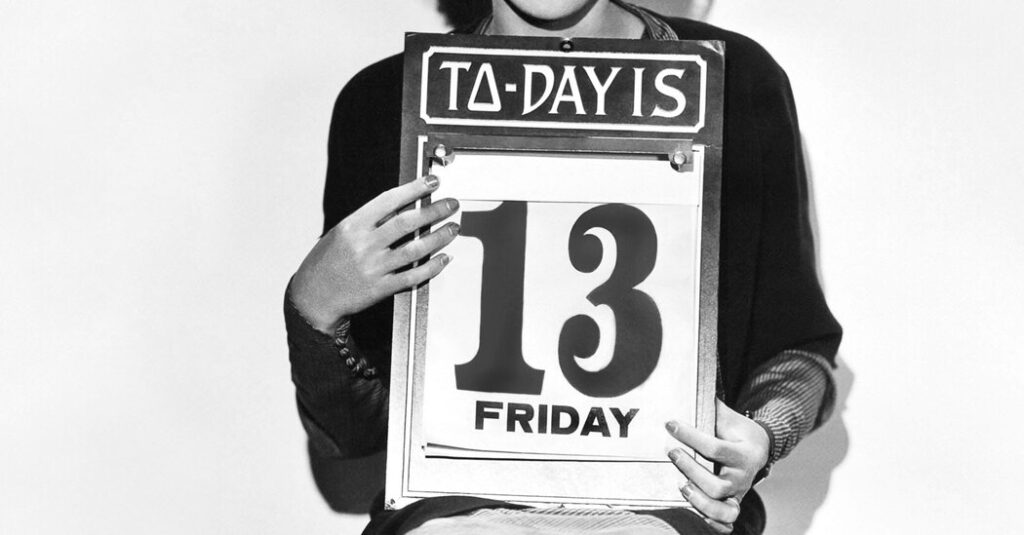
This Friday is Friday the 13th, a day infamously associated with unlucky things. You may be wondering, “Didn’t we just have one of those?” Yes we did. Last month. But we’re not done. There is one more coming this year, in November.
This is a tough year for people with friggatriskaidekaphobia, which is, yes, a fear of Friday the 13th. (Apologies if you have hippopotomonstrosesquippedaliophobia, or a fear of long words.)
A calendar year with three Fridays the 13th comes around more often than you might think. It has already happened twice so far this century, in 2009 and 2015. For those of you unburdened by gnosiophobia (a fear of knowledge), here is a closer look at this quirk of the calendar.
Three Fridays the 13th in a year? What are the odds?
We asked Marty Ross, an Australia-based mathematician and an author of, among other titles, “A Dingo Ate My Math Book,” to crunch the numbers.
It’s not simple because, as Ross put it in an email, “calendars are a mess and, in some senses, necessarily so.”
The Gregorian calendar runs in 400-year cycles, meaning that it repeats itself every 400 years. (Put another way, the months and days in the 2026 calendar align with the one for 1626.) Within that 400-year cycle, there are only 14 possible calendar configurations. That’s because Jan. 1 can fall on one of seven possible days, and a year is either a Leap Year or it isn’t, creating two sets of possibilities. Seven times two is 14.
Is your head swimming? Ours too.
We’ll cut to the chase: There are 59 years in the 400-year cycle with three Fridays the 13th, Dr. Ross said: 44 in common years and 15 in leap years. A common year that begins on a Thursday, as 2026 did, will have three Fridays the 13th, in February, March and November, and a leap year that begins on a Sunday also will have three, in January, April and July.
No more than three Fridays the 13th can fall in a given year, and every year has at least one.
Why do we care about Friday the 13th, anyway?
The origins of the Friday the 13th superstition are murky. It is believed to be a relatively recent Western phenomenon — bad luck is associated with the number 13 in Western culture, while in China, 13 is considered lucky. But that has not stopped people from looking to history or to scripture for clues.
In Christian lore, the apostle Judas, one of 13 people at the Last Supper, is said to have betrayed Jesus Christ on a Friday. Others look to the Knights Templar, the powerful Catholic military-religious order established to protect pilgrims heading to Jerusalem, whose leaders were arrested and tortured on the orders of King Philip IV of France on a Friday the 13th in 1307.
Part of the issue with 13 is that it follows 12 — an easily divisible number long associated with easily digestible things: 12 months in a year, for example, or 12 zodiac signs. Or a dozen doughnuts.
The date has long been a touchstone in American popular culture. “Friday the 13th” became a horror movie staple upon its release in 1980, and was followed by several sequels. But even decades earlier, the negative association with the day was prevalent in early 20th-century cinema, as in the 1916 silent film “Friday the 13th,” which was adapted from a 1907 novel by Thomas William Lawson.
Kendall R. Phillips, a professor in the department of communication and rhetorical studies at Syracuse University, said that early vaudeville sketches like “Superstitious Joe,” from 1913, were full of humorous references to the date. Fixating on Friday the 13th is “really our way of pretending we can control or predict a universe that is uncontrollable and unpredictable,” Dr. Phillips said. “So if you think about it, all the things we think are omens of bad luck — Friday the 13th, walking under a ladder, a black cat crossing your path — all those just become ways for us to try to make sense of the reality that is — stuff just happens.”
I’m really scared. What do I do?
If you are terrified of this Friday, you might be truly friggatriskaidekaphobic, and not just superstitious.
A superstition becomes a phobia when it “causes a significant level of distress in the person or interference in their functioning, meaning it gets in the way of their relationships, or their ability to perform at work,” said Rafaella Reytan, a psychologist at the Center for the Treatment and Study of Anxiety at the University of Pennsylvania School of Medicine.
If that sounds like you, Dr. Reytan suggested leaning into Friday the 13th through gradual exposure therapy.
“You could, of course, watch a movie about Friday the 13th every night leading up to it,” Dr. Reytan said. “You could read about spooky events that have taken place on that day. You could take a stroll with a friend and see how many ladders each of you can walk under.”
Remember the captain!
Few people have leaned harder into Friday the 13th than Capt. William Fowler, the founder of the Thirteen Club. Born in 1827, the number 13 kept coming up in his life. A New Yorker, he graduated from Public School No. 13 when he was 13. He became a builder and erected 13 structures. At 26 (13 times two), he took command of a New York State militia regiment, and led the company until April 13, 1861.
After being wounded, he resigned his commission on Aug. 13, 1863. He was so fascinated by the number 13 that he formed a supper club for the elites called the Thirteen Club, whose members tucked into a 13-course meal on the 13th day of each month in Room 13 of the Knickerbocker Cottage in Manhattan. (The first meeting was on Sept. 13, 1881.) Captain Fowler died in 1897, but his club’s roster of honorary members would include the U.S. presidents Chester A. Arthur, Grover Cleveland and Theodore Roosevelt.
Not everyone can carry off that type of commitment. But if all else fails, remember the good news: A triple-Friday the 13th year will not happen again until 2037.
Sopan Deb is a Times reporter covering breaking news and culture.
The post Bad News for Friggatriskaidekaphobes: 2026 Has Three Fridays the 13th appeared first on New York Times.