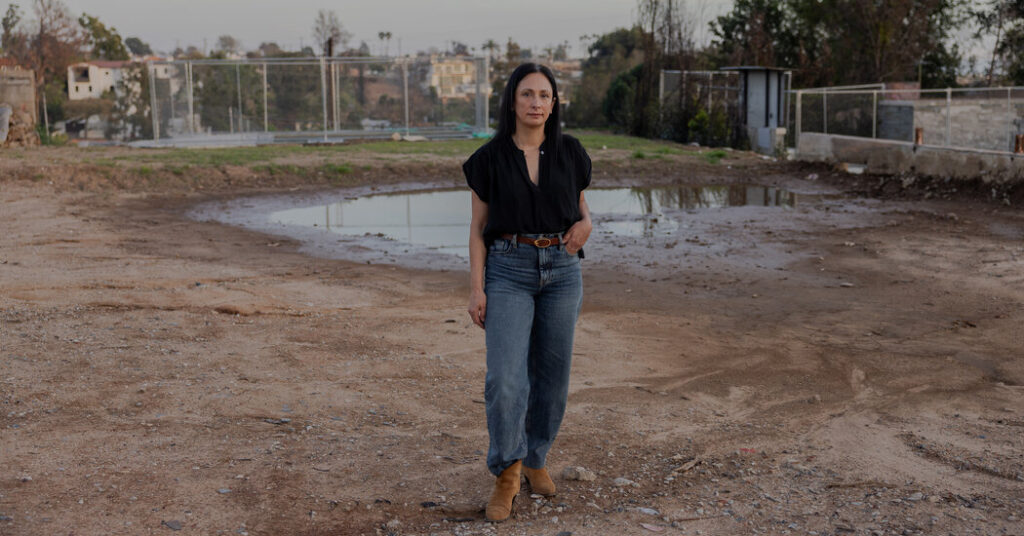
Allison Holdorff Polhill looks out at the slice of paradise she’s rebuilding near the Pacific coast, and worries.
In her backyard, a utility pole towers over a small pool — the only thing left of her home of 30 years after the Palisades fire flattened 97 percent of her neighborhood in 2025.
But sometimes when Ms. Polhill gazes across the blocks of empty lots, lonely chimneys and front steps to nowhere, she sees possibilities.
She and her husband are pouring their retirement funds into fire-resistant materials for their rebuilt home. And Ms. Polhill hopes many of her neighbors will do the same to ensure a future for the community.
It would take money, though — which may be hard to find even in this enclave where the average home sold for more than $3 million before the fire. Federal disaster aid isn’t flowing as fast as expected, local leaders say. Insurance companies are battling fire victims over every dollar. And billions more the community is seeking from Congress may not materialize.
City officials are considering a proposal to allow the Palisades to take some local property tax gains and create a climate disaster resilience district. The funds could help people afford the roofing, windows and stucco that vendors were hawking at a recent recovery expo here, along with promises that homes could be slower to burn when the next fire comes.
To prevent future megafires, the community could bury power lines and invest in cisterns to store water. Adapting to rainstorms from intensifying systems known as atmospheric rivers will require stabilizing eroding slopes. Evacuation routes and emergency drills need improvement.
“The Palisades could be a model,” Ms. Polhill said.
But the resilience program is stalling here. It’s a complicated and expensive project, made more difficult by distrust in local government, conspiracy theories about hidden agendas and concerns about fairness and affordable housing.
“We are so many billions of dollars behind the curve,” said Traci Park, a Los Angeles city councilwoman representing the Palisades who proposed the resilience district. “We have no choice but to rebuild this community.”
Why Fire Prevention Faces Skepticism
Concerns about building materials, water supplies and evacuation plans arose before the smoke had even cleared from the Palisades fire and the Eaton fire, which burned through unincorporated Los Angeles County about 25 miles to the east.
The windstorms that fanned the blazes couldn’t have been prevented. But many Palisades residents felt glaring deficiencies in preparations and response made the destruction much worse.
They want to be better prepared next time. Months after the fires, Ben Allen, a state senator whose district stretches along the coastline, proposed a new regional body known as a resilient rebuilding authority, which would help streamline reconstruction while promoting disaster prevention.
But the fires sowed deep distrust in government across Los Angeles, and conspiracy theories about Mr. Allen’s proposal began to fester. Fears arose that it would take development decisions away from residents and bring in denser housing. Backlash killed the proposal last summer.
Now communities are taking a more piecemeal approach to the problem. In Los Angeles County, supervisors are exploring a resilient rebuilding authority of their own, covering the Eaton fire scar and areas affected by the Palisades fire that are outside city boundaries. Lindsey Horvath, a county supervisor, helped lead the push for a broader regional approach as leader of the Blue Ribbon Commission on Climate Action and Fire-Safe Recovery, a local panel launched after the fires.
“We can still do this at the local level,” Ms. Horvath said.
The idea of a Palisades resilience district has faced skepticism in the City Council, despite a recognition of the urgent need. The question isn’t whether climate resilience districts should exist — but whether the Palisades should get to create one first, when so many communities have similar needs but fewer resources.
“Several of us would like to create C.R.D.s in our own districts, but there are potentially huge financial implications of us doing that,” Katy Yaroslavsky, a city councilwoman representing western and central Los Angeles, said at a December meeting. “As a city, we can’t afford to divert property tax revenue from the general fund.”
Financial questions are only getting thornier. The council voted this month to advance a feasibility study on the Palisades resilience proposal, but a fiscal briefing minutes earlier warned that wildfire-related lawsuit risks and other factors could bring a bond rating downgrade costing the city tens or hundreds of millions of dollars in interest.
More than a year after the fire, some Palisades residents are still unsure they’ll ever be able to afford to return home.
For Marcela Silva, the weeks and months after the blaze were filled with urgent needs, both big and small: “Where am I going to live right now? I need a toaster oven right now.” With those questions behind her, Ms. Silva said, figuring out the future is proving to be the hardest part.
Ms. Silva’s home in a part of the Palisades known as the Bluffs was her financial security.
After it burned down, she wasn’t able to get any assistance from the Federal Emergency Management Agency, and she is still going through tedious processes with her insurer, the California F.A.I.R. Plan. She has explored options for rebuilding, but isn’t sure she can afford a house similar to the one she got in her divorce in 2020 and that once stood valued at $4 million. She knows she is better off than some elderly and lower-income neighbors, but she also isn’t one of the ultra-wealthy Palisades residents the area is known for.
Even if she can afford to rebuild, she worries that the fire left behind toxic pollution and wonders if her new house would just feel like a matchbox waiting to burn.
Communities Grapple With Costs of Readiness
Similar challenges are popping up in disaster-struck and disaster-prone communities across the country.
A report by C.D.P., an environmental nonprofit formerly known as the Carbon Disclosure Project, found that 124 American cities were exploring resilience to climate-fueled disasters in 2024 — and that cumulatively, they faced a nearly $41 billion shortfall. Across the country, officials and residents know they need to adapt to changing weather extremes, but costs are preventing projects from moving past initial stages, said Katie Walsh, C.D.P.’s global director for cities, states and regions.
Connecticut passed a law last year allowing municipalities to create special financing districts to collect revenue for flood defenses and other disaster resilience. There hasn’t been much time for communities to digest the idea and begin exploring it, but “there’s not a rush of enthusiasm” to do so, either, said James O’Donnell, executive director of the Connecticut Institute for Resilience and Climate Adaptation.
In Maryland, two communities have created resilience authorities under a state law passed in 2020, and a third is exploring the idea.
In Boulder County, Colo., the 2021 Marshall fire helped spur passage of a 0.1 percent sales tax to harden communities to wildfires and other threats in 2022. That covers up to $500 in rebates for homeowners who take actions to lower wildfire risks, such as clearing brush, and has paid out nearly $700,000 so far. Xcel Energy, which agreed to pay $640 million to settle liability claims tied to the Marshall fire, is spending $1.9 billion on its own efforts to reduce fire risks.
Since 2022, California has allowed localities to set up resilience districts and raise public and private funding to address climate change, but none have been established yet in what is one of the country’s most disaster-prone states.
Some 400 miles north of Los Angeles in Sonoma County, an effort to pay for fire-resilient infrastructure that predated the 2022 law still lacks a steady source of funding, said Tanya Narath, chief deputy executive director at the Regional Climate Protection Authority. The 2017 Tubbs fire, which ravaged the county, was the state’s most destructive wildfire on record at the time.
Polling before the 2024 elections found strong support for actions to prepare for such disasters — but, Ms. Narath said, no appetite for a tax to pay for them.
Many Fire Victims ‘Can’t Afford to Wait’
Even if Los Angeles moves ahead with a resilience plan in the Palisades, actual investments would be years off. In the meantime, rebuilding is inching along.
Signs in the village center in the Palisades declare a Chipotle and clothing shop open, unlike most businesses. In many areas, empty lots far outnumber the few homes that survived or the others taking new shape in two-by-fours and plywood.
“Lots of folks were asset-rich but resource-poor,” said Jim Kirtley, executive director of the Palisades-Malibu YMCA.
Some residents worry that if neighbors can’t rebuild safely, they won’t come back at all.
“People are selling their lots right and left because they can’t afford to wait,” Ms. Polhill said. “We want everyone possible to be able to rebuild.”
Still, the perception is that the Palisades has the resources to move forward with its rebuild, making it a harder sell that such a “very high-value neighborhood” should be able to hold onto any gains in its property taxes, said Megan Mullin, a public policy professor at the University of California, Los Angeles.
For residents like Roseanne Landay, that is frustrating.
Ms. Landay thought she was choosing relative safety when she moved into a condominium off Sunset Boulevard in the Palisades rather than to somewhere like Malibu or Topanga Canyon, where fire and landslide risks seemed higher.
If the climate resilience district goes forward, Ms. Landay said she would push for grants for multifamily housing, where rebuilding decisions can be much more complicated and challenging. She and her husband only owned their home from the walls inward; replacing the building itself will require money from everyone in the homeowners’ association.
But many of her neighbors are seniors, widows, health care workers or teachers. They need to make decisions about rebuilding within the coming months — long before any resilience funds are available.
By the time a resilience district is set up, she said, “it’s probably going to be too late.”
Scott Dance is a Times reporter who covers how climate change and extreme weather are transforming society.
The post They Want to Rebuild. Can They Afford to Prevent the Next Fire, Too? appeared first on New York Times.