The women are sad. Sometimes they are angry, but mostly they are sad. They have lost love. Or love has betrayed them, leaving them puddled on the sofa, quivering on the floor, underdressed in the rain. But these sad women, they are stronger than they know. They will pick themselves up — by their spaghetti straps — and they will start again.
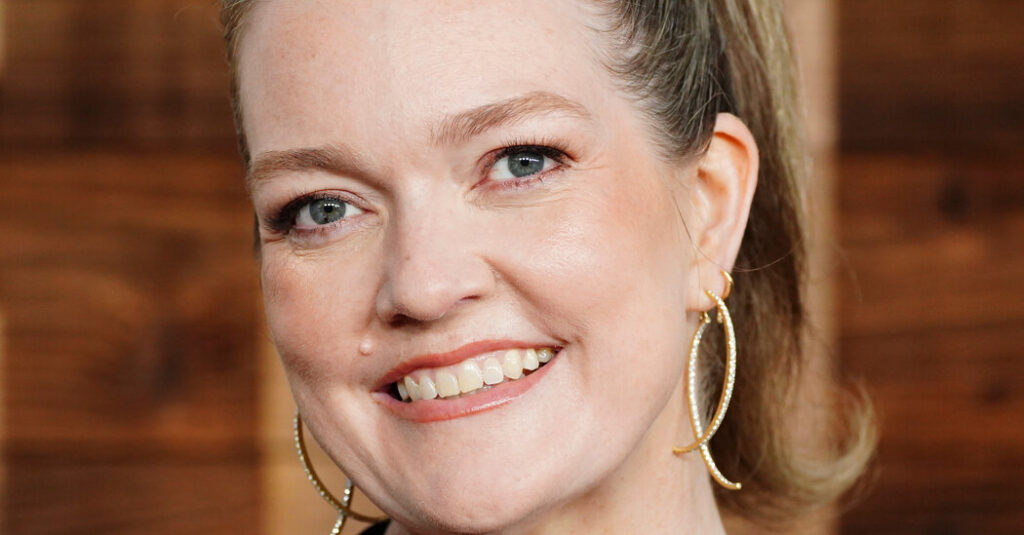
These heroines are the creations of the novelist Colleen Hoover, and more and more of them are leaping from the trade paperback page onto the big screen. “It Ends With Us” opened a year and a half ago. “Regretting You” followed last October. The romantic drama “Reminders of Him” is now in theaters, and “Verity,” a romantic thriller starring Anne Hathaway and Dakota Johnson, will premiere in the fall. Another novel, “Confess” (2015), was made into a TV series for a mobile streamer, two others have recently been optioned, and Hoover and her producing partner, Lauren Levine, are working on adapting a third. All of which makes Hoover the rare novelist — and the even rarer female novelist and the especially rare female novelist who writes stand-alone books rather than series about teen wizards — to have her work in fervid demand in Hollywood.
“I’m not sure how I got lucky,” Hoover recently told me in an recent email.
Luck doesn’t quite account for Hollywood’s Hoovermania. The popularity of her work — she has sold more than 35 million books — is a more salient factor, as is a talent for depicting female suffering alleviated by feminine resilience. Her style is plain-spoken and feelings forward. Her protagonists want so much and so desperately. That wanting, that unadulterated emotion, is an addictive substance.
“They’re very bingeable,” Shannon DeVito, the senior director of books at Barnes & Noble, said of Hoover’s novels. “You can go through a cycle of emotions when you’re reading.” And those emotions makes these stories watchable. As The Times’s chief film critic, Manohla Dargis, put it in her review of “It Ends With Us, “watching beautiful people suffer beautifully is a reason movies were invented.”
Hoover loves movies, which also helps explain why her books lend themselves to the screen. “I picture every book as a film as I’m writing it,” she said.
Michael Showalter, who directed the forthcoming adaptation of Hoover’s 2018 novel “Verity,” recognized this quality. “Her books have a very cinematic feeling to them,” he said. “The characters are big and the situations are big.”
If the characters are big, they are also recognizable. Levine, who adapted the screenplay for “Reminders of Him” with the novelist, believes the ordinariness of Hoover’s characters heightens their appeal.
“She makes them everyday people,” Levine said. “They don’t have superpowers, they are not always the most stunning. She wants ordinary people to have a moment.” For the most part, Hoover’s heroines are extraordinary only in the depth of their feelings.
Their stories, though temporarily tragic, are ultimately reassuring stories of female empowerment that align with conventional femininity. The happy(ish) endings resituate women in normative family structures and traditionally feminine careers. Have you suffered abuse or betrayal or terrific loss? That suffering — and the love of a good man who definitely works out his shoulders — will strengthen and redeem you. In the Hooververse, problems are individual, never systemic, and are resolved individually.
So far, the movies based on Hoover’s books slot into a recognized film genre — the woman’s picture, sometimes denigrated as the woman’s weepie. “It’s quite a key genre in the history of cinema,” Annette Kuhn, a film studies professor, said. “It’s an outlet for emotions.”
Most popular in the 1930s and ’40s, with the release of films like “Stella Dallas” (1937) and “Now, Voyager” (1942), the genre is defined by its focus on female protagonists and its attention to women’s issues. In recent decades, the woman’s picture has found comparatively little purchase in an industry more interested in male spectators and four-quadrant engagement. The movies that come from Hoover’s books make a persuasive case for the importance of this genre and a need for these multi-hankie outlets. But like many of the original woman’s pictures, which reinforced normative social codes, they represent a limited vision of female self-determination.
“It Ends With Us,” which earned more than $350 million worldwide on a reported budget of $25 million, is one such story. While it celebrates a woman for leaving an abusive marriage, it is a fantasy of domestic violence, in which the abused woman, Lily, played by Blake Lively, is unquestioningly believed and supported by everyone around her, including, eventually, her abusive husband, played by Justin Baldoni, who also directed the film. The ending promises a reunion between Lily and her muscular first love Atlas (Brandon Sklenar). “The movie wants to be a form of comfort food, assuring us that everything would be all right if only women embraced their traditional roles as nurturers, mothers, and healers,” the critic Roxana Hadadi wrote in Vulture.
“It Ends With Us” was quickly overshadowed by a botched publicity rollout and by Lively’s filing a lawsuit against Baldoni, and his production company, for sexual harassment and a retaliatory smear campaign. (Last June, a judge dismissed Baldoni’s countersuit, which accused Lively and her husband, Ryan Reynolds, and their publicist, of defaming him. The New York Times, which had reported on Lively’s claims, was also named as a defendant.) The case goes to trial this month. While it is an individual matter, it raises broader questions of power, abuse and bias within the industry and beyond it.
In a way, the real-life drama suggests the limitations of Hoover’s vision, with its emphasis on personal responsibility and its obliviousness to systemic issues. Hoover has commented on the furor only sparingly, telling Elle that she found it “all around sad.” If that sadness was likely uglier and less romantic than what her heroines suffer, she seems to have channeled some of it into her most recent book, “Woman Down,” about an author retreating from the fallout of a film adaptation of her work.
Hoover’s books and movies assert that women want stories — lush and longings-filled — about their lives. Taking love and sacrifice seriously, that matters. And her heroines, in their desire and regret and tenuous ambition, they matter, too. Maybe it’s too much to ask any author, any film, to recognize larger power dynamics, to push for solidarity and community in place of individual empowerment. Hoover films offer happy endings. For these few women, for the children they care for, for their typically broad-chested boyfriends. Is this the ending we want? Some women might hope for more.
Alexis Soloski has written for The Times since 2006. As a culture reporter, she covers television, theater, movies, podcasts and new media.
The post ‘It Ends With Us,’ but It Starts With Her appeared first on New York Times.