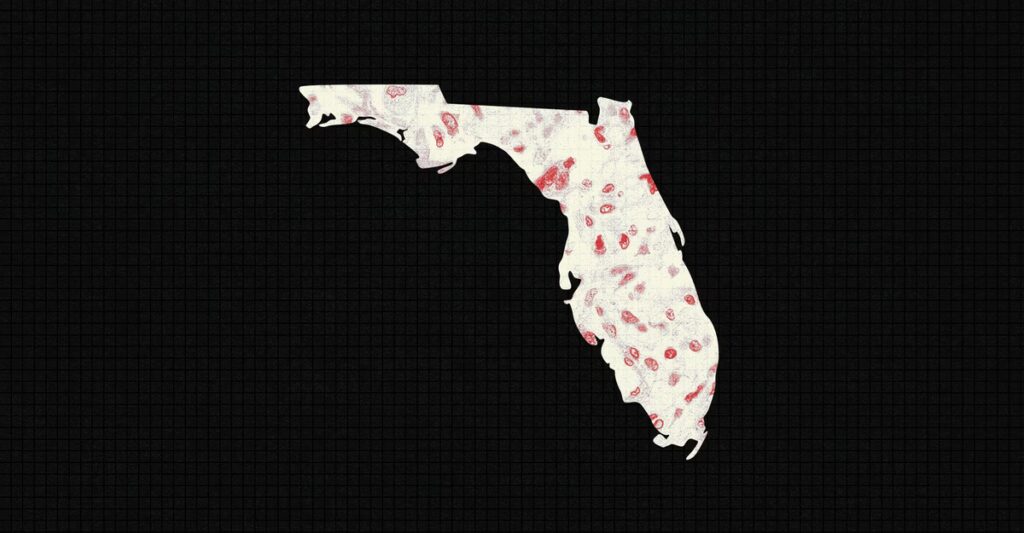
Out of the 30 states where measles has been detected in 2026, Florida currently ranks third in case counts. Since the start of the year, at least 132 confirmed or probable cases of measles have been reported across the state, where vaccination rates have consistently fallen below the threshold required to prevent outbreaks. The measles situation in Florida is, in other words, an urgent problem for the state that the state should be urgently addressing.
But on all things measles, the state’s health department has been mostly silent. The department’s measles landing page has no map of the state’s cases and no list of vaccination sites; its “Data and Statistics” section points to measles numbers that were last updated in 2024. In the months that measles has been spreading in the state, health officials have not issued press releases about the virus or launched information campaigns to caution residents about the risks. They have not publicly advertised the benefits of vaccines. Many of Florida’s health experts remain in the dark about their own state: “There has been no—capital N, capital O—communication to physicians, in particular pediatricians, about the outbreak,” Jeffrey Goldhagen, a pediatrician at the University of Florida at Jacksonville and the former head of the Duval County health department, told me.
Officials in other states are not being so coy. In South Carolina, where nearly 1,000 measles cases have been documented in recent months, the state health department holds weekly press briefings and has plastered an orange MEASLES OUTBREAK banner at the top of its website; in Utah, which has had more than 200 cases in 2026, the health department shares granular details about where the virus has been found. Even South Dakota, which has reported just 23 cases in the past year, provides a list of vaccination clinics at the top of its health department’s measles page.
Florida is the stark outlier—and has been headed in this direction for some time. Under the leadership of Governor Ron DeSantis and Surgeon General Joseph Ladapo, the state has spent the past few years bucking public-health wisdom. A year ago, when measles spread through a Florida elementary school, Ladapo allowed unvaccinated children to return to class instead of staying home to limit the size of the outbreak; in September, he and DeSantis announced that they intend to do away with all vaccine mandates. Now, by all appearances, Florida is testing out a head-in-the-sand approach to measles.
During an outbreak, health departments are usually the first line of defense. Few other entities can serve as a hub for public communication and a trove of data while coordinating across health-care systems and emergency services. In the dozens of states that have reported measles cases since the start of 2025, most health departments have offered a consistent and very public response: issuing press releases, mapping infections, sending health-care bulletins, hosting vaccination clinics. Last year, for instance, after measles started to spread in Texas, New Mexico health officials began pushing out information before the virus had been detected there; by the time New Mexico’s own 2025 outbreak ended, the state had logged 56,000 new immunizations, Andrea Romero, the state’s immunization-program manager, told me. Several of the state health officials I spoke with emphasized transparency as one of their core philosophies: “People have a right to know,” Natasha Bagdasarian, Michigan’s chief medical executive, told me.
In Florida, though, several of the doctors I spoke with weren’t even certain how many cases had been detected in their own county. “We cannot get any information on what is happening in various parts of the state,” Mobeen Rathore, a pediatric-infectious-disease specialist at the University of Florida at Jacksonville, told me. Researchers have been able to tap into Florida’s measles-case counts only via a poorly publicized database that is not linked on the health department’s measles page. Lauren Gardner, an infectious-disease modeler at Johns Hopkins University, where she and her colleagues run a national measles tracker, told me that Florida’s data stand out as unusually difficult to find, and of the 11 Florida physicians and epidemiologists I spoke with for this story, most were unaware that recent measles cases could be found on the state database. Even when cases hit Jacksonville, Rathore said, he heard about them only because some of his colleagues had seen them; pediatricians in the broader community, meanwhile, weren’t told at all.
In response to a request for comment, the Florida Department of Health’s communications director, Brian Wright, told me in an email that The Atlantic was “leaning on unverified third- and fourth-hand claims and calling it reporting.” The department did not respond to questions about why it has not readily publicized measles cases.
Florida’s health department used to be as reliable as other states’: As recently as 2019, its website clearly documented recent measles cases and described the measles-mumps-rubella vaccine as “the best way to prevent measles.” That information is now gone—and the experts I spoke with consistently described the measles content left on the health department’s website as superficial, biased, and even misleading. Although the website does warn about “suspected measles cases” in Collier County—which accounts for about three-quarters of the cases in the state—it then links to Collier’s health-department website, which links back to the state health department’s website. The state’s site also fails to mention that unvaccinated people are at high risk of severe illness; meanwhile, it promotes vitamin-A supplements as a possible treatment (as Health and Human Services Secretary Robert F. Kennedy Jr. has), even though supplementation is generally considered essential only for those with a deficiency, which is very rare in the United States.
Rana Chakraborty, a pediatric-infectious-disease specialist at University of Miami’s Miller School of Medicine, told me that he has stopped relying on the health department for measles information and has instead been following the advice of the American Academy of Pediatrics and the Infectious Diseases Society of America. Health-care establishments across the state are now charting their own course as they prepare for future outbreaks. “We’re all scrambling a little bit to know what the right or best thing to do is,” Chakraborty said.
Even in Collier County, where dozens of cases have been detected at Ave Maria University since late January, information is spotty. Shannon Fox-Levine, who represents that region in the Florida chapter of the AAP, told me that she consistently hears from her colleagues in Collier that “there has been very little transparency from the school and the health department” about local measles cases—including whether officials have continued to detect spread. A page on Collier’s health-department website lists two clinics where vaccine appointments can be scheduled, but not much else; Ave Maria University has said that it has coordinated with the health department to perform contact tracing and testing, but it stopped releasing data about the outbreak in mid-February. (Neither Ave Maria University nor the Collier County health department returned a request for comment.)
The relative silence in and around Collier has made communicating with patients challenging, Fox-Levine told me. “We are the trusted source for our families,” she said. “When we don’t have answers, it can be hard to reassure them.” Many physicians also worry that the lack of public information has lulled the rest of the state into complacency: Surely, if Florida officials aren’t sounding the alarm, there’s little to worry about. “For the rest of Florida, it’s like, Measles? What measles?” one physician in southern Florida told me. (Several of the health experts I spoke with for this article requested anonymity to avoid professional repercussions for speaking about measles and vaccination without the permission of the health department or their university.)
Many of the Florida experts I spoke with said they didn’t blame health officials specifically for Florida’s minimalist response to measles. Across the health department, officials desperately want to do more to address measles cases, Goldhagen, who remains connected with many former health-department colleagues, told me. But “their hands are tied by the state.”
Several of the experts I spoke with—including one health-department employee—cited an environment of fear and restriction within Florida’s health department. The message from state leaders, they told me, has been that health officials are not to publicize outbreaks, or encourage quarantines, isolation, or vaccines. The state has embraced such hands-off policies since the coronavirus pandemic: In 2020, DeSantis strongly encouraged COVID vaccines for the elderly, but as political sentiment toward COVID vaccines and policy shifted, Florida began taking a more relaxed approach to infectious disease. In 2021, the state passed a law that restricted officials’ ability to quarantine students exposed to COVID; measles cases are not subject to such restrictions, but attitudes about the viruses appear to be similar, several researchers told me.
Unlike many other states, Florida runs a fairly centralized health department: The local health departments are staffed with state employees. “All the directors are scared enough that nobody talks,” one physician in northern Florida told me. The department has suffered serious budget cuts too in the past few years, and many health-department employees worry that doing the job they were hired for could now mean losing it altogether. (Neither the health department nor DeSantis’s office responded to my questions about how politics has shaped Florida’s measles response, or about the limits put on health-department employees.)
Still, where they can, many health officials are “working quietly to implement standard public-health practices,” the northern-Florida physician said. After two cases were detected at the University of Florida at Gainesville, for instance, health-department officials performed contact tracing, ultimately reaching some 1,000 people, Fred Southwick, an infectious-disease specialist at the university, told me. Health officials also recommended quarantines and isolation as appropriate—and people were able to seek vaccines through the health department as well as through the university or their own health-care providers, two physicians in Gainesville said. (Southwick spoke to me in a personal capacity, not on behalf of the University of Florida. In response to a request for comment, the university referred me to communications it had sent to its students, faculty, and staff about measles and then directed me to the health department; it did not answer my questions about the department’s degree of involvement or transparency in managing the cases.)
But these covert operations won’t cut it for much longer, experts told me. A key part of public health, Goldhagen said, is to be public about health, so that everyone has the opportunity to protect themselves and their community. Matt Hitchings, an infectious-disease researcher at the University of Florida at Gainesville, told me that “there are lots of places in Florida that appear to be right on the knife’s edge between sufficient vaccine coverage and not enough,” and although active messaging from the health department wouldn’t change every mind, Hitchings suspects that it could bump vaccination rates enough to prevent outbreaks in some of those regions. As things stand, two physicians told me that they’ve begun to imagine a future in which measles could soon be detected in nearly every single one of the state’s 67 counties.
DeSantis and Ladapo’s approach to infectious disease has been polarizing: Recent polls show that roughly 80 percent of Florida parents support maintaining current laws that require vaccines for schoolchildren—approximately in line with national attitudes. But Florida has become a firmly red state, and across the country, Republicans express doubts more frequently than Democrats do that immunizations are safe and beneficial. In Florida, the number of families seeking exemptions from vaccine requirements has been increasing steadily, and is now about 5 percent.
At some point, the health department may be forced to change tactics—if other states begin warning against travel to Florida, hospitals are overrun, or people begin to die. The “look away” strategy, after all, works only as long as a disease’s impact is small enough to ignore without political consequence. But Hitchings and others told me that they can’t yet picture what that shift might look like. “What is the end game? I really don’t know,” Hitchings said. DeSantis has pitched Florida as a haven from liberal policies: In 2024, the state posted on its borders signs reading Welcome to the free state of Florida, advertising its commitment to personal choice. It may yet have to reckon with how the decisions of a relatively small number of individuals will affect the health of entire populations—who may soon have less of a choice about whether they get sick.
The post Florida Is Trying to Ignore Measles Until It Can’t appeared first on The Atlantic.