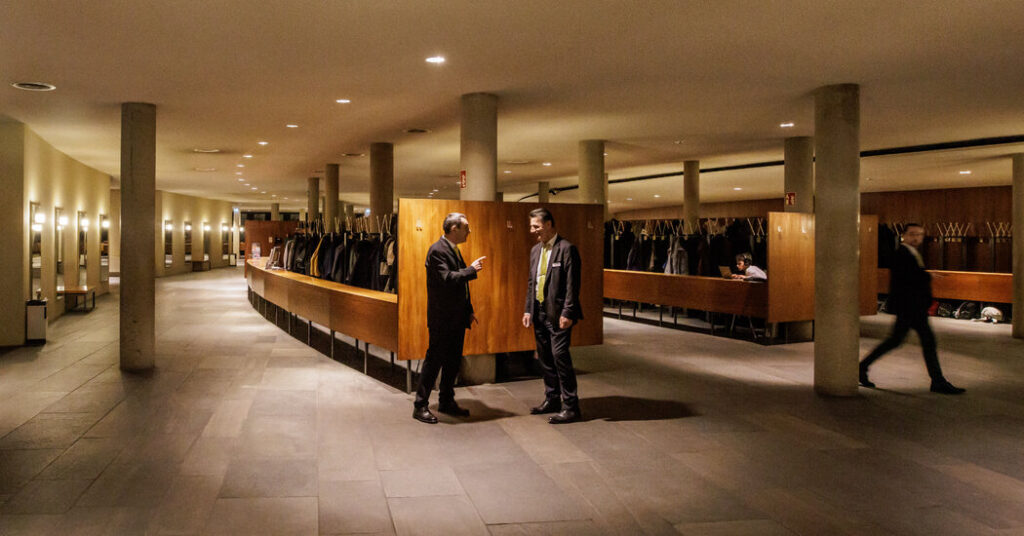
Calmly at first, and then ever more rushed, the visitors arrived at the Deutsche Oper in Berlin as if carried in by waves. The peaks were timed to the arrival of the subway at a stop just steps from the modernist building’s front doors.
So the large-scale coat check on the ground floor works to a rhythm, determined by the rushes before and after its shows — but also by season and the opera being performed.
“I can tell what’s playing just by seeing how people dress,” said Nina Birsan, 64, who runs the Deutsche Oper’s front of the house, including the coat check, ticket takers, bar staff and ushers.
At a recent Friday evening performance of Mozart’s “The Magic Flute,” it was a mix, with some audience members relishing the chance to dress up and others dressed much more casually.
Unlike at theaters, opera houses and concert halls in the United States, coat checks are compulsory at most performance venues in Germany because of fire safety rules. The cost is usually included in the ticket fee. Audience members at the Deutsche Oper who try to sneak into the auditorium wearing an outdoor jacket or — heaven forbid — a backpack are politely sent back to the coat check by elegantly dressed ushers.
On a sold-out night in the winter months, Birsan employs 16 coat check assistants to handle 1,865 garments. After handing their coats to the attendants, visitors receive a metal tag with an engraved number. Three hours later, the tag can be exchanged for the coat. The trick of the job is to be polite and welcoming, but also fast.
“In many cases, we are the only people at the opera the audience interacts with directly,” said Victoria Mazuhn, 22, a college student who works part time in the coat check.
Especially after the night’s final curtain, speed is of the essence. Within about 15 minutes of the show’s ending, the coat check assistants have to get everybody into their jackets and out the door. That means nearly 2,000 patrons sidling up to the counters with their numbered tags.
To speed up the process, the coat checkers have developed some tricks. Some tags go onto the hooks backward to show colleagues that the visitor also brought a bag or an umbrella. Coats for groups are handled together. And when school groups visit, the coat checkers make sure that only the teacher gets a chit. (The fee for a lost tag is 10 euros, about $12.)
Jeremy Ekenobaye, 20, likes to hand over the numbered tag at the moment he takes the coat. This saves him a trip back from the rack, he said, but also takes some concentration, since he has to remember the number.
The thing that annoys the checkers most, Ekonabaye said, was coats with no loop or a hood from which to hang them. “It seems so tiny, but it becomes a big problem,” he said.
Others lamented patrons who bring bulky items.
“I shouldn’t really care, but some of it doesn’t belong in operas,” said Nerio Matas, 43, who has been working the coat check at the Deutsche Oper for 15 years. “These backpacks, all these suitcases, all this junk that they bring — it’s madness sometimes.”
The checkers were divided on how important the clothes were underneath the coats. While some don’t mind patrons coming more casually to the opera, others longed for the days when everybody dressed up.
“I would just take an evening like that as an opportunity to really get out the fancy clothes and just go completely overboard,” said Ekonabaye, who wears the coat checker’s uniform of a black suit and dress shirt for his shift.
In Berlin, a city known both for its abundance of high culture and its laid-back vibe, it’s a question that divides patrons as well.
“I think it would be nice if everyone gave a little thought to this evening and also to the performers and artists onstage,” said Sabrina Meisinger, 46, who works at a health insurer. “I dressed up also for them,” she said, “because they are doing something special for me.”
During the recent evening performance of “The Magic Flute,” an accessible opera that is often an entry point to the art form, the glamour levels in the audience varied widely. The youngest and oldest patrons had dressed up, but many middle-aged patrons dressed more casually.
Jutta Osterhof, 84, who first came to the Deutsche Oper in 1962, said the days of well-dressed patrons had ended sometime in the 1970s when women stopped wearing furs. Back then, a big part of the opera was seeing and being seen, she said.
“If I just wanted just to hear a great singer,” she said, “I could stay at home and listen to a record.”
Christopher F. Schuetze is a reporter for The Times based in Berlin, covering politics, society and culture in Germany, Austria and Switzerland.
The post 1,865 Coats in 15 Minutes: A Fine-Tuned Opera House Team appeared first on New York Times.