To Carolina Caro, chatbots are a marvel. To her husband, they are a menace.
Caro, the 51-year-old CEO of a leadership-coaching company in Pasadena, California, uses artificial-intelligence tools “every day, for everything.” She uses generative AI chatbots to write emails, and she runs her work through them, asking for tweaks. Throughout each bizarre and uncomfortable symptom of menopause, ChatGPT has been her “confidant.”
Caro’s husband is a TV writer and an AI skeptic. He is a member of the Writers Guild of America, which spent nearly five months on strike in 2023, winning a contract that limits the ways studios can use AI for screenwriting.
“My husband makes so much fun of me,” Caro said, laughing. “He’s like, ‘I can’t believe you’re having these conversations with literally a robot.’ He thinks they’re going to take over the world because people like me are giving it too much information.”
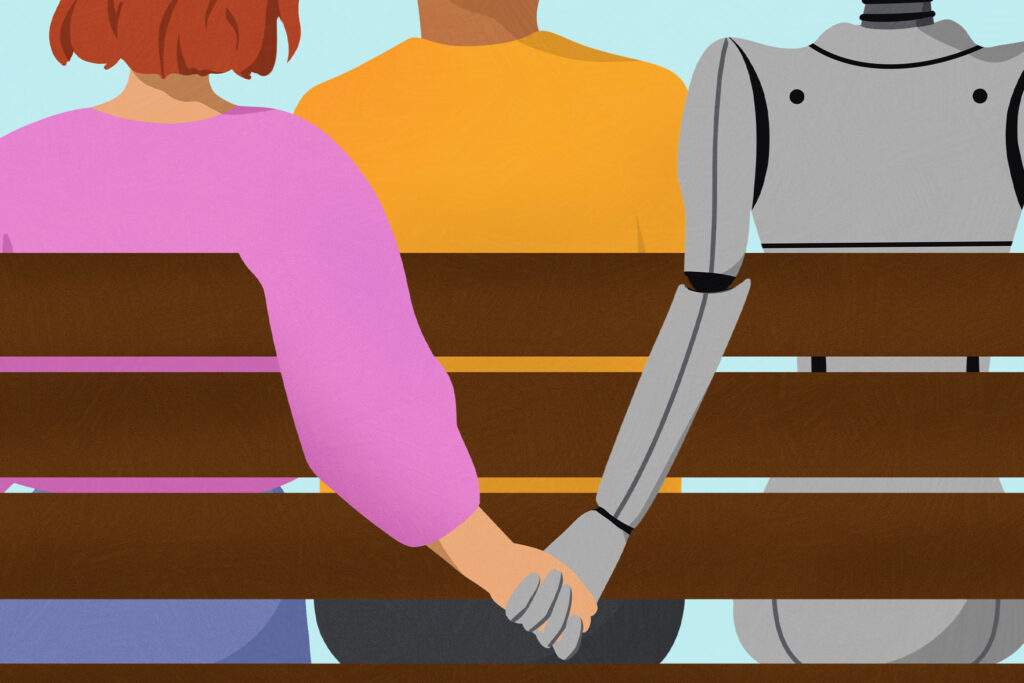
AI, she said, “is like the third member of my marriage.”
Caro and her husband are playing out what seems to be an increasingly common dynamic between partners. Relationships that have found equilibrium on other political and ideological issues are being rocked by the mainstreaming of generative AI tools. A person who scrolls past Google search’s AI function can easily find herself married to someone who interrupts dinner to shout into Claude’s voice-to-text function, “How far away is the moon?”
Natalie Capano, a licensed mental health counselor in New York, has seen strain over differences in AI use come up in her practice. “I usually see the extremes, where one person is using it for everything — for meal planning, for planning a vacation, for all of these little things throughout the day,” she said. To their partner, this sudden dependence on a chatbot can be annoying or even disturbing.
“It can almost feel like a third entity in someone’s relationship,” she said, using nearly identical language to Caro.
Any two Americans, married or not, might hold opposite beliefs about AI. In a survey last year from Pew, half of all respondents were more concerned than excited about increased AI use; 10 percent were more excited than concerned. About a fifth think AI will help people make tough decisions, while more than a third think AI will make people worse at making such decisions.
Still, the adaptation of AI tools for general use has been swift — nearly a third of Americans say they interact with AI multiple times a week. Yet unlike politics, religion, substance use or child-rearing, views on AI may not have come up during a courtship period.
It’s tempting to avoid talking about differences in AI usage, to not want to start a conflict just because your partner has taken to treating ChatGPT like a therapist, research librarian and omnipotent god. But having a different relationship to AI than your partner is not akin to a disagreement about how to load the dishwasher (the eternal battle between the rinsers and the non-rinsers). The gulf between chatbot adapters and chatbot skeptics, said Capano, is significant.
“I think there is that discrepancy there, of people that value human connection,” she said, compared with “the people who can kind of facilitate that humanistic connection with a robot, with technology, with a computer.”
When that difference emerges, it can feel “similar to what we’ve seen with political differences over the past couple of years,” Capano said. “It really is a big values discrepancy.”
Joe Keilch, 52, an executive coach in New York, uses chatbots for everything from email drafting to rash identification and more. His wife, who works in music marketing, “has invested zero time in it.”
It’s not that she is opposed to AI exactly, Keilch explained. She is “fiercely independent,” he said. “I think that a reliance on that type of fake person in the form of a chatbot is just antithetical to her.”
What happens when an AI avoider finds herself in a relationship with an AI pragmatist? The best way to handle that kind of conflict, said Claudia Johnson, a licensed marriage and family therapist in Seattle, is by asking genuine questions about the other person’s thinking.
“When partners disagree, regardless of what they’re disagreeing about, what they’re often reacting to is what it represents,” she said. Chatbot usage reveals fault lines over personal values: One person prioritizes efficiency and accessibility, the other finds worth in struggling toward a goal on their own merits. One person sees AI as a collaborator, another sees it as competition.
The best way to bridge that gap, Johnson said, is “leading with curiosity to better understand that person’s experience, rather than getting stuck in the content.”
Couples who forgo honest conversation about bot usage may do so at their own peril. That was the case for Rhea Srivastava, a 24-year-old living in Washington, whose fights with her ex-boyfriend often resolved over text message. The messages he sent were emotionally mature, thoughtful and well-reasoned. They just didn’t seem to be written by him. “There was no vulnerability on his end,” she said.
Over time, she observed that the things he wrote didn’t seem like natural outgrowths of their conversations. They were the result, she began to suspect, of a more unguarded back-and-forth with ChatGPT, which then resulted in a carefully crafted text to her. “It was as though our relationship problems were being solved with him, through Chat,” she said, referring to ChatGPT by a nickname popular with younger users. (Srivastava’s boyfriend confirmed to The Washington Post that he did discuss his relationship with ChatGPT, though he said he wrote the texts himself.)
“As time passed, it was pointless to argue with him because I could just ask Chat what he was about to say,” she said.
That very desire to talk to a chatbot instead of arguing with your partner is, Johnson suspects, more revealing of societal problems than of the strengths of chatbots. People confide in chatbots because “they want relief from loneliness, concern, exhaustion,” she said. “Not because they want to speak to machines instead of humans but because speaking to humans increasingly feels fraught, labor-intensive or downright scary.”
For Caro, discussions with her writer husband about their respective beliefs about AI — discussions that are often accompanied by teasing and laughter — have been valuable. “I, right now, am enjoying it, I’m thinking it’s fun, I’m not seeing the detriment that can be there,” she says. “His voice is necessary to say — let’s be mindful of this. That’s what his voice has been, cautionary.”
Those conversations require the very human connection, Johnson said, that is a kind of antidote to emotional overreliance on chatbots. “It requires of us to be aware not only of our own thoughts and values but also of others, which goes back to that intimacy — having that conversation, being vulnerable, agreeing to disagree and understanding that others may have a different experience.”
It’s an ability, she pointed out, that separates us from robots.
That distinction means more to Srivastava after experiencing a relationship that felt like it had been infiltrated by a chatbot. When she and her ex-boyfriend finally broke up, she wasn’t exactly sure who made the decision — her, or her ex, or ChatGPT.
“Lesson learned,” she said. “Being messy with your partner is better than trying to have filtered, perfect conversations.”
The post She uses AI for everything. Her husband thinks AI is a menace. appeared first on Washington Post.