For most of its four-year-long war with Russia, Ukraine has been a recipient of security aid from the United States and European allies. With war now raging in the Middle East, Ukraine’s government is seeking to turn the tables by offering a pivotal technology to intercept the exploding drones menacing the region’s oil facilities and shipping.
In a possible prelude to sales agreements, Ukraine has sent interceptor drones and teams to operate them to three American allies in the Persian Gulf: Saudi Arabia, Qatar and the United Arab Emirates.
Eleven countries in all, including the United States, European nations and Gulf monarchies, have sought Ukraine’s assistance or advice on shooting down Iranian-made Shahed drones, according to President Volodymyr Zelensky. For years, Ukraine has been fine-tuning defenses against such drones, which Russia fires into the country by the thousands each month.
“This phone has been ringing off the hook,” said Oleg Rogynskyy, the chief executive of Uforce, a conglomerate of Ukrainian defense technology start-ups that has attracted seed capital valuing it above $1 billion. As the U.S.-Israeli war against Iran spreads through the Middle East, interest in the company’s drone aircraft and boats is skyrocketing, he said.
Ukraine wants to leverage its defense expertise into political recognition of a security partnership with the United States and European countries, and to reap potentially vast profits for its arms industry. While no deals have been announced yet, the market for drone defenses for oil fields and tankers could run to many billions of dollars, Ukrainian defense executives say.
Ukraine’s counter-drone technology, initially cobbled together from off-the-shelf consumer goods and video game gear, now rivals conventional air defense systems but at a fraction of the cost, military analysts say.
The most common type of Ukrainian drone used to intercept Shaheds resembles a toy rocket. It is made of 3-D-printed plastic parts, stands about three feet tall and is powered by electric motors and propellers. It zooms at speeds close to 200 miles an hour and can hit targets up to an altitude of about 15,000 feet.
By last year, Ukrainian companies’ capacity to produce such drones exceeded the government’s budget to buy them. Mr. Zelensky lifted wartime restrictions on exports, saying that export revenues could help domestic arms companies cover costs at home.
Skyfall, a Ukrainian drone maker, says it can produce 50,000 of its P1-Sun interceptors per month. Another manufacturer, General Cherry, can make 10,000 of its Bullet interceptor drones a month. F-Drones, which makes the Litavr interceptor, has adapted its systems for compatibility with foreign radars, the company’s founder, Hnat Buyakin, said.
As they enter the international arms market, Ukrainian defense technology companies are promoting a business model of subscription services, rather than selling just devices. They are calling it “drones as a service.”
In Ukraine, companies continually tweak software and hardware to get around Russian signal jamming or to adapt to new tactics, such as programming Shaheds to undertake evasive flight maneuvers. Antennas, batteries, motors, cameras and other components are mixed and matched for specific missions. The companies are proposing a similar service of updates for foreign customers.
On Wednesday evening, reporters for The New York Times watched the launch of F-Drones’ Litavr interceptor.
Operators working in a secret office space sat sipping coffee from cardboard takeout cups and scrolling on their phones until a Russian attack drone appeared on the radar.
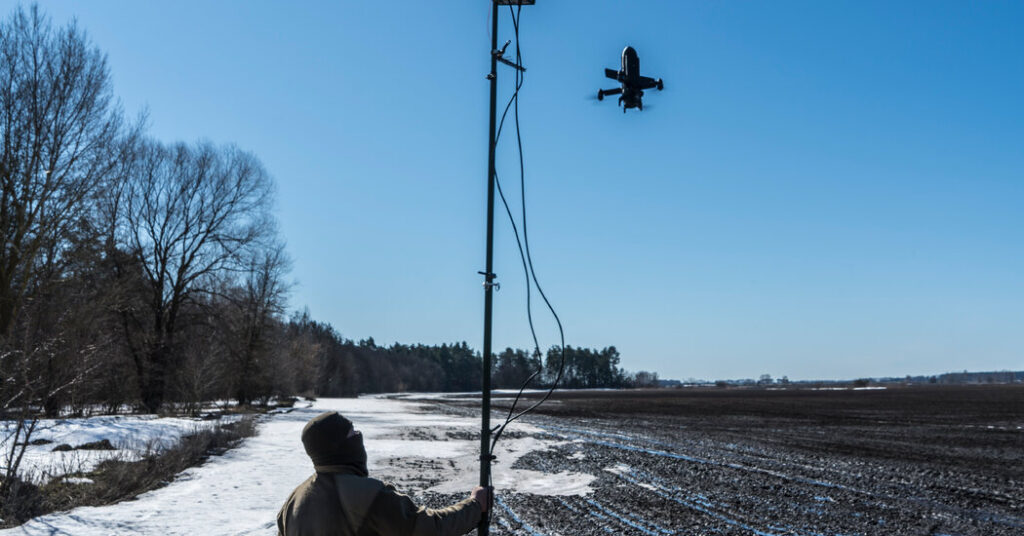
With the flip of a switch, the operators activated an internet-controlled lid on a launcher box placed in a forest hundreds of miles away. The fast-flying interceptor drone zipped out. Using joysticks, the operators could steer the interceptor to its target in the sky.
“I’m sitting here, signing documents, doing paperwork,” said Col. Oleh Ochkan, commander of training for Ukraine’s Unmanned Systems Forces. “I see a Shahed, I get up, shoot it down, then go back to work.”
Remote piloting, as Colonel Ochkan does in his office, could allow customers of Ukrainian defense companies to buy drones together with piloting services by experienced operators who would not need to leave Ukraine.
The Ukrainian government’s offer of help in the Gulf is in part an effort to keep global attention on Kyiv’s own war and to score points with the Trump administration, which is leading peace negotiations to end the conflict that Russia started in 2022. Such efforts have become even more urgent after the United States announced on Thursday that it was suspending sanctions on Russian oil, the most important source of funding for the Kremlin’s war machine.
Ukraine’s discussions with the Middle East are also a stark turnaround for Kyiv. When Russia invaded four years ago, Ukraine was left pleading for air defenses.
“Ukraine asked the U.S. and Europe to protect our skies” with air defense systems, said Anatolii Kharpchynskyi, director of business development for Fly Group UA, a maker of drone-detecting radars and jamming systems. “Now, we are being asked to protect them.”
Last spring, the Trump administration did not engage with a Ukrainian offer to share drone technology with the U.S. military and defense industry.
But after the U.S.-Israeli war on Iran began about two weeks ago, Ukraine sent drone interceptors and a team of experts to protect U.S. military bases in Jordan, Mr. Zelensky told The Times in an interview last week.
Mr. Zelensky asked the White House this week to consider a formal agreement on sharing drone technology, reviving the proposal from last year. Such a deal would acknowledge Ukraine as a contributor to, as well as a recipient of, security aid. The Trump administration has so far offered no high-level reply.
Inside Ukraine, Mr. Zelensky’s proposal was seen partly as a response to the verbal lashing that he received from President Trump in the Oval Office early last year. Mr. Trump accused Mr. Zelensky of being ungrateful for U.S. aid and said that the Ukrainian leader had no “cards” to play in the war with Russia.
“Now everyone understands, we have them,” Mr. Zelensky told an Irish journalist and influencer, Caolan Robertson, in an interview in Kyiv this week.
A main draw for the Ukrainian systems is cost, said Mr. Khrapchynskyi of Fly Group UA. Plentiful and cheap Shahed drones need to be countered with even cheaper interceptors, he said.
“War is about technology but also mathematics,” Mr. Khrapchynskyi said. Ukrainian interceptors cost several thousand dollars each, compared with millions of dollars for the Patriot missiles that Middle Eastern militaries have been using.
Uforce, the conglomerate that has drawn foreign investor interest, makes a range of products, including the Magura drone speedboat. To defend Ukraine’s Black Sea coast, the company has mounted launchers for Shahed interceptors on the boats, creating miniature aircraft carriers.
These systems could potentially defend Gulf cities from attacks by sea or escort oil tankers, providing some protection without risking crews of naval vessels.
“You don’t have to expose American ships,” said Mr. Rogynskyy, the Uforce chief executive. “If there is a Shahed coming for the tanker, they will take it down.” He said the company thinks of itself as “an app store for drone interceptors.”
Evelina Riabenko contributed reporting from Kyiv, Ukraine.
Andrew E. Kramer is the Kyiv bureau chief for The Times, who has been covering the war in Ukraine since 2014.
The post Phones ‘Ringing Off the Hook’ for Ukraine Defense Firms as Mideast Seeks Help appeared first on New York Times.