Relatability in politics is out, at least these days. Scranton Joe, Coach Walz and Democrats’ appeals to basic decency didn’t do much to stop Donald Trump’s return to the White House.
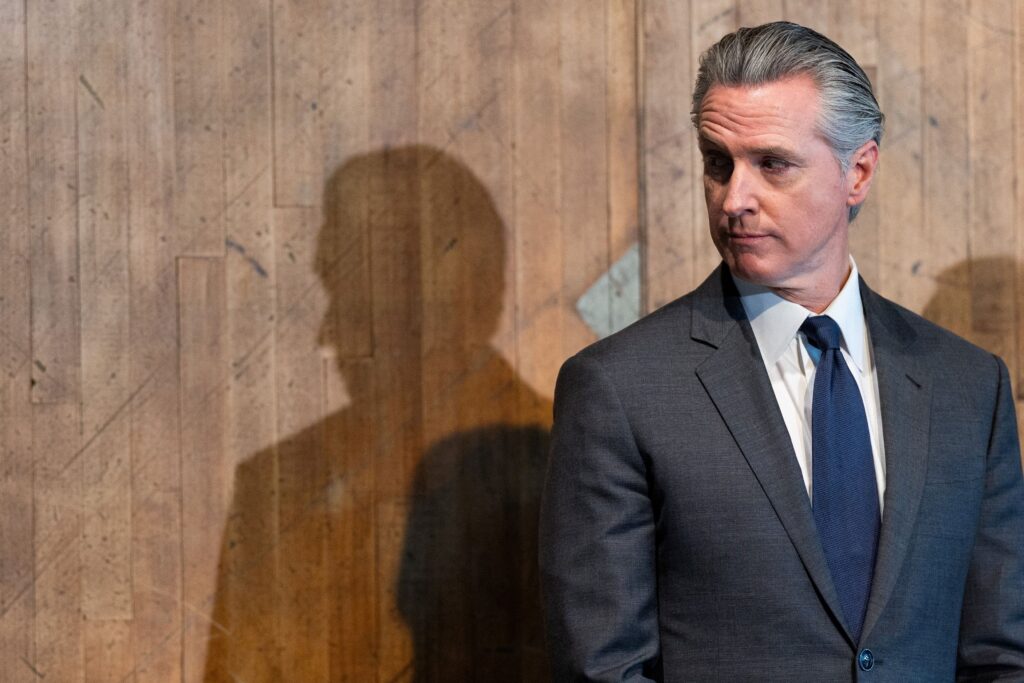
Gavin Newsom hasn’t gotten the memo. In the California governor’s new memoir, “Young Man in a Hurry,” he strains to emphasize his personal challenges despite a life of exceptional privilege and extraordinary hair (for the latter, we apparently have the well-gelled Pierce Brosnan of 1980s TV “Remington Steele” to thank).
The issue for Newsom is that many of the hardships he recounts — his parents’ divorce, dyslexia, self-doubt — are not so remarkable to the human condition. Many Americans might recognize the pangs of loneliness a kid feels upon returning to an empty house while mom is hustling at one of her several jobs. They might identify with the anxiety of being bullied — when, he writes, he also acquired the nickname “Newscum,” now applied to him by Trump.
What many Americans won’t connect so much with is all the billionaire-backed vacations in between. Thanks to his father’s close relationship with Gordon Getty, an heir to the J. Paul Getty oil fortune, the young Newsom was whisked off on not-so-relatable expeditions, including to Hudson Bay in Canada in search of polar bears; to East Africa on a sightseeing safari featuring a prehistory lesson from paleoanthropologist Mary Leakey herself; and to Venice for a party at an “opulent sixteenth-century palazzo,” where the only wildlife on view was the “debauched face of Jack Nicholson.” The actor mistook Newsom for one of the Getty boys.
Looking back, Newsom gives his younger self grace for not being able to “summon” his voice in that moment at the palazzo. Who wouldn’t feel flattered by being grouped with the rich kids, especially given Newsom’s “lower station”? Returning home to his single mother after flights on the Gettys’ “Jetty” with her ex-husband and his billionaire best friend must have put young Newsom in an awkward position. No doubt that caused him distress. The doubt is that many readers will sympathize.
Newsom’s account of his rise in business and politics is just as torn between an impulse to play the everyman and the tremendous opportunities he was given by not-so-everymen. Despite enduring “three hours of dyslexic torture” on the SAT, Newsom got into Santa Clara University. The memoir doesn’t mention a recommendation letter from family friend Jerry Brown, the former California governor.
After leaving his job in the real-estate empire of Walter Shorenstein (another family friend), Newsom pursued his “first calling,” entrepreneurship. Like a modern-day forty-niner, Newsom attributes his rise in the wining-and-dining business to pioneering ideas. San Franciscans apparently have Newsom to thank for high-end wine by the glass: “Regular folk” who wouldn’t spring for a $100 to $150 bottle, he writes, “would now be able to taste what they never could afford to taste before.” He calls that development a “rebellion.”
A further wine rebellion: Screw-tops on luxury pours. The idea came from one of his investors, Gordon Getty. It “aligned,” Newsom writes, “with our whole irreverent reason for being.”
Newsom cannot be blamed for grabbing at the opportunities life offered. Who wouldn’t? He can be blamed for so obviously laboring to rationalize it for those “regular folk” — voters who will decide the fate of the 2028 presidential campaign he presumably intends to launch. What, exactly, is Newsom trying to tell prospective voters about his policies?
It’s hard to know, because Newsom can’t be entirely sure of his audience. That’s the peril of vying to lead a party attempting to rebuild its identity, especially with working-class and minority voters. The book offers plenty of liberal boilerplate, to be sure: Lamenting his state’s fiery “manifestations of climate change”; fighting for same-sex marriage; extending the California Dream to families who can’t afford “housing, health care, and higher education”; characterizing the overturning of Roe v. Wade as going “backward a half century in time.”
But Newsom — whose great-grandfather “turned into a Democrat out of his compassion for the working man” — comes across as more of a cradle Democrat than a deep ideologue. He avoids the touchier topics for which he has drawn national headlines, like his acknowledgment that the participation of men who identify as women in high-school and college women’s sports is unfair. Like the good Democrat he is, Newsom levels no friendly fire in his book — unlike the incoming from fellow Cali Dem Kamala Harris’s recent campaign memoir.
Newsom is of course harsh about Donald Trump, describing a president desperate to flex his power. During a day spent together touring the damage of a 2018 fire in California, Newsom recalls Trump bragging about Air Force One’s luxurious trappings and jokingly offering his companions the chance to call up Chinese President Xi Jinping. But Newsom also reveals a Trump human enough to call him, sounding “wounded,” after the governor attacked “the corruption and incompetence in the White House” in a speech.
Earlier in the book, Newsom recounts Trump’s 2016 victory and writes that dealing with someone like the president-elect would require “a subtler set of skills.” That doesn’t do much to explain Newsom’s recent habit of mimicking Trump, caps-lock and all, on social media. But if the governor is going to borrow from the president’s playbook, here’s another suggestion: Don’t try to explain yourself and don’t pretend to be something you’re not. In this sorry political age, audacity has more purchase than relatability. And for Newsom, it’s much easier to sell.
The post Newsom missed the memo: Relatability is out appeared first on Washington Post.