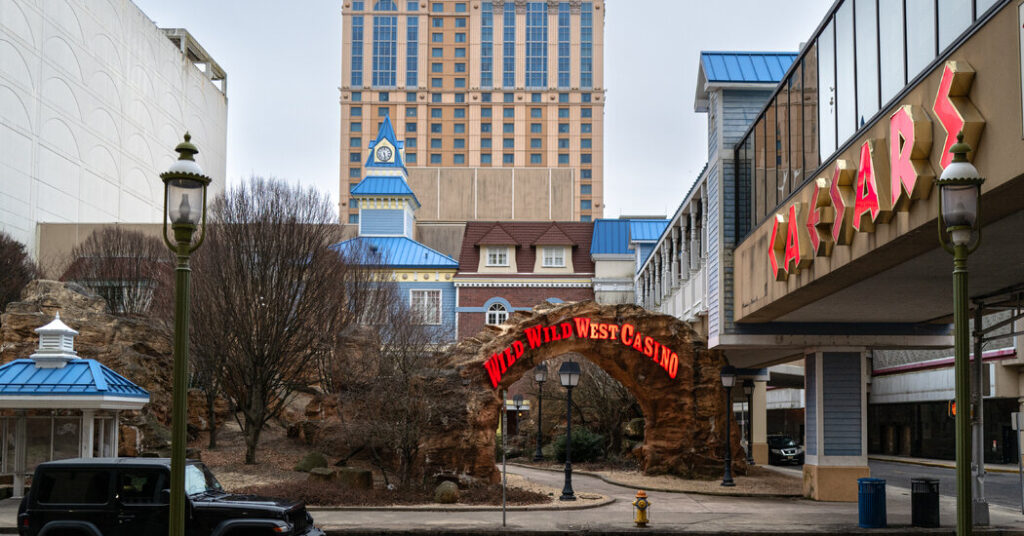
A decade after New Jersey voters categorically rejected a proposal to allow casinos to expand beyond Atlantic City, momentum is building among real estate developers and elected officials to give it another try.
The owners of the Meadowlands and Monmouth Park racetracks have been pitching state officials to get behind a campaign to legalize casinos in northern New Jersey.
The impetus is the potential loss of gambling and tax revenue that might drift from New Jersey to New York, where three new casinos are being built across the river in New York City.
Casino lobbyists in New York City have already begun strategizing about ways to counter the burgeoning North Jersey effort. But the largest obstacle remains South Jersey power brokers, who are fiercely protective of Atlantic City and the casinos there.
Michael Suleiman, the chairman of the Atlantic County Democratic Committee, called the addition of casinos in New York City an “impending meteor.”
But both he and Marty Small Sr., the mayor of Atlantic City, said that business and political leaders in South Jersey would strenuously oppose any effort to win public support for casinos in Monmouth and Bergen Counties.
“We will have to defeat it,” Mr. Suleiman said.
Atlantic City remains an important, if faded, economic engine in New Jersey. And the state’s new governor, Mikie Sherrill, has said that efforts to revitalize the seaside resort are a priority of her administration.
“Our plan is to sit with the Atlantic City casino industry and come up with a plan to protect their interests,” Jeff Gural, the managing partner of the group that owns the Meadowlands, said in an interview on Thursday.
Louis Greenwald, the Assembly’s Democratic majority leader and an ally of George E. Norcross III, who has long been a key power broker in South Jersey, said “an idea of this magnitude is worth the conversation,” but said not enough was known yet to form an opinion.
“What does it look like? What do you project the revenue to be?” he said. “It’s a worthy question and it’s certainly worthy of discussion.”
It has become a truism of casino development that new casinos often cannibalize existing ones, because the market for casinos is relatively finite. Atlantic City, the southern New Jersey gambling stronghold, knows something about that. A handful of casinos were forced to close a decade ago, and the nine that remain have had to compete against newer casinos in neighboring states. Now Atlantic City is facing the prospect of three new multibillion-dollar casinos in nearby New York City.
“This seems to be a last-ditch effort to try to preserve some market share and to attempt to get some people from northern New Jersey to bet locally,” said Marc Edelman, a professor of law at Baruch College.
“I don’t think at this point building additional casinos will meaningfully grow the market for betting,” Mr. Edelman added.
To add casinos in other parts of New Jersey, voters would need to approve a change to the State Constitution.
Two influential Democratic state senators in New Jersey, Vin Gopal and Paul Sarlo, have introduced legislation that could pave the way for a voter referendum as early as the November election. Mr. Gopal said that he has had several conversations about the proposal with Ms. Sherrill’s chief of staff, Alex Ball.
“We’ve had good conversations,” said Mr. Gopal, who represents Monmouth County along the Jersey Shore. “I would be suspicious if they said ‘yes’ right away, right now. We’re going to start the process and give them time to do their due diligence, too.”
A spokesman for Ms. Sherrill declined to comment. But a person familiar with the conversation with the governor’s office, who was not authorized to speak publicly about the private discussions, said that the Sherrill administration was at least open to learning more about the proposal and assessing its feasibility. “Not outright rejecting. Not necessarily on board,” the person said.
The plan would authorize new casinos at the Meadowlands and Monmouth racetracks, where sports betting is already legal.
Mr. Gopal said it would be foolish to sit back and permit New York to poach gamblers from New Jersey without at least trying to offset potential tax revenue losses. Monmouth Park and the Meadowlands — which is about 20 miles from Hard Rock’s planned $8 billion casino near Citi Field in Queens — are logical locations for new casinos, he said.
“We’re already doing sports betting on site, we’re already betting on horse racing on site,” Mr. Gopal said. “Gambling is already happening. How is this any different?”
The legislation specifies that at least 10 percent of tax revenue from any new casinos be “dedicated to provide funding for the support of Atlantic City tourism.”
In New York City, winning casino bidders were required to pay an upfront fee of at least $500 million each. Mr. Gural said he was proposing a similar licensing payment for New Jersey.
“I think the people that would be hurt the most are basically the new casinos coming to New York and not so much Atlantic City,” Mr. Gural said. Atlantic City, he added, is a “destination resort.”
In 2016, New Jersey voters rejected a proposal to open casinos in places other than Atlantic City by a 4-to-1 margin, a drubbing that stunned many, including the Republican governor at the time, Chris Christie.
“The effort in 2016 just reinforced what New Jerseyans have been saying for the nearly 50 years of the experiment of Atlantic City: They were OK with Atlantic City — no place else,” said Mr. Christie, who is now a consultant for the American Gaming Association, focused on sports betting. “There’s nothing I’ve seen over the last 10 years that would lead me to believe that there’s a real hunger for more casinos in New Jersey.”
He added, “I don’t think New York is going to affect Atlantic City at all.”
Dana Rubinstein covers New York City politics and government for The Times.
The post New Jersey Is Reconsidering Legalizing Casinos Outside Atlantic City appeared first on New York Times.