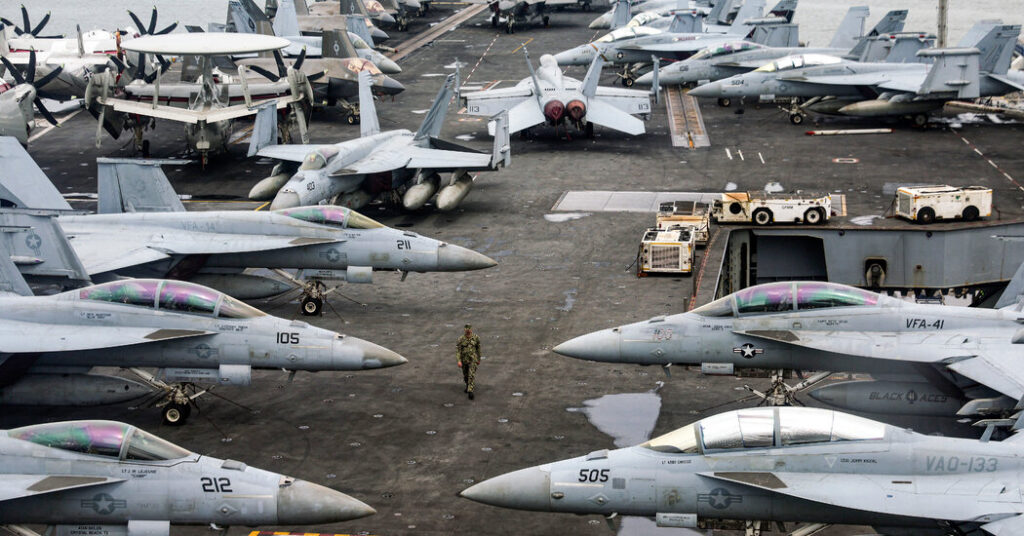
Before the war with Iran started, American military commanders redirected a carrier strike group from the South China Sea to the Middle East. This week, the Pentagon has been moving sophisticated air defenses from Asia to bolster protection against Iran’s drones and rockets.
The redirected weapons include Patriot missiles and interceptors from the THAAD system in South Korea — the only Asian ally hosting the advanced missile defense system, deployed by the Pentagon to counter North Korea’s growing missile threat. Now, for the first time, its interceptors are being moved away, followed by launchers if the diplomatic and logistical details can be worked out, according to American officials.
The war in Iran — barely two weeks old — is already straining America’s promise of security in a region that U.S. military leaders have called “our priority theater.” Longer term, officials and analysts suggest the war will weaken American influence, aid Chinese arguments about American decline and accelerate a middle-power arms race.
The war’s demands are widening. Australia this week sent aircraft, personnel and a supply of air-to-air missiles to the Middle East. Japan and Taiwan are facing potentially delayed arms deliveries as the United States and its Middle Eastern allies burn at a blistering rate through attacking missiles and defensive interceptors. Pentagon officials told Congress on Tuesday that they estimated the cost of the war had exceeded $11.3 billion in the first six days alone.
American military commanders have told The New York Times that they are worried about the shrinking stockpiles and diversions, which are affecting many regions. In Asia, U.S. allies feel the deficit acutely as they struggle to counter China’s surging military and increasingly aggressive regional maneuvers.
President Lee Jae Myung of South Korea told his cabinet on Tuesday that while his government opposed the Pentagon’s relocation of air-defenses, “it is also an undeniable reality that we cannot fully have our way on this matter.”
Asia is drawing three early conclusions about America’s latest conflict.
1. Asia is far from the United States’ top priority.
At a regional security conference in Singapore last year, Defense Secretary Pete Hegseth stressed that America would stay focused on the region.
“No one should doubt America’s commitment to our Indo-Pacific allies and partners,” he said. “We will continue to wrap our arms around our friends.”
Now that’s harder for many countries to believe — especially when the Middle East’s needs draw specialty equipment from an ally bordering North Korea, a rogue nuclear power.
“Moving air defenses out of Korea sends a terrible signal at a time when there are already huge concerns in Seoul about the Trump administration’s shaky commitment to Asia,” said Ely Ratner, a former assistant secretary of defense for Indo-Pacific security affairs under President Biden.
THAAD batteries (THAAD stands for Terminal High Altitude Area Defense) are the apex defenders of the American arsenal. Each battery typically includes several truck-mounted launchers and precise radar systems that can crash interceptors into incoming fire at many altitudes. At least five such systems are in the Middle East. In Asia, THAAD launchers have been deployed to Guam and South Korea.
Mr. Ratner noted that after the THAAD was installed near Seoul in 2017, China retaliated with boycotts on South Korean products and bans on tourism to the country, arguing the system threatened Chinese security.
“And now,” Mr. Ratner added, “the U.S. is taking it away for a war in the Middle East.”
2. China will get a boost in influence and confidence.
Economics and security stressors are intertwined. With oil prices spiking, Asia, a manufacturing powerhouse that gets most of its oil from the Middle East, is especially exposed.
Its stock markets are showing steep declines. Gasoline rationing is hitting U.S. allies like the Philippines especially hard — and that gives Beijing an opening. China can use America’s seeming disregard for the region’s economic pain to argue (even more than usual) that China is the only reliable superpower.
The war has given Chinese state media plenty of fodder for criticizing U.S. foreign policy. The state-run China Daily ran a cartoon on Tuesday that depicts Uncle Sam caught in a thick spider web. “U.S. mired in Middle East,” read the headline.
Diplomats in the region worry that the war’s demands give Beijing a freer hand for territorial assertiveness. While it has quieted its military flights around the democratic island of Taiwan, China’s maritime forces have stayed busy there and elsewhere.
Late last year, China resumed island-building in the Paracels off Vietnam’s coast in the South China Sea. Satellite imagery from the Open Source Centre showed dredging intensified in recent weeks, with nearly two dozen Chinese ships at Antelope Reef with cranes and construction equipment fashioning a new outpost.
Japan is also in a precarious position, sitting close to Taiwan and occupying islands that China also claims as its own. More than 90 percent of Japan’s oil moves through the Strait of Hormuz. An economic crisis coupled with a military crisis is particularly worrisome to Tokyo.
“That would be a nightmare,” said Tsuneo Watanabe, a senior fellow at the Sasakawa Peace Foundation in Tokyo.
“Japan recognizes that anything could happen under Mr. Trump,” he added. “We need to think about a worst-case scenario.”
3. Nations can’t rely on America for weapons.
The shifting of weapons and air defenses from the Indo-Pacific has revealed that the American war machine lacks depth, even more than many had expected.
The military math makes many American partners shudder. Patriot interceptor missiles can cost nearly $4 million each. The United States produced about 600 of them in all of 2025. Some estimates suggest that more than 1,000 have already been used in less than two weeks of war.
The U.S. military has many other assets — American airstrikes are shifting toward cheaper, more plentiful bombs. And a deal made with Lockheed Martin in January aims to triple production of Patriot systems by 2030.
But in many countries that agreed to increase military spending on American hardware at the urging of the Trump administration, the war in Iran feels like a flashing red light, warning that what they buy may not be delivered anytime soon.
A Japanese government inquiry found in January that 118 orders for American weapons worth about $7.2 billion had not been delivered at least five years after contracts were signed.
In Taiwan, there are worries that the war will make a bad situation worse, weakening deterrence from the United States because of munitions shortages, and making it harder for Taiwan’s government to justify a bigger defense budget to buy more American weapons.
“It will inevitably affect shipments,” said Shu Hsiao-huang, a researcher at the Institute for National Defense and Security Research, a think tank backed by the defense ministry of Taiwan. “We have already experienced delays.”
Many countries will likely race to develop more military industrial capacity. Japan is developing its own long-range missile systems. South Korea secured U.S. approval in October to develop its first nuclear-powered attack submarines, which some experts have described as a step toward building nuclear weapons in the future.
Mr. Lee, South Korea’s president, said that the war shows a clear need for more self-reliance.
“If we rely on others, there are times when that dependence can collapse,” he said. “You always have to think about what you’re going to do if there’s no external support.”
Asked for comment on the region’s concerns, the Pentagon responded with a brief email: “We have nothing to provide.”
Reporting contributed by Amy Chang Chien and Chris Buckley in Taipei, Taiwan, Tung Ngo in Hanoi, Hisako Ueno in Tokyo and Lara Jakes in Rome.
Damien Cave leads The Times’s new bureau in Ho Chi Minh City, Vietnam, covering shifts in power across Asia and the wider world.
The post How the War in Iran Could Help China and Change Asia appeared first on New York Times.