Tunde calls himself a tech bro, which in Lagos is shorthand for owning a pitch deck and a suspicious number of hoodies. On our first date, he spent half the evening explaining scalability metrics for an app that helps people share umbrellas during sudden rainfall.
“Imagine,” he said, eyes sparkling, “like Uber, but for staying dry.”
Romantic evenings with Tunde are less candlelight than PowerPoint. He once compared our relationship to a beta test: “We’ll iterate, fix the bugs, push updates.”
I told him I didn’t want to be software. He smiled and asked for feedback in bullet points.
Yet he can be unexpectedly sweet. When my landlord threatened to evict me over a mysterious leak, Tunde arrived with a tool kit, duct tape and quiet determination. For an hour the world shrank to the sound of dripping water and his low humming of old Wizkid songs. It wasn’t fireworks, but it was something.
In Lagos, where even the mosquitoes hustle as if they have rent to pay, I sometimes walk the Marina at midnight when the city exhales. Streetlights flicker like tired stars; the lagoon smells of salt and hidden stories. Here, loneliness feels almost luxurious.
I imagine love drifting across the water, wearing a head wrap made of mist. It isn’t the grand, sweeping thing Nollywood promises. It’s quieter, stubborn, a bit sarcastic — like Lagos itself.
On those walks, I remember my grandmother’s advice: “Love is not palm wine. If it ferments too long, it will knock you out.” She married three times, buried two husbands and still flirted with the tailor until her 80s. She would have approved of Tunde’s ambition but not his sneakers.
Of course, my aunties have opinions. Nigerian aunties are the original push-notification system, appearing at weddings, funerals and supermarket queues to remind you that your ovaries are on a countdown.
“When will we eat your rice?” Auntie Ngozi asks. “Don’t be choosy. Good men are scarce like petrol.”
“If good men are scarce,” I say, “perhaps the government should subsidize them.”
She doesn’t laugh. Aunties rarely do.
Auntie Bisi once invited a pastor to pray for my “marital destiny.” The pastor sprinkled holy water on my phone “to attract calls from suitors.” My phone short-circuited the next day. Coincidence? Maybe. But now I use a waterproof case.
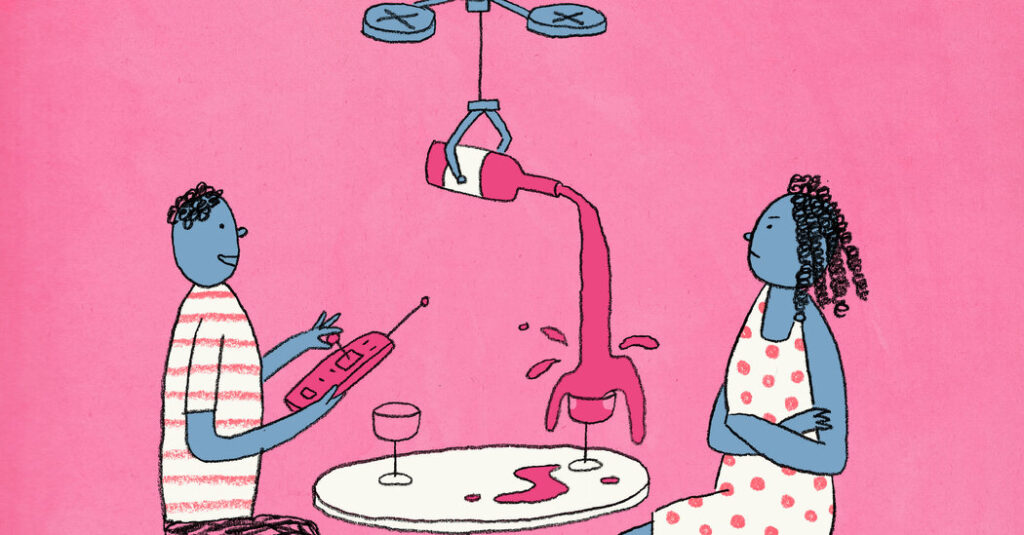
Tunde, determined to impress, once planned a “tech-forward” romantic gesture. He hired a drone to deliver grilled skewers of suya to my balcony because “flowers are too analog.” The drone misread the GPS, crashed into the neighbor’s laundry line and scattered spicy beef across their freshly washed bedsheets. The ensuing shouting match involved three households and one irate landlord waving a broom like a machete.
I laughed until my ribs hurt. Tunde called it “an unexpected product pivot.”
Later, over drinks, he asked if I thought we were “scalable.” I told him love isn’t a start-up. He countered that neither is Lagos, which has an established tech industry. Yet here we are.
A month later Tunde came with me to a cousin’s wedding in Ibadan — a high-stakes mission, as weddings are where aunties sharpen their matchmaking claws. He survived the onslaught of “When is your own wedding?” questions with a polite smile and several small bottles of stout.
During the after-party, as Fuji music vibrated the ground, he whispered, “Your family is like a lively app — no off button.”
I almost kissed him then, swept up by the absurd tenderness of the moment. But my mother appeared, armed with more questions about our future plans, and the spell broke.
Weeks later, during a blackout so total it felt biblical, Tunde admitted he wasn’t sure about forever. He liked me — loved me, even — but his start-up might require moving to Nairobi, maybe Berlin.
“Love should be borderless,” he said.
Borderless love sounds poetic until you realize it comes with roaming charges. I nodded but felt something snap inside me.
We didn’t break up immediately. Nigerians rarely end things cleanly; we prefer slow fades and ambiguous WhatsApp messages. Our conversations became shorter, sprinkled with network excuses: “Bad signal,” “generator noise,” “meeting ran late.”
Eventually we just stopped pretending.
Now I drift. Some evenings I sit on the balcony, sipping chilled zobo while the city hums below. I watch ferries glide across the lagoon, their lights soft as distant constellations. I think about how love here tastes of pepper soup and diesel, how it smells of rain on hot concrete, how it dances between comedy and tragedy without missing a beat.
Friends ask if Tunde and I are still “a thing.”
I shrug. We are and aren’t. My Grandma used to say, “In this country you need backup plans for everything — your job, your electricity, even your happiness.”
She was right. My happiness now includes long walks, loud music and the luxurious decision to be single without apology.
Months later, I run into Tunde at a co-working space one humid Tuesday. We do the Lagos half-hug, half-wave — friendly enough to fool any onlookers, distant enough to protect the tender scar of what we used to be.
“How’s the app?” I ask.
“Pivoting,” he says, which is tech speak for “still dreaming, still broke.”
“How’s your heart?” he says, eyes curious but careful.
I tell him it’s also pivoting. We both laugh, the sound landing like a truce.
These days I date myself. I take myself to the National Museum, where the artifacts whisper stories older than any wedding vow. I ride the new blue line of the Lagos light rail, feeling like a time traveler in a city that’s always catching up with itself. I dance at rooftop parties until dawn, letting Afrobeats rearrange my DNA.
And sometimes, when the night is slow and the lagoon is a sheet of black silk, I imagine love sitting beside me on the sea wall, helmet in hand, waiting to see if I’m ready for another trip.
Grandma used to say, “Happiness in Nigeria is like light from the power company — take it when it comes, charge all your devices, dance if you can.” So I do. I charge my phone, my heart, my laughter. I dance.
One rainy Thursday, my phone buzzed with a number I didn’t recognize.
“Hello?” I said, ready to hang up if it was another scam.
“Good evening,” a calm voice replied. “This is Officer Durojaiye from Ikeja.”
My heart did a small backflip. Policemen rarely call to compliment your hairstyle.
He asked if I knew Tunde.
For a second, the city went silent — no horns, no generator cough, no hawker singing about gala sausage rolls. Only the drumbeat of rain on my window.
“Yes,” I said.
“I’m calling because his office had a fire last night. He’s fine — shaken but fine. But he gave us your number for emergencies. Said you’d know what to do.”
I sank into the nearest chair. We hadn’t spoken in weeks. He still thought of me.
When I reached him, Tunde sounded like a man who had been forced to reboot his entire operating system. “Everything burned,” he said, voice cracking. “Servers, prototypes, even the ridiculous beanbag chairs. But I kept one thing safe.”
“What?” I asked, expecting some encrypted hard drive.
“You,” he whispered.
I took a taxi through floodwater streets that smelled of wet earth and diesel. At the charred remains of his co-working space, Tunde stood beneath a broken neon sign, rain soaking his hoodie. For a moment, Lagos blurred behind us, the chaos muted.
He looked at me with a softness I had almost forgotten. “I thought about Berlin, Nairobi, everywhere,” he said. “But when the fire started, all I wanted was to call you. Not my investors. Not even the fire service. Just you.”
The logical part of me — the one armed with sarcasm and survival instincts — wanted to scoff, to remind him of his roaming charges and beta tests. Instead, I stepped forward. The rain didn’t care about logic.
We stood there, soaked and shivering, the smell of smoke mixing with rain. Around us, Lagos carried on: generators groaned back to life, hawkers shouted, a bus blared its horn as if to say the story must continue. I don’t know if we’ll rebuild a relationship or simply share this strange, wet, smoky night.
Weeks later, people still whisper about the fire that almost erased a dream. Tunde and I meet for quiet walks by the lagoon, no business plans allowed. Sometimes we talk of starting over; other times we just watch the ferries slice through the black water.
And every time the rain begins, I think: Maybe this city, with all its noise and heartbreak, has a way of shocking you back to life just when you’re certain the power has gone out for good.
Solape Adetutu Adeyemi is a writer in Lagos, Nigeria.
Modern Love can be reached at [email protected].
To find previous Modern Love essays, Tiny Love Stories and podcast episodes, visit our archive.
Want more Modern Love? Watch the TV series, sign up for the newsletter and listen to the podcast on iTunes or Spotify. We also have two books, “Modern Love: True Stories of Love, Loss, and Redemption” and “Tiny Love Stories: True Tales of Love in 100 Words or Less.”
The post Yes, He Actually Tried to Woo Me by Drone appeared first on New York Times.