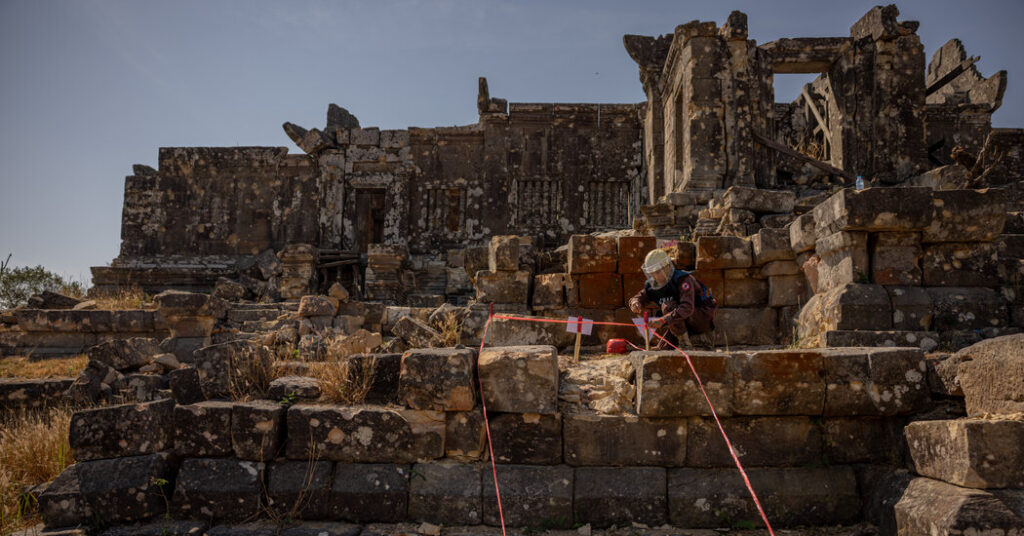
The sandstone walls are more than a millennium old but they are pockmarked with holes from artillery fire. An ornate column has collapsed. A carving of a mythical seven-headed serpent has been destroyed. All along the half-mile causeway are triangular red placards that warn of unexploded ordnance.
This monument, the Preah Vihear temple in Cambodia, was largely unscathed for centuries because it’s so remote. Conceptualized as a “stairway to heaven,” this series of stone pavilions and hallways sits on a sheer cliff in the Dangrek Mountains along the Cambodia-Thailand border.
But since colonial times, the temple — a masterpiece of Khmer architecture that was built as a shrine to the Hindu god Shiva and evolved into a Buddhist sanctuary — has been a flashpoint for tension and conflict. A few decades ago the area was a stronghold of the Khmer Rouge, and littered with land mines.
Today, it is an emblem of two warring neighbors, Cambodia and Thailand, that cannot agree on where their border sits. The International Court of Justice has affirmed that the temple belongs to Cambodia. But tensions spilled over last year into two devastating rounds of clashes that left dozens dead and hundreds of thousands displaced on both sides of the border.
During the fighting, Cambodia says Thailand attacked the temple, which is a UNESCO World Heritage Site. Thailand says it was targeting Cambodian military installations inside the temple. To support their claim, Thai officials provided images of bunkers, artillery and command posts that they said were within the temple complex. But a New York Times analysis was not able to verify those locations independently. Cambodia denies Thailand’s claim.
The fighting left deep scars at the site, which is older than the more famous Angkor Wat in nearby Siem Reap. Years of work by the United States to restore an ancient staircase have been erased. Efforts by China and India to help with other repairs have stalled.
The temple’s Cambodian custodians fear that the damage is irreparable.
“If it’s destroyed, it’s lost,” said Mao Chanthou, 21, a temple “preservation agent” whose job was to prevent tourists from vandalizing the site. “Even if it’s rebuilt, it won’t be the same as the original.”
The temple remains closed to the public. But last month, after the Cambodian authorities swept the area for unexploded ordnance, they allowed a small group of journalists, including from The Times, to visit.
Two government officers met us in Siem Reap and we drove north for about four hours by car, and then traveled in a pickup truck for 45 minutes to ascend the 1,700-foot cliff.
Blanketing the 150-hectare complex was a sea of cordoned-off zones with remnants of bombs and artillery shells. It was a stark scene of how nationalism could threaten centuries of shared history.
A millennium ago, this mountainous jungle was a thriving center of the Khmer civilization, then one of the world’s most advanced and artistic empires, which extended across a vast swath of Southeast Asia.
The Preah Vihear temple, known as Phra Viharn in Thailand, dates back to the ninth century. Both names are translated as “sacred monastery” or “abode of gods.”
The border dispute comes down to the different maps used by Thailand and Cambodia. Thailand contends that the 500-mile border between the nations should follow the natural watershed line, while Cambodia insists on following a map drawn up by colonial France.
For historians, Preah Vihear offers a living record of the evolution of the Khmer Empire. Because it was built over the course of 300 years by multiple kings, it provides insight into Khmer religion, art and engineering. Some visitors consider its setting more spectacular than Angkor Wat.
The Preah Vihear temple was long a shared religious space. Many people living in Thailand’s northeastern Isan region on the border have the same Khmer ancestry as the Cambodians. Some have relatives across the border. On both sides, many Buddhists revere Hindu deities, maintaining the crossover of faiths born centuries ago.
Kim Chantrea, 26, a temple cleaner, recalled how, as a child, she used to see Thai tourists cross into the temple without even having to show their passports.
“The people who used to come before, — they are like us, they saw that the temple was beautiful,” said Ms. Kim. “They came to pray for peace.”
But in 2008, after UNESCO listed the temple as a World Heritage Site, fighting broke out between Thailand and Cambodia for the first time in decades. The damage at the temple then was minimal, but ever since, no tourists have been able to access it from the Thai side.
Clashes erupted again last year. Temple workers said that they took cover in the pavilions and survived only on bottled water for three consecutive days.
Sen Sokha, 37, a temple caretaker, said she saw bombs falling from airplanes.
“Just thinking about it makes us cry,” she said. “Seeing the place we used to work at, keep clean, and take care of, now destroyed like this.”
Like her colleagues, she is still living in tents donated by China, even after the latest cease-fire was signed in late December, because the Cambodian authorities do not believe it is safe for them to return home.
International law requires both Thailand and Cambodia to protect cultural sites in the event of armed conflict.
The 1.8 square miles of land surrounding the temple are claimed by both nations. In the distance, Thai military camps were visible. Cambodian bunkers were built into the path leading up to the temple.
Before the pandemic, Preah Vihear received about 10,000 visitors a year, a fraction of the two million who go to Angkor Wat, according to Pheng Sam Oeun, the deputy director general of the National Authority for Preah Vihear.
Cambodia has documented 142 damaged sites at the temple, with damage more extensive from the fighting in December, said Mr. Pheng, a trained archaeologist who has worked at the temple since in 2008.
It is preparing to present its preliminary assessment of the damage to a UNESCO body that is overseeing the restoration of the temple, he added. The group includes the United States, China, India and Thailand.
Still, many carvings have survived, including “The Churning of the Ocean of Milk,” which depicts a Hindu myth in which gods and demons churn the ocean to create the elixir of immortality.
During our nearly three-hour tour, several workers from Cambodia’s demining authority continued to nail stakes in the ground, putting up placards, some of which read “Art 105 mm,” a reference to artillery rounds.
Nearby, Mr. Pheng walked among the rubble, showing reporters one of the most famous and historically significant records at the site. It was an inscription on a pillar that told of how King Suryavarman II, who built Angkor Wat, sent his high priest from the city of Angkor to Preah Vihear to cement his authority over the region.
Mr. Pheng then pointed to a large chunk of the pillar that had broken off. He said the stone could be replaced but not the carving or script. That, he said, was gone.
Pablo Robles contributed reporting.
Sui-Lee Wee is the Southeast Asia bureau chief for The Times, overseeing coverage of 11 countries in the region.
The post An Ancient Temple at the Heart of a Modern Conflict appeared first on New York Times.