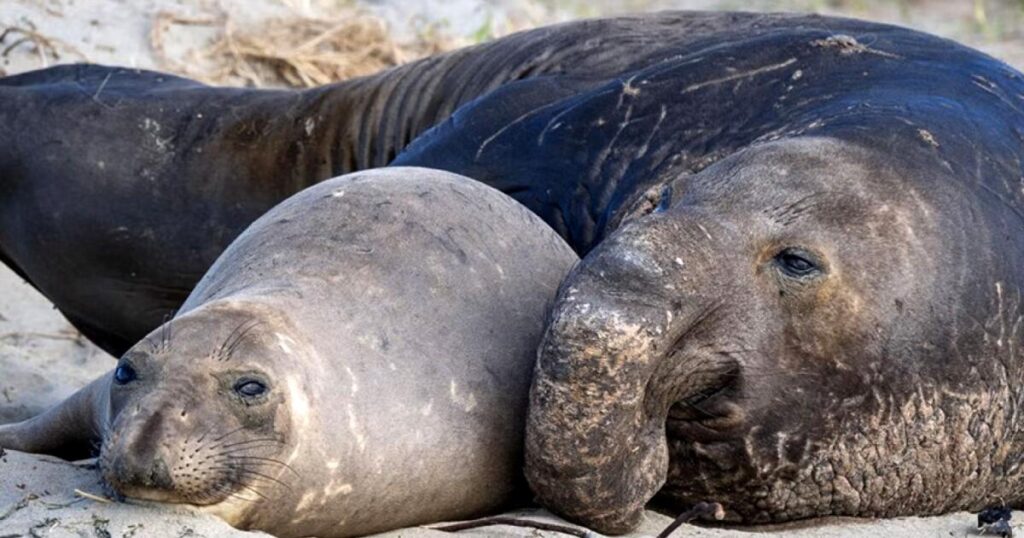
Researchers say the H5N1 bird flu outbreak in California elephant seals has spread to other marine mammals, including a sea otter and sea lion.
However, wildlife officials are cautiously optimistic the outbreak will remain contained. It has so far only been detected on beaches in San Mateo County, although testing is being conducted along the coastline.
The strain of bird flu found in these animals contains a mutation that allows it to more easily transmit between mammals. It is also a different variation than the ones found in dairy cows and commercial poultry. This one is Eurasian in origin, and was first seen in 2022. It has been detected in birds that fly along the Pacific Flyway, and is responsible for a mass mortality event in 2023 in northern fur seals on an island in eastern Russia, said Christine Johnson, the director of UC Davis’ Center for Pandemic Insights, during a press conference Thursday morning.
Johnson said researchers think this is the first detection of the A3 variation of the virus on the Pacific Coast and therefore likely a new introduction into North America, she said.
In late February, a team of researchers from UC Davis, UC Santa Cruz, California Department of Fish and Wildlife and the Marine Mammal Center announced they had found the virus in seven dead elephant seal pups collected from the beach at Año Nuevo State Park. That number is now 16, but Johnson said likely more will be confirmed in the weeks to come.
“This count reflects only the animals that have gone through sampling and confirmatory testing in multiple labs,” she said. “We know there are more animals with signs of infection that we have sampled that are being tested across the different laboratory systems.”
She said no other otters have been found, but a “handful” of California sea lions are “in the queue.” This kind of spillover, she said, is not unusual.
“Outbreaks affect a wide range of birds and mammals, and these animals all share the near shore ecosystem,” she said, although it’s “especially tragic when infections impact less common species in the southern sea otter.”
Patrick Robinson, the Año Nuevo reserve director, and a marine biologist at UC Santa Cruz, said 47 elephant seals on the mainland have died since the start of the outbreak, and the wildlife team is finding two new symptomatic and two dead animals every day.
Symptoms of bird flu in mammals can include tremors, convulsions, seizures and muscle weakness.
He said it is normal for some individuals to die of natural causes, so testing is critical. And he said the percentage of animals that have died in the Año Nuevo rookery is relatively small: Only about 5% of weaned pups and 6% of adult males have died. Although, in the case of the pups, that’s four times higher than last year’s death rates. And he said, the death of large males is “basically nonexistent in most males.”
He said 80% of the adult females had departed by the time the outbreak began, and nearly all of them are now gone. No adult females died, and none have been observed as being symptomatic.
“The outbreak is not over, and we’re not really sure what’s going to happen in the future,” he said. “I remain hopeful about this thing right now.”
In late 2022, the H5N1 bird flu virus decimated southern elephant seal populations in South America and several sub-Antarctic Islands. At some colonies in Argentina, 97% of pups died, while on South Georgia Island, researchers reported a 47% decline in breeding females between 2022 and 2024. Researchers believe tens of thousands of animals died.
More than 30,000 sea lions in Peru and Chile died between 2022 and 2024. In Argentina, roughly 1,300 sea lions and fur seals perished.
At the time, researchers were not sure why northern Pacific populations were not infected, but suspected previous or milder strains of the virus conferred some immunity.
The virus is better known in the U.S. for sweeping through the nation’s dairy herds, where it infected dozens of dairy workers, millions of cows and thousands of wild, feral and domestic mammals. It’s also been found in wild birds and killed millions of commercial chickens, geese and ducks.
Two Americans have died from the virus since 2024, and 71 have been infected. The vast majority of infected people were dairy or commercial poultry workers. One death was that of a Louisiana man who had underlying conditions and was believed to have been exposed via backyard poultry or wild birds.
The post H5N1 bird flu spreads to sea otters and sea lions along San Mateo coast, wildlife experts say appeared first on Los Angeles Times.