Death Valley is having a golden moment.
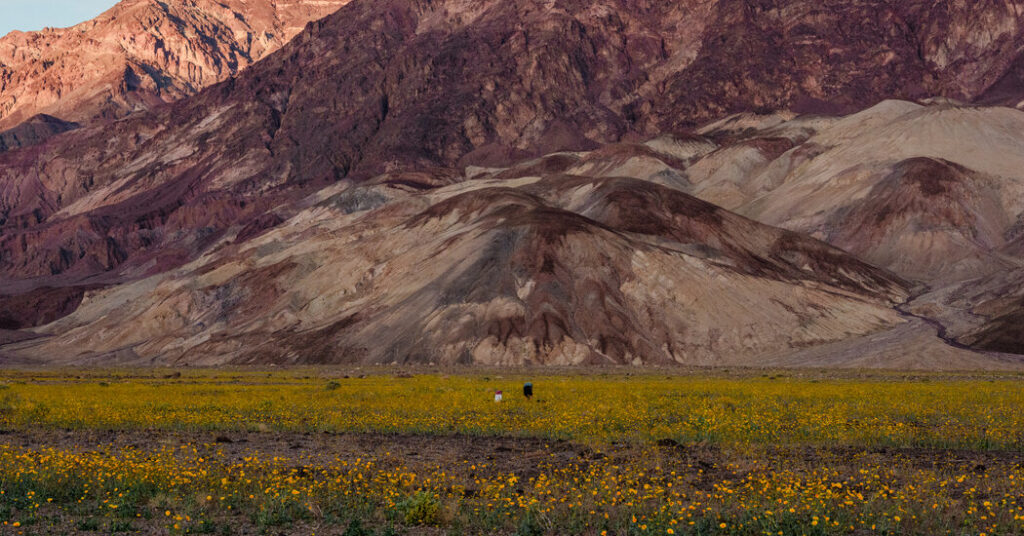
Since February, wildflowers have burst from the desert floor of the national park in California, dotting the typically barren landscape with pops of color in shades of lemony yellow, cotton candy pink and deep violet. It has been called the most abundant bloom in a decade.
“Some flowers bloom every year,” said Abby Wines, a park ranger at Death Valley National Park. “Just not this many.”
The desert gold is the most common flower in the park, and entire hillsides near the Furnace Creek Visitor Center are bathed in yellow from this bloom resembling a yellow daisy. But there are dozens of other species, especially if you take a walk off Badwater Road and look closely at the ground.
One of Ms. Wines’s favorites is the gravel ghost with a thin gray stem that’s almost invisible, so the white flower appears as if it’s hovering through the air.
Ms. Wines also likes to direct visitors to watch out for the desert fivespot, with pink petals forming a cup that’s marked with five red blotches inside.
“It looks like a place where a fairy should live,” she said.
The flowers are blooming thanks to an especially wet few months last fall. Death Valley recorded more than a year’s worth of rain — 2.41 inches — between September and November.
The park isn’t the only place in Southern California to have benefited from that rain. Healthy blooms are springing up in other locations, including in parts of Anza-Borrego Desert State Park and Carrizo Plain National Monument. But the bloom in Death Valley is special because it happens so rarely, experts said.
Flowers need water, and Death Valley — the driest place in North America — doesn’t often get enough for so many wildflowers to emerge. The park can go an entire year with no rain at all, as it did in 1929, 1953 and 1989. Late 2024 brought only a little rain, which meant that last spring was a “zero year” for wildflowers, said Patrick Donnelly, a conservation biologist who lives on the outskirts of the park.
The last big bloom at Death Valley was in 2016, and before that, in 2005, when flowers carpeted the deserts of Southern California. It was 2016 that injected the word “superbloom” into the social media-fueled landscape of the time, and visitors to the park may have been drawn as much by the opportunity to see the flowers as to share pictures of them online.
This year’s display is extraordinary in certain places — and certainly one of the best in a long time — but it falls a little short of those past big blooms.
“It’s a wonderful magical thing,” Mr. Donnelly said, but he added that the scale in those earlier years was “orders in magnitude different.”
This year’s bloom is still unfolding. Some areas have peaked, and a heat wave this week will cause many of the flowers to wither. But new blooms are expected to pop through June, especially at higher elevations in the hills and mountains, said Jenette Jurado, a spokeswoman for the park.
When the flowers fade at the end of their lives, they will help provide the fuel for a future spectacle, dropping seeds into the soil. A handful of dirt scooped up from the valley floor contains thousands of minuscule seeds. These seeds, many too small to see, rest dormant for years waiting for water to wake them up. When the rains finally arrive, the seeds swell, and their outer coats break, sticking out stems that push through the dirt and pop out leaves that soak up the sun’s rays.
And in Death Valley, there are usually loads of sun.
For weeks, people have been flocking to this remote corner of the Mojave Desert, a two-hour drive from Las Vegas, to see the flowers. Last Wednesday morning, visitors were stopping for coffee and plates of bacon and eggs at the Crowbar Cafe and Saloon in Shoshone, Calif, before heading into the park.
“They’re either here to see the flowers, or the flowers become their reason for being here once they hear about them,” said Brianna Klenczar, who was waiting tables.
Ms. Klenczar said that she drove through the park a few days earlier to check out the spectacle and that “it was yellow everywhere.”
Zoe Dinh, 20, and her brother, Eric, 16, were visiting from Upland, Calif., and standing in one of those rocky fields peppered with gold. They had pulled their car over to the side of Highway 190 near the Furnace Creek Visitor Center, along with loads of other people.
“It feels unreal, like you’re on another planet,” Ms. Dinh said.
The two had fun posing, leaping into the air and flaying their arms above their heads to get the perfect photos for Instagram.
Mr. Donnelly said the images can sometimes mislead people.
While the flowers are no doubt abundant this year with mountains of purple and many fields awash in yellow, the landscape is still the desert and there are more rocks than flowers.
“That is definitely a thing where people see things on Instagram and they come to the desert expecting it to perform as they’ve seen on Instagram,” said Mr. Donnelly, who works for the Center for Biological Diversity.
To get off the beaten path, he likes to walk up a narrow canyon meandering to the top of Sheephead Mountain on the southeast side of the park. He pointed out small flowers that could be easily missed without the help of a guide. There were buttery yellow desert dandelions, and desert tobacco exploding with little white flowers.
Many of these flowers have defense mechanisms. The caltha-leafed phacelia with deep-purple blooms and hairy leaves and stems can cause a poison ivy-like rash. The desert chicory, featuring showy white flowers with frayed petal tips, are among flowers that use their flashiness to attract pollinators.
There were also clusters of small-leaved monkey flowers, a common native species in California that rely heavily on water, and their presence here was another indication that the canyon was rich in moisture.
Bighorn sheep frequent this canyon to munch on flowers and sip water collected within the natural depressions in the rocks. The animals weren’t there on Wednesday, but other fauna were out and about. A Zebra-tailed lizard darted across the trail, a Panamint rattlesnake sunbathed on a hot rock, and a Painted Lady butterfly fluttered about.
“This is the desert living its best life,” Mr. Donnelly said. “Everyone is living large right now.”
Amy Graff is a Times reporter covering weather, wildfires and earthquakes.
The post What It Takes for Flowers to Thrive in the Hottest, Driest Place in North America appeared first on New York Times.