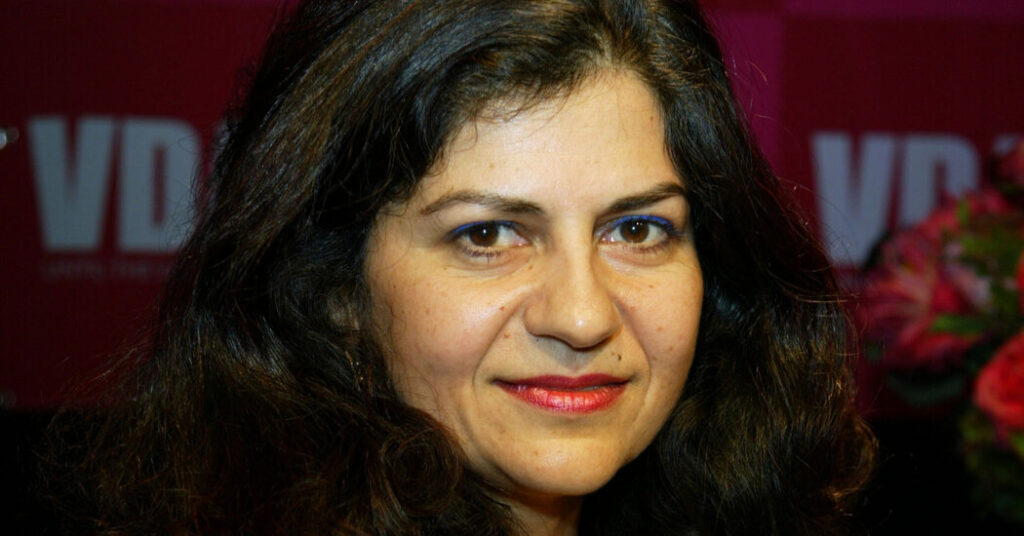
Yanar Mohammed, an Iraqi feminist and women’s rights advocate who established a network of safe houses for abused women and Yazidi victims of Islamic State sexual violence, was killed on March 2 outside her home in Baghdad. She was 65.
The Organization of Women’s Freedom in Iraq, the group she co-founded, said in a statement that two gunmen on motorcycles opened fire on Ms. Mohammed, who died of her injuries at a hospital.
Human Rights Watch called her death “a profound loss.” Amnesty International’s Iraq researcher, Razaw Salihy, described her killing as a “calculated assault to stifle human rights defenders.”
Both organizations called on the Iraqi government to investigate the murder, which Amnesty said was part of a pattern of targeted killings of rights activists in the country, likely carried out by Iran-aligned units of the Popular Mobilization Forces. These armed, mostly Shiite paramilitary groups are nominally under the control of the government but answer mostly to Tehran.
Iraq’s interior minister, Abdul Amir al-Shammari, said an investigative team would conduct an inquiry into the killing.
Ms. Mohammed, the recipient of numerous international human rights prizes, dedicated herself to sheltering and caring for victims of rape, physical abuse and other forms of ill treatment in a society where the basic rights of women are under constant threat.
Her organization had established 10 safe houses in central and southern Iraq, according to the group, but there are now only six because of “ongoing persecution,” Ms. Mohamed’s colleague Jannat Al-Ghezi said by text message. Ms. Mohammed herself was also subjected to constant threats of violence.
The safe houses worked in secret, Ms. Mohammed told The Tribune de Genève newspaper in 2017, and are unlicensed, although now — unlike in the past — they sometimes receive official referrals from government institutions.
For more than 20 years, Ms. Mohammed was an outspoken voice at demonstrations, in the halls of the Iraqi Parliament and in the press. Her campaign to free women from the strictures of Islamic fundamentalists and the government made her popular with neither.
Trained as an architect, she returned from a self-imposed eight-year exile in Lebanon and Canada in 2003, following the U.S.-led invasion that overthrew Saddam Hussein. She started small, cofounding the Organization of Women’s Freedom in Iraq in downtown Baghdad and opening two safe rooms that sheltered three women. In those years, she carried a gun and sometimes traveled with a bodyguard. To promote her views, she started a feminist newspaper, Al-Mousawat, or Equality.
By 2012, her organization had two shelters. In the next three years, that number grew to five as she began focusing on helping Yazidi women, members of a persecuted ethnic minority who had been made sex slaves by the Islamic State and subjected to mass rape. In all, the organization has “saved the lives” of more than 700 women, girls and L.G.B.T.Q. individuals, its website said.
Establishing the shelters “put Yanar Mohammed in direct confrontation with families and tribal members, religious political parties and sections of the Iraqi government,” Mehiyar Kathem, a senior research fellow at University College London who participated in the founding of Ms. Mohammed’s organization, wrote in the online magazine Counterfire after her death.
But Ms. Mohammed insisted that she was not afraid of challenging Iraq’s traditional male power centers. “When I see the gradual change in a person, reconstructing herself, becoming healthy — this is an immense source of strength to continue fighting as a defender of women,” she told The Tribune de Genève.
Her organization’s shelters, she said, were “the only safe places where women can go to escape honor killing” — killings carried out with impunity by aggrieved family members for perceived sins on the part of the women.
She put no faith in the Iraqi government to protect women. The country’s institutions remained repressive, she said, and too often caved to the dictates of fundamentalist Islam.
Ms. Mohammed’s education, at the University of Baghdad, took place during Mr. Hussein’s secularist, if murderous, Baathist regime, arguably a time of more freedom for women. But the current Iraqi government “has allowed an agenda that is dismissive of women’s rights,” she told the activist group Nobel Women’s Initiative in an interview about five years ago.
In 2023, she again fled temporarily to Canada, where she had become a citizen, because the Iraqi government had issued a warrant for her arrest as a human trafficker. Ms. Mohammed said in an interview with Manara Magazine that she had been accused of the very practice from which she protected women.
She and others campaigned against Iraq’s so-called personal status law, obtaining some concessions — marriage at the age of 9 was ruled out — but when the law finally passed in 2025, it sanctioned marriage at 15 as well as polygamy.
“The government policies are based on religion and are extremely patriarchal and tribal, and they preach hatred of women,” she told the Nobel Women’s Initiative.
Yanar Mohammed was born on Nov. 25, 1960, in Baghdad, the third of five children of Hasan Mohammed, an engineer, and Najiba (Saber) Mohammed, a schoolteacher.
She wrote later of an early lesson in feminism, when she discovered as a girl that her grandmother had been her grandfather’s child bride, at 14.
In a letter to her mother broadcast on the BBC in 2003, Ms. Mohammed wrote: “Dearest mother … how could that ‘respectable’ man that you still call your father rape, horrify and torture the innocence of a girl, a kid in her early teenage life, and what gave him the right?”
Ms. Mohammed studied architecture at the University of Baghdad, where she received a bachelor’s degree in 1984 and a master’s degree in 1993.
With life increasingly difficult in Iraq under international sanctions after the Persian Gulf war of 1991, she fled in 1995, first to Lebanon and then to Canada two years later with her first husband and their son. In 1998, while living in Toronto, she founded the Defense of Iraqi Women’s Rights, a precursor to her later organization.
After returning to Baghdad in 2003, Ms. Mohammed was increasingly a target of threats, especially after she publicly burned a head scarf, Mr. Kathem, the research fellow at University College London, wrote. She took an active part in anti-government demonstrations in 2011 and 2019. As a critic of the U.S. presence in Iraq, she turned down an award from the State Department in 2017.
She received the Gruber Foundation Women’s Rights Prize in 2008 and the Professor Thorolf Rafto Memorial Prize for Human Rights from the nonprofit Rafto Foundation in 2016.
Ms. Mohammed, who divorced and remarried, is survived by her husband, her son, her four siblings and her father. (Citing safety concerns, her organization requested that their names be withheld.)
Recently, she has been “vilified” online in Iraq, Mr. Kathem wrote, for promoting L.G.B.T.Q. rights at the request of outside donors. But Ms. Mohammed was aware of the risks she was running.
“The government starts with smear campaigns, then court cases, to stop you from doing your human rights work,” she told the Nobel Women’s Initiative. “And if that doesn’t work, then they kidnap and kill you.”
Abu Malic contributed reporting from Baghdad
Adam Nossiter has been bureau chief in Kabul, Paris, West Africa and New Orleans and is now a writer on the Obituaries desk.
The post Yanar Mohammed, 65, Iraqi Women’s Rights Advocate, Is Killed by Gunmen appeared first on New York Times.