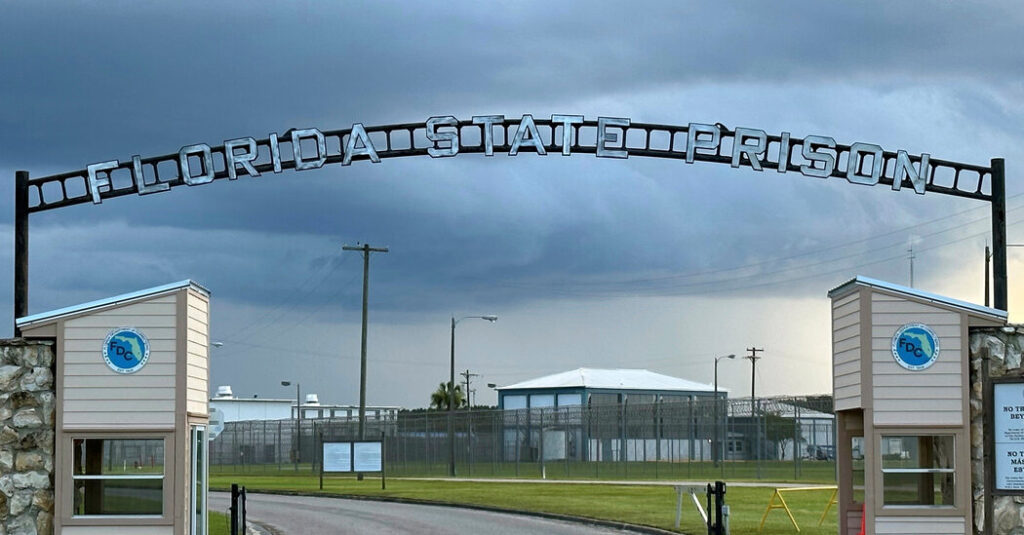
The machinery of death is humming in Florida. Officials there executed 19 inmates last year, the most of any state and the most by far in Florida’s modern history.
Only Texas has executed more people in a single year since the Supreme Court reinstated the death penalty in 1976. (Decades ago, it was not unusual for Texas to execute more than 30 inmates in a year. But it has been 16 years since that state, known for its steadfast commitment to the death penalty, put more people to death than Florida did last year.)
Florida has already executed three prisoners this year, and the next execution is scheduled for Tuesday. Another is set for March 30. At this rate, Florida may execute 20 people in 2026 — more than were put to death nationally in 2020, 2021 or 2022.
My colleague Patricia Mazzei has been following these developments, which deserve sustained attention.
The driving force behind the spike in executions is the state’s governor, Ron DeSantis. Unlike most other states, Florida gives its governor the sole power to sign death warrants for prisoners who have exhausted their appeals, without the involvement of a court or any other body. Pennsylvania also confers that power to its governor, but that state has not executed anyone since 1999.
DeSantis, a Republican, has been in office since 2019, and for years he used his power sparingly, overseeing no more than two executions in any year but 2023, when he was running for president. That year, the state executed six people.
Following Trump’s Lead?
The reason for the recent spike is unclear. But Melanie Verdecia, a lawyer who writes the “Tracking Florida’s Death Penalty” newsletter, has a theory. “The best indication,” she wrote last year, “seems to be the direction from the Trump administration in early 2025 to aggressively pursue the death penalty at all costs,” though she acknowledged that DeSantis had not made that link.
In the final months of the first Trump administration, after a de facto moratorium of 17 years, the federal government executed 13 inmates, more than three times as many as it had put to death in the previous six decades.
On his first day back in office last year, Trump issued an executive order “restoring the death penalty.” It told the attorney general “to seek the overruling of Supreme Court precedents that limit the authority of state and federal governments to impose capital punishment.” And it decried President Joe Biden’s commutation of the death sentences of almost every federal inmate, telling the attorney general to imprison them “in conditions consistent with the monstrosity of their crimes.”
Lacking federal prisoners to execute, Trump encouraged states to get busy. Over the next 11 months, DeSantis signed more than twice as many death warrants as he had in the previous six years.
Advice: Don’t Murder People
I asked Molly Best, the governor’s press secretary, for comment. She pointed me to remarks DeSantis delivered at a news conference last November in response to a question about the increase in executions.
He said his slow start was partly a product of setting up a review process and partly a result of the pandemic. He added that he owed it to the families of victims to make sure that executions “ran very smoothly and promptly,” adding: “I do think the death penalty could be a very strong deterrent if you had the stuff happen quicker.”
Best also passed along a statement from Alex Lanfranconi, the governor’s communications director. “My advice to those who are seeking to avoid the death penalty in Florida,” he said, “would be to not murder people.”
Eight Is Enough
DeSantis has led the charge, but the other two branches of Florida’s government are doing their part. The state legislature, for instance, has enacted a series of laws of doubtful constitutionality that expanded capital punishment.
One extended the death penalty to crimes involving the sexual abuse of children. That would seem to be at odds with a 2008 Supreme Court decision, Kennedy v. Louisiana, that said crimes against people that do not involve killing, including the rape of a child, could not be punished by death.
Another new Florida law called for the automatic imposition of the death penalty to unauthorized immigrants who commit capital crimes. That is in tension with Woodson v. North Carolina, a 1976 Supreme Court decision that said mandatory death sentences were unconstitutional.
A third law lets juries recommend death sentences by votes as narrow as 8 to 4, instead of requiring a vote on the sentence to be unanimous.
It was prompted by a Florida jury’s decision in 2022 to sentence to life in prison without parole the gunman who murdered 17 people in the 2018 mass shooting at Marjory Stoneman Douglas High School in Parkland. The jury had voted 9 to 3 in favor of the death penalty.
In 2020, the Supreme Court ruled in Ramos v. Louisiana that the Constitution requires unanimous jury verdicts in cases involving serious crimes. But the Florida Supreme Court upheld the state law last December, saying that the Ramos decision applied to convictions, not sentencing.
The American Civil Liberties Union, which represents the inmate in that case, has filed a request for a rehearing in the state court. If that fails, as is likely, the group said that it will ask the U.S. Supreme Court to hear an appeal.
Challenges to the other two laws are inevitable, too. Indeed, the law on the sexual abuse of children seemed calculated to let the U.S. Supreme Court reconsider its earlier ruling.
In a reluctant concurring opinion in the December decision on non-unanimous juries, Justice Jorge Labarga wrote that the law “renders Florida the absolute outlier among states that impose the death penalty.”
Alabama is the only other state that does not require unanimity, though it sets the floor at 10 votes.
Justice Labarga wrote that the state has another distinction, one that justifies requiring a unanimous jury. Florida, he wrote, “still leads the nation in exonerations from death row.”
Other Legal News
-
A “polite but forceful” public debate between Justices Kavanaugh and Jackson over the Supreme Court’s use of truncated procedures to decide weighty issues.
-
The Trump administration’s latest emergency application asked the Supreme Court to let it deport hundreds of thousands of Haitians.
-
The former government lawyer whose biting courtroom assessment — “The system sucks. This job sucks” — drew national attention said she is running for Congress.
Mailbag
Do All Nine Justices Have to Hear Every Case?
Why does the Supreme Court hear cases with all of the justices? Appeals courts pick three judges at random to hear most cases, and only rarely, I believe, does the entire bench hear a case. The shadow docket could be replaced by three-justice panels, which would have the time to actually hear and deliberate. — Peter Wadsack
You’re right that most federal appeals are heard by three-judge panels, with very occasional rehearings by the full appeals court. It is even more unusual for an initial hearing to come before the full appeals court.
The highest courts of other countries likewise often sit in panels. A typical case before the Supreme Court of the United Kingdom is heard by five of its 12 justices, though the full court considers important constitutional cases. The Supreme Courts of Canada, Ireland, Australia and India also hear many cases in panels made up of fewer than all of their members.
There is a constitutional and a practical argument against adopting that approach in the United States. The Constitution calls for “one Supreme Court,” and many argue that this requires the court to sit as a single body. But individual justices sometimes act on behalf of the court.
The practical argument is that the justices often divide in predictable ways. A decision from a panel not representative of the majority’s views would surely be reheard. That would introduce the very inefficiency that panels are meant to address.
I’d love to hear your questions on the law, the courts or whatever is on your mind. Send them my way at [email protected].
What I’m Reading
-
“The Equity Docket,” by Thomas Schmidt and Kellen Funk, proposes a new name for what has been called, variously, the “shadow docket,” the “emergency docket” and the “interim docket” — along with a fresh theoretical framework for thinking about it. The article will be published in The New York University Law Review.
-
“Court-Martialing the Class Clown: George Carlin and the Military Justice System,” by Dwight Sullivan in The Green Bag, draws on the comedian’s military records to show that his argumentative personality made him an “awful airman” but a “comedic genius.”
-
“Vaccines and ‘Religious Parental Rights,’” by Zalman Rothschild, explores the surprising sweep of the Supreme Court’s decision last June letting religious parents withdraw their children from classes on subjects they find offensive. The article will be published in The Harvard Law Review Forum.
Closing Argument
Bleak House, Built By Bots
Could A.I. make it too easy to file a barrage of legal documents?
In a lawsuit filed last week, a big insurance company represented by a serious law firm sued OpenAI, the maker of ChatGPT, for among other things, the unauthorized practice of law.
OpenAI has said that the complaint “lacks any merit whatsoever.” And the lawsuit merely unspools the insurance company’s account, untested in court.
Still, it offers a digitally Dickensian cautionary tale of how a determined and frustrated litigant, representing herself, can flood the court system with filings generated by a chatbot.
The suit and the court documents it cites, available on the electronic dockets of the Federal District Court in Chicago, paint a picture of a campaign of harassment by a woman who settled a disability case and later regretted it. Egged on by a chatbot, she fired her lawyer and, representing herself, filed a motion to reopen the case. That was followed by 21 other motions also drafted by ChatGPT.
A patient judge sorted through this fusillade of filings and ruled that “second thoughts are not a valid reason to reopen this lawsuit.”
The woman then added the insurer, Nippon Life Insurance Company of America, to another pending lawsuit. As of last week, the woman had filed 44 motions, memorandums, demands, petitions and requests in that second lawsuit. Nippon says it has spent $300,000 responding to “the deluge of demonstrably frivolous motions.”
(The New York Times sued OpenAI and Microsoft in 2023, accusing them of copyright infringement of news content related to A.I. systems. The two companies have denied those claims.)
Whether any of this amounts to the unauthorized practice of law or is otherwise OpenAI’s responsibility is up for debate. But the ability of litigants to create legal filings at the push of a button may test the judicial system.
Adam Liptak is the chief legal affairs correspondent of The Times and the host of The Docket, a newsletter on legal developments. A graduate of Yale Law School, he practiced law for 14 years before joining The Times in 2002.
The post Ron DeSantis Wants Speedy Executions, and Lots of Them appeared first on New York Times.